
Mapa mental
The nature of sleep and lifespan changes
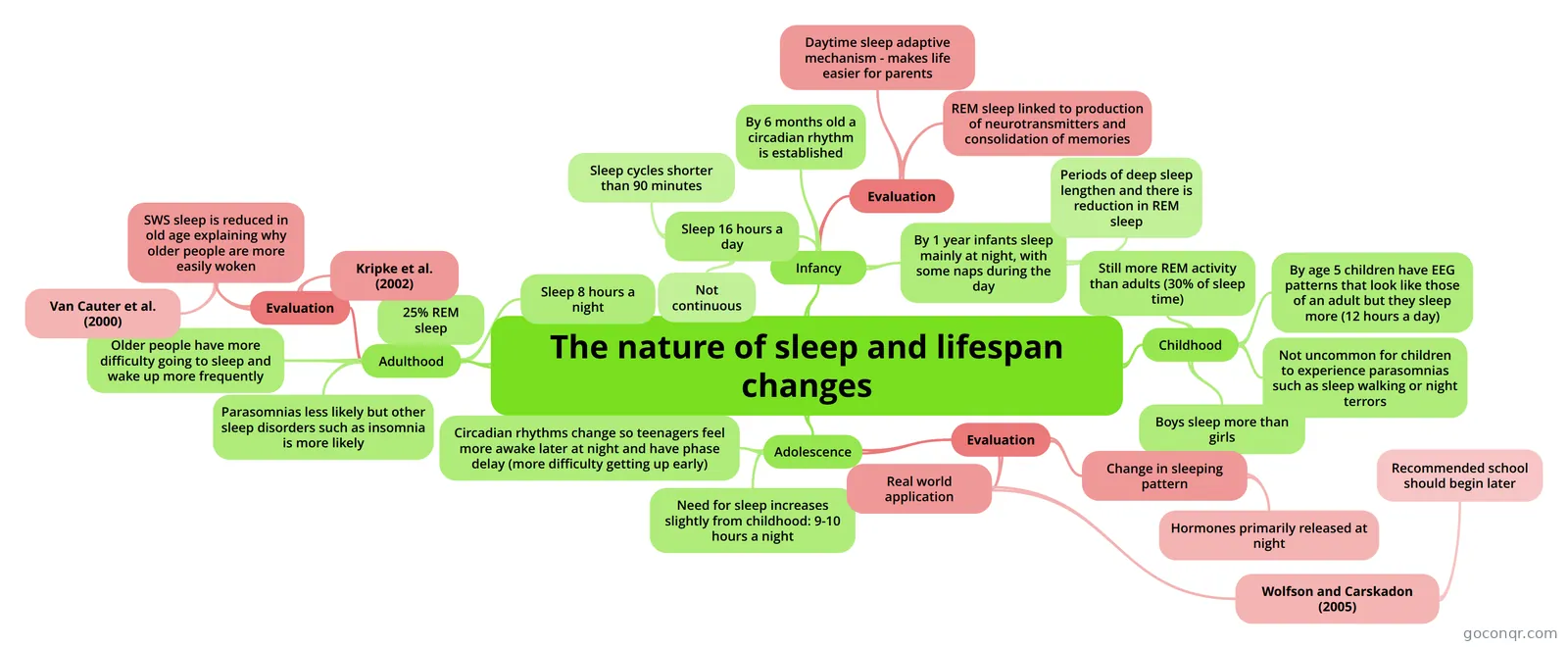
Mind map: The nature of sleep and lifespan changes
Contenido del mapa
The nature of sleep and lifespan changes
Infancy
- Sleep 16 hours a day
- Not continuous
- Sleep cycles shorter than 90 minutes
- By 6 months old a circadian rhythm is established
- By 1 year infants sleep mainly at night, with some naps during the day
- Periods of deep sleep lengthen and there is reduction in REM sleep
- Evaluation
- Daytime sleep adaptive mechanism - makes life easier for parents
- REM sleep linked to production of neurotransmitters and consolidation of memories
- Sleep 16 hours a day
Childhood
- By age 5 children have EEG patterns that look like those of an adult but they sleep more (12 hours a day)
- Still more REM activity than adults (30% of sleep time)
- Boys sleep more than girls
- Not uncommon for children to experience parasomnias such as sleep walking or night terrors
Adolescence
- Need for sleep increases slightly from childhood: 9-10 hours a night
- Circadian rhythms change so teenagers feel more awake later at night and have phase delay (more difficulty getting up early)
- Evaluation
- Change in sleeping pattern
- Hormones primarily released at night
- Real world application
- Wolfson and Carskadon (2005)
- Recommended school should begin later
- Wolfson and Carskadon (2005)
- Change in sleeping pattern
Adulthood
- Sleep 8 hours a night
- 25% REM sleep
- Parasomnias less likely but other sleep disorders such as insomnia is more likely
- Older people have more difficulty going to sleep and wake up more frequently
- Evaluation
- Kripke et al. (2002)
- Surveyed over 1 million adult men and women and found that people sleeping for only 6 or 7 hours had a reduced mortality risk, whereas those sleeping 8 had a 15% increase in risk of death, and over 30% for people who slept 10 hours. However, there may be other factors affecting this such as underlying illness
- SWS sleep is reduced in old age explaining why older people are more easily woken
- Van Cauter et al. (2000)
- Less SWS means less growth hormones which explains lack of energy and lower bone density in older people
- Van Cauter et al. (2000)
- Kripke et al. (2002)
Información
- Descripción
- A Levels (Biological rhythms) Psychology Mapa Mental sobre The nature of sleep and lifespan changes, creado por davieschloe7 el 24/09/2013.
- Creado por
- davieschloe7
- Visitas
- 182
- Etiquetas
- Valoración