
Mapa mental
Biology
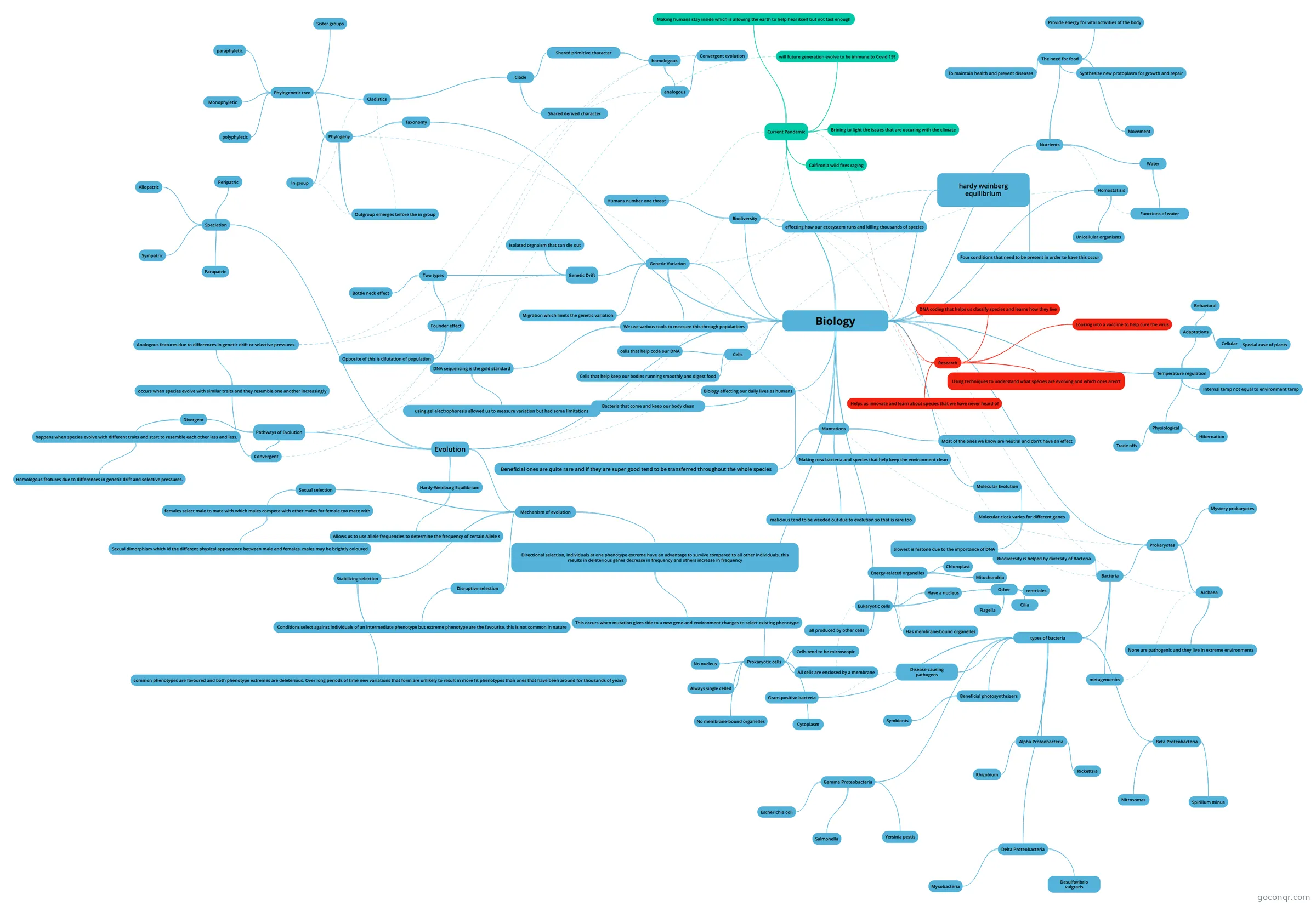
Mind map: Biology, Evolution, and Genetic Variation
Contenido del mapa
Biology
Biology affecting our daily lives as humans
- Bacteria that come and keep our body clean
- Making new bacteria and species that help keep the environment clean
Cells
- cells that help code our DNA
- Cells that help keep our bodies running smoothly and digest food
Research
- Helps us innovate and learn about species that we have never heard of
- DNA coding that helps us classify species and learns how they live
- Using techniques to understand what species are evolving and which ones aren't
- Looking into a vacciine to help cure the virus
Biodiversity
- effecting how our ecosystem runs and killing thousands of species
- Humans number one threat
Genetic Variation
- Migration which limits the genetic variation
- Genetic Drift
- Isolated orgnaism that can die out
- Two types
- Bottle neck effect
- Founder effect
- Opposite of this is dilutation of population
- We use various tools to measure this through populations
- DNA sequencing is the gold standard
- using gel electrophoresis allowed us to measure variation but had some limitations
- DNA sequencing is the gold standard
Muntations
- Beneficial ones are quite rare and if they are super good tend to be transferred throughout the whole species
- malicious tend to be weeded out due to evolution so that is rare too
- Most of the ones we know are neutral and don't have an effect
Evolution
- Hardy-Weinburg Equilibrium
- Allows us to use allele frequencies to determine the frequency of certain Allele s
- Mechanism of evolution
- Directional selection, individuals at one phenotype extreme have an advantage to survive compared to all other individuals, this results in deleterious genes decrease in frequency and others increase in frequency
- This occurs when mutation gives ride to a new gene and environment changes to select existing phenotype
- Disruptive selection
- Conditions select against individuals of an intermediate phenotype but extreme phenotype are the favourite, this is not common in nature
- Stabilizing selection
- common phenotypes are favoured and both phenotype extremes are deleterious. Over long periods of time new variations that form are unlikely to result in more fit phenotypes than ones that have been around for thousands of years
- Sexual selection
- females select male to mate with which males compete with other males for female too mate with
- Sexual dimorphism which id the different physical appearance between male and females, males may be brightly coloured
- females select male to mate with which males compete with other males for female too mate with
- Directional selection, individuals at one phenotype extreme have an advantage to survive compared to all other individuals, this results in deleterious genes decrease in frequency and others increase in frequency
- Pathways of Evolution
- Divergent
- happens when species evolve with different traits and start to resemble each other less and less.
- Homologous features due to differences in genetic drift and selective pressures.
- happens when species evolve with different traits and start to resemble each other less and less.
- Convergent
- occurs when species evolve with similar traits and they resemble one another increasingly
- Analogous features due to differences in genetic drift or selective pressures.
- occurs when species evolve with similar traits and they resemble one another increasingly
- Divergent
- Speciation
- Allopatric
- Sympatric
- Parapatric
- Peripatric
- Hardy-Weinburg Equilibrium
Molecular Evolution
- Molecular clock varies for different genes
- Slowest is histone due to the importance of DNA
- Molecular clock varies for different genes
hardy weinberg equilibrium
- Four conditions that need to be present in order to have this occur
Current Pandemic
- Brining to light the issues that are occuring with the climate
- Calfironia wild fires raging
- Making humans stay inside which is allowing the earth to help heal itself but not fast enough
- will future generation evolve to be immune to Covid 19?
Taxonomy
- Phylogeny
- In group
- Outgroup emerges before the in group
- Phylogenetic tree
- Cladistics
- Clade
- Shared primitive character
- homologous
- analogous
- Convergent evolution
- analogous
- homologous
- Shared derived character
- Shared primitive character
- Clade
- Monophyletic
- polyphyletic
- paraphyletic
- Sister groups
- Cladistics
- Phylogeny
Prokaryotes
- Bacteria
- Biodiversity is helped by diversity of Bacteria
- types of bacteria
- Disease-causing pathogens
- Beneficial photosynthsizers
- Symbionts
- Alpha Proteobacteria
- Rhizobium
- Rickettsia
- Beta Proteobacteria
- Nitrosomas
- Spirillum minus
- Gamma Proteobacteria
- Escherichia coli
- Salmonella
- Yersinia pestis
- Delta Proteobacteria
- Myxobacteria
- Desulfovibrio vulgraris
- Gram-positive bacteria
- metagenomics
- Archaea
- None are pathogenic and they live in extreme environments
- Mystery prokaryotes
- Bacteria
Prokaryotic cells
- No nucleus
- Always single celled
- No membrane-bound organelles
- Cells tend to be microscopic
- All cells are enclosed by a membrane
- Cytoplasm
Eukaryotic cells
- Have a nucleus
- Has membrane-bound organelles
- all produced by other cells
- Other
- centrioles
- Cilia
- Flagella
- Energy-related organelles
- Chloroplast
- Mitochondria
Temperature regulation
- Internal temp not equal to environment temp
- Physiological
- Trade offs
- Hibernation
- Adaptations
- Cellular
- Behavioral
- Special case of plants
Homostatisis
- Unicellular organisms
Nutrients
- The need for food
- Provide energy for vital activities of the body
- Synthesize new protoplasm for growth and repair
- To maintain health and prevent diseases
- Movement
- Water
- Functions of water
- The need for food
Información
- Descripción
- Biology Mapa Mental sobre Biology, creado por Christopher Bermingham el 27/08/2020.
- Creado por
- Christopher Bermingham
- Visitas
- 10
- Valoración
Más sobre Population Genetics and Evolutionary Mechanisms