
Mapa mental
Self Report
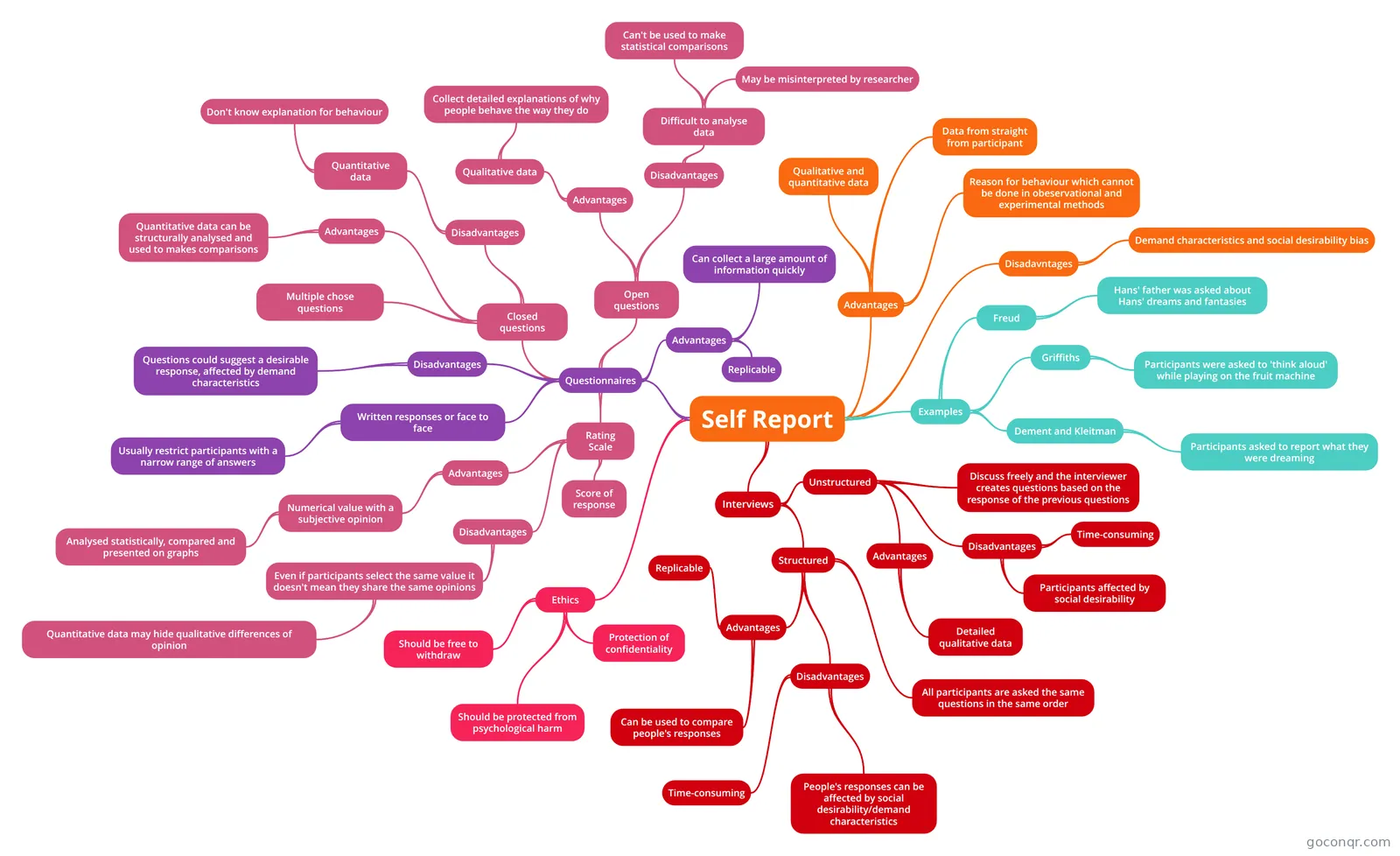
Mind map: Self report psychology
Contenido del mapa
Self Report
Interviews
- Structured
- All participants are asked the same questions in the same order
- Advantages
- Replicable
- Can be used to compare people's responses
- Disadvantages
- Time-consuming
- People's responses can be affected by social desirability/demand characteristics
- Unstructured
- Discuss freely and the interviewer creates questions based on the response of the previous questions
- Advantages
- Detailed qualitative data
- Disadvantages
- Time-consuming
- Participants affected by social desirability
- Structured
Examples
- Dement and Kleitman
- Participants asked to report what they were dreaming
- Griffiths
- Participants were asked to 'think aloud' while playing on the fruit machine
- Freud
- Hans' father was asked about Hans' dreams and fantasies
- Dement and Kleitman
Questionnaires
- Written responses or face to face
- Usually restrict participants with a narrow range of answers
- Advantages
- Can collect a large amount of information quickly
- Replicable
- Disadvantages
- Questions could suggest a desirable response, affected by demand characteristics
- Open questions
- Advantages
- Qualitative data
- Collect detailed explanations of why people behave the way they do
- Qualitative data
- Disadvantages
- Difficult to analyse data
- Can't be used to make statistical comparisons
- May be misinterpreted by researcher
- Difficult to analyse data
- Advantages
- Closed questions
- Multiple chose questions
- Advantages
- Quantitative data can be structurally analysed and used to makes comparisons
- Disadvantages
- Quantitative data
- Don't know explanation for behaviour
- Quantitative data
- Rating Scale
- Score of response
- Advantages
- Numerical value with a subjective opinion
- Analysed statistically, compared and presented on graphs
- Numerical value with a subjective opinion
- Disadvantages
- Even if participants select the same value it doesn't mean they share the same opinions
- Quantitative data may hide qualitative differences of opinion
- Even if participants select the same value it doesn't mean they share the same opinions
- Written responses or face to face
Ethics
- Should be protected from psychological harm
- Should be free to withdraw
- Protection of confidentiality
Advantages
- Qualitative and quantitative data
- Data from straight from participant
- Reason for behaviour which cannot be done in obeservational and experimental methods
Disadavntages
- Demand characteristics and social desirability bias