
Mapa mental
Developmental Psychology: Autistic Spectrum Disorder
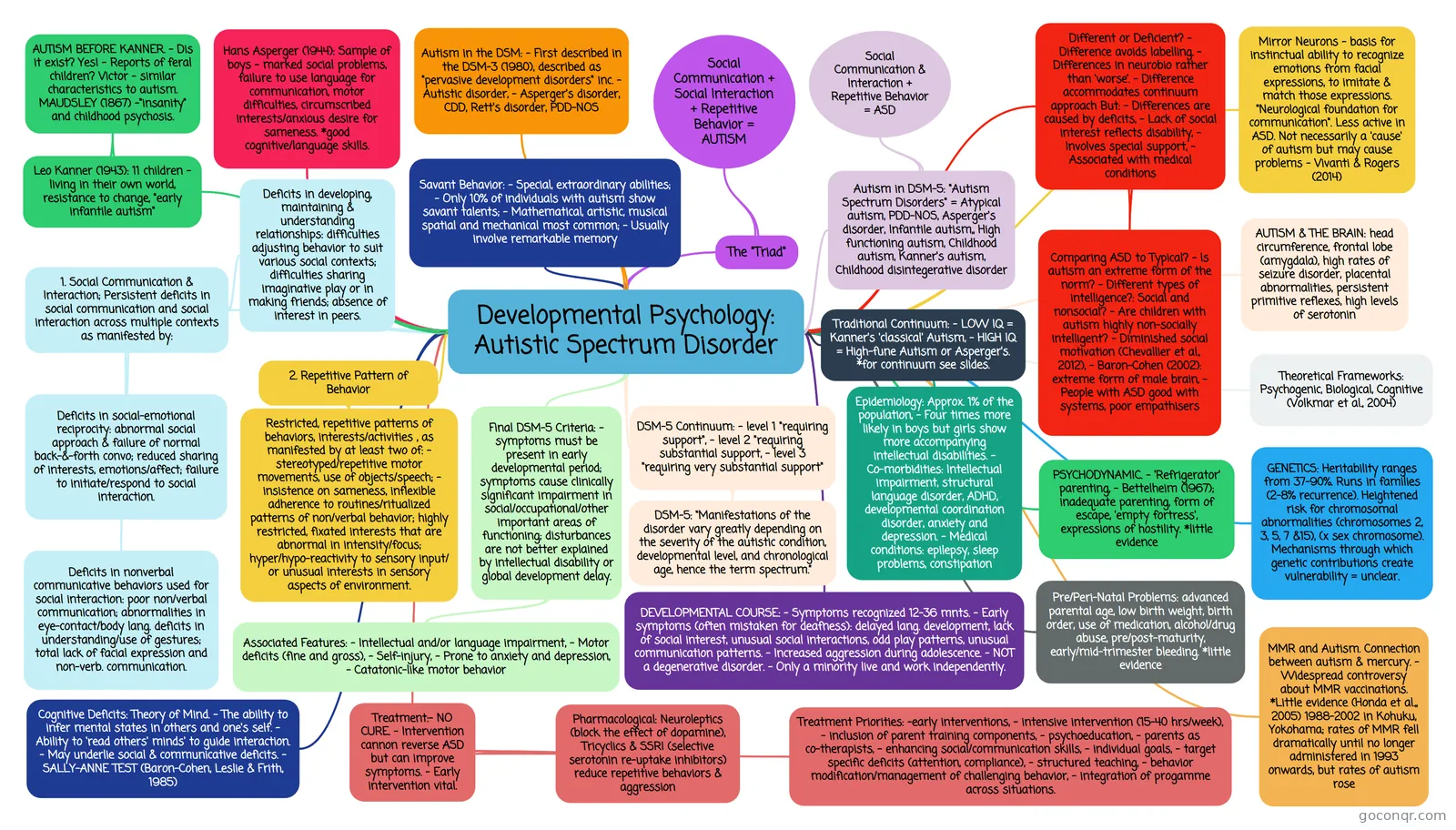
Mind map: Developmental Psychology: autistic spectrum disorder
Contenido del mapa
Developmental Psychology: Autistic Spectrum Disorder
Leo Kanner (1943): 11 children - living in their own world, resistance to change, "early infantile autism"
- AUTISM BEFORE KANNER. - Dis it exist? Yes! - Reports of feral children? Victor - similar characteristics to autism. MAUDSLEY (1867) -"insanity" and childhood psychosis.
Hans Asperger (1944): Sample of boys - marked social problems, failure to use language for communication, motor difficulties, circumscribed interests/anxious desire for sameness. *good cognitive/language skills.
Autism in the DSM: - First described in the DSM-3 (1980), described as "pervasive development disorders" inc. - Autistic disorder, - Asperger's disorder, CDD, Rett's disorder, PDD-NOS
The "Triad"
- Social Communication + Social Interaction + Repetitive Behavior = AUTISM
Autism in DSM-5: "Autism Spectrum Disorders" = Atypical autism, PDD-NOS, Asperger's disorder, Infantile autism,, High functioning autism, Childhood autism, Kanner's autism, Childhood disintegerative disorder
- Social Communication & Interaction + Repetitive Behavior = ASD
1. Social Communication & Interaction; Persistent deficits in social communication and social interaction across multiple contexts as manifested by:
- Deficits in social-emotional reciprocity: abnormal social approach & failure of normal back-&-forth convo; reduced sharing of interests, emotions/affect; failure to initiate/respond to social interaction.
- Deficits in nonverbal communicative behaviors used for social interaction: poor non/verbal communication; abnormalities in eye-contact/body lang. deficits in understanding/use of gestures; total lack of facial expression and non-verb. communication.
- Deficits in developing, maintaining & understanding relationships: difficulties adjusting behavior to suit various social contexts; difficulties sharing imaginative play or in making friends; absence of interest in peers.
2. Repetitive Pattern of Behavior
- Restricted, repetitive patterns of behaviors, interests/activities , as manifested by at least two of: - stereotyped/repetitive motor movements, use of objects/speech; - insistence on sameness, inflexible adherence to routines/ritualized patterns of non/verbal behavior; highly restricted, fixated interests that are abnormal in intensity/focus; hyper/hypo-reactivity to sensory input/ or unusual interests in sensory aspects of environment.
Final DSM-5 Criteria: - symptoms must be present in early developmental period; symptoms cause clinically significant impairment in social/occupational/other important areas of functioning; disturbances are not better explained by intellectual disability or global development delay.
- Associated Features: - Intellectual and/or language impairment, - Motor deficits (fine and gross), - Self-injury, - Prone to anxiety and depression, - Catatonic-like motor behavior
Savant Behavior: - Special, extraordinary abilities; - Only 10% of individuals with autism show savant talents; - Mathematical, artistic, musical spatial and mechanical most common; - Usually involve remarkable memory
DSM-5 Continuum: - level 1 "requiring support", - level 2 "requiring substantial support, - level 3 "requiring very substantial support"
- DSM-5: “Manifestations of the disorder vary greatly depending on the severity of the autistic condition, developmental level, and chronological age, hence the term spectrum.”
Traditional Continuum: - LOW IQ = Kanner's 'classical' Autism, - HIGH IQ = High-fune Autism or Asperger's. *for continuum see slides.
Different or Deficient? - Difference avoids labelling. - Differences in neurobio rather than ‘worse’. - Difference accommodates continuum approach But: - Differences are caused by deficits, - Lack of social interest reflects disability, - Involves special support, - Associated with medical conditions
- Comparing ASD to Typical? - Is autism an extreme form of the norm? - Different types of intelligence?: Social and nonsocial? - Are children with autism highly non-socially intelligent? - Diminished social motivation (Chevallier et al., 2012), - Baron-Cohen (2002): extreme form of male brain, - People with ASD good with systems, poor empathisers
Epidemiology: Approx. 1% of the population, - Four times more likely in boys but girls show more accompanying intellectual disabilities. - Co-morbidities: Intellectual impairment, structural language disorder, ADHD, developmental coordination disorder, anxiety and depression. - Medical conditions: epilepsy, sleep problems, constipation
DEVELOPMENTAL COURSE: - Symptoms recognized 12-36 mnts. - Early symptoms (often mistaken for deafness): delayed lang. development, lack of social interest, unusual social interactions, odd play patterns, unusual communication patterns. - Increased aggression during adolescence. - NOT a degenerative disorder. - Only a minority live and work independently.
Theoretical Frameworks: Psychogenic, Biological, Cognitive (Volkmar et al., 2004)
PSYCHODYNAMIC. - 'Refrigerator' parenting, - Bettelheim (1967); inadequate parenting, form of escape, 'empty fortress', expressions of hostility. *little evidence
Pre/Peri-Natal Problems: advanced parental age, low birth weight, birth order, use of medication, alcohol/drug abuse, pre/post-maturity, early/mid-trimester bleeding. *little evidence
MMR and Autism. Connection between autism & mercury. - Widespread controversy about MMR vaccinations. *Little evidence (Honda et al.,, 2005) 1988-2002 in Kohuku, Yokohama; rates of MMR fell dramatically until no longer administered in 1993 onwards, but rates of autism rose
GENETICS: Heritability ranges from 37-90%. Runs in families (2-8% recurrence). Heightened risk for chromosomal abnormalities (chromosomes 2, 3, 5, 7 &15), (x sex chromosome). Mechanisms through which genetic contributions create vulnerability = unclear.
AUTISM & THE BRAIN: head circumference, frontal lobe (amygdala), high rates of seizure disorder, placental abnormalities, persistent primitive reflexes, high levels of serotonin
Mirror Neurons - basis for instinctual ability to recognize emotions from facial expressions, to imitate & match those expressions. "Neurological foundation for communication". Less active in ASD. Not necessarily a 'cause' of autism but may cause problems - Vivanti & Rogers (2014)
Cognitive Deficits: Theory of Mind. - The ability to infer mental states in others and one's self. - Ability to 'read others' minds' to guide interaction. - May underlie social & communicative deficits. - SALLY-ANNE TEST (Baron-Cohen, Leslie & Frith, 1985)
Treatment:- NO CURE. - Intervention cannon reverse ASD but can improve symptoms. - Early intervention vital.
- Pharmacological: Neuroleptics (block the effect of dopamine), Tricyclics & SSRI (selective serotonin re-uptake inhibitors) reduce repetitive behaviors & aggression
- Treatment Priorities: -early interventions, - intensive intervention (15-40 hrs/week), - inclusion of parent training components, - psychoeducation, - parents as co-therapists, - enhancing social/communication skills, - individual goals, - target specific deficits (attention, compliance), - structured teaching, - behavior modification/management of challenging behavior, - integration of progamme across situations.
Información
- Descripción
- Autism Spectrum Disorder
- Creado por
- DaniTemeng
- Visitas
- 101
- Etiquetas
- Valoración