
Mapa mental
relationships
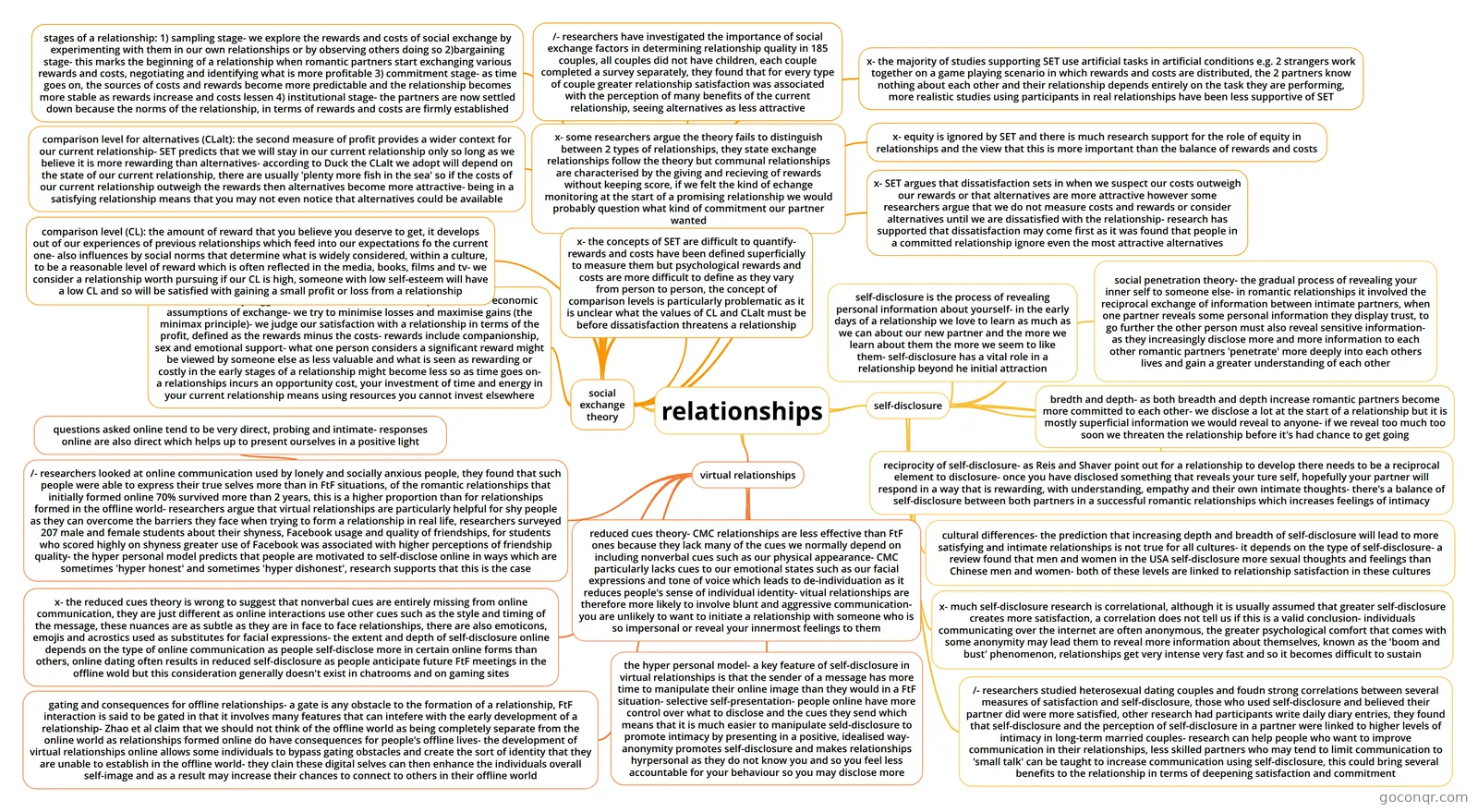
Mind map: relationships
Contenido del mapa
relationships
self-disclosure
- self-disclosure is the process of revealing personal information about yourself- in the early days of a relationship we love to learn as much as we can about our new partner and the more we learn about them the more we seem to like them- self-disclosure has a vital role in a relationship beyond he initial attraction
- social penetration theory- the gradual process of revealing your inner self to someone else- in romantic relationships it involved the reciprocal exchange of information between intimate partners, when one partner reveals some personal information they display trust, to go further the other person must also reveal sensitive information- as they increasingly disclose more and more information to each other romantic partners 'penetrate' more deeply into each others lives and gain a greater understanding of each other
- bredth and depth- as both breadth and depth increase romantic partners become more committed to each other- we disclose a lot at the start of a relationship but it is mostly superficial information we would reveal to anyone- if we reveal too much too soon we threaten the relationship before it's had chance to get going
- reciprocity of self-disclosure- as Reis and Shaver point out for a relationship to develop there needs to be a reciprocal element to disclosure- once you have disclosed something that reveals your ture self, hopefully your partner will respond in a way that is rewarding, with understanding, empathy and their own intimate thoughts- there's a balance of self-disclosure between both partners in a successful romantic relationships which increases feelings of intimacy
- cultural differences- the prediction that increasing depth and breadth of self-disclosure will lead to more satisfying and intimate relationships is not true for all cultures- it depends on the type of self-disclosure- a review found that men and women in the USA self-disclosure more sexual thoughts and feelings than Chinese men and women- both of these levels are linked to relationship satisfaction in these cultures
- x- much self-disclosure research is correlational, although it is usually assumed that greater self-disclosure creates more satisfaction, a correlation does not tell us if this is a valid conclusion- individuals communicating over the internet are often anonymous, the greater psychological comfort that comes with some anonymity may lead them to reveal more information about themselves, known as the 'boom and bust' phenomenon, relationships get very intense very fast and so it becomes difficult to sustain
- /- researchers studied heterosexual dating couples and foudn strong correlations between several measures of satisfaction and self-disclosure, those who used self-disclosure and believed their partner did were more satisfied, other research had participants write daily diary entries, they found that self-disclosure and the perception of self-disclosure in a partner were linked to higher levels of intimacy in long-term married couples- research can help people who want to improve communication in their relationships, less skilled partners who may tend to limit communication to 'small talk' can be taught to increase communication using self-disclosure, this could bring several benefits to the relationship in terms of deepening satisfaction and commitment
virtual relationships
- reduced cues theory- CMC relationships are less effective than FtF ones because they lack many of the cues we normally depend on including nonverbal cues such as our physical appearance- CMC particularly lacks cues to our emotional states such as our facial expressions and tone of voice which leads to de-individuation as it reduces people's sense of individual identity- vitual relationships are therefore more likely to involve blunt and aggressive communication- you are unlikely to want to initiate a relationship with someone who is so impersonal or reveal your innermost feelings to them
- the hyper personal model- a key feature of self-disclosure in virtual relationships is that the sender of a message has more time to manipulate their online image than they would in a FtF situation- selective self-presentation- people online have more control over what to disclose and the cues they send which means that it is much easier to manipulate seld-disclosure to promote intimacy by presenting in a positive, idealised way- anonymity promotes self-disclosure and makes relationships hyrpersonal as they do not know you and so you feel less accountable for your behaviour so you may disclose more
- gating and consequences for offline relationships- a gate is any obstacle to the formation of a relationship, FtF interaction is said to be gated in that it involves many features that can intefere with the early development of a relationship- Zhao et al claim that we should not think of the offline world as being completely separate from the online world as relationships formed online do have consequences for people's offline lives- the development of virtual relationships online allows some individuals to bypass gating obstacles and create the sort of identity that they are unable to establish in the offline world- they clain these digital selves can then enhance the individuals overall self-image and as a result may increase their chances to connect to others in their offline world
- x- the reduced cues theory is wrong to suggest that nonverbal cues are entirely missing from online communication, they are just different as online interactions use other cues such as the style and timing of the message, these nuances are as subtle as they are in face to face relationships, there are also emoticons, emojis and acrostics used as substitutes for facial expressions- the extent and depth of self-disclosure online depends on the type of online communication as people self-disclose more in certain online forms than others, online dating often results in reduced self-disclosure as people anticipate future FtF meetings in the offline wold but this consideration generally doesn't exist in chatrooms and on gaming sites
- /- researchers looked at online communication used by lonely and socially anxious people, they found that such people were able to express their true selves more than in FtF situations, of the romantic relationships that initially formed online 70% survived more than 2 years, this is a higher proportion than for relationships formed in the offline world- researchers argue that virtual relationships are particularly helpful for shy people as they can overcome the barriers they face when trying to form a relationship in real life, researchers surveyed 207 male and female students about their shyness, Facebook usage and quality of friendships, for students who scored highly on shyness greater use of Facebook was associated with higher perceptions of friendship quality- the hyper personal model predicts that people are motivated to self-disclose online in ways which are sometimes 'hyper honest' and sometimes 'hyper dishonest', research supports that this is the case
- questions asked online tend to be very direct, probing and intimate- responses online are also direct which helps up to present ourselves in a positive light
social exchange theory
- Thibault and Kelly suggest that behaviour in a relatinship reflects the economic assumptions of exchange- we try to minimise losses and maximise gains (the minimax principle)- we judge our satisfaction with a relationship in terms of the profit, defined as the rewards minus the costs- rewards include companionship, sex and emotional support- what one person considers a significant reward might be viewed by someone else as less valuable and what is seen as rewarding or costly in the early stages of a relationship might become less so as time goes on- a relationships incurs an opportunity cost, your investment of time and energy in your current relationship means using resources you cannot invest elsewhere
- comparison level (CL): the amount of reward that you believe you deserve to get, it develops out of our experiences of previous relationships which feed into our expectations fo the current one- also influences by social norms that determine what is widely considered, within a culture, to be a reasonable level of reward which is often reflected in the media, books, films and tv- we consider a relationship worth pursuing if our CL is high, someone with low self-esteem will have a low CL and so will be satisfied with gaining a small profit or loss from a relationship
- comparison level for alternatives (CLalt): the second measure of profit provides a wider context for our current relationship- SET predicts that we will stay in our current relationship only so long as we believe it is more rewarding than alternatives- according to Duck the CLalt we adopt will depend on the state of our current relationship, there are usually 'plenty more fish in the sea' so if the costs of our current relationship outweigh the rewards then alternatives become more attractive- being in a satisfying relationship means that you may not even notice that alternatives could be available
- stages of a relationship: 1) sampling stage- we explore the rewards and costs of social exchange by experimenting with them in our own relationships or by observing others doing so 2)bargaining stage- this marks the beginning of a relationship when romantic partners start exchanging various rewards and costs, negotiating and identifying what is more profitable 3) commitment stage- as time goes on, the sources of costs and rewards become more predictable and the relationship becomes more stable as rewards increase and costs lessen 4) institutional stage- the partners are now settled down because the norms of the relationship, in terms of rewards and costs are firmly established
- /- researchers have investigated the importance of social exchange factors in determining relationship quality in 185 couples, all couples did not have children, each couple completed a survey separately, they found that for every type of couple greater relationship satisfaction was associated with the perception of many benefits of the current relationship, seeing alternatives as less attractive
- x- some researchers argue the theory fails to distinguish between 2 types of relationships, they state exchange relationships follow the theory but communal relationships are characterised by the giving and recieving of rewards without keeping score, if we felt the kind of echange monitoring at the start of a promising relationship we would probably question what kind of commitment our partner wanted
- x- the concepts of SET are difficult to quantify- rewards and costs have been defined superficially to measure them but psychological rewards and costs are more difficult to define as they vary from person to person, the concept of comparison levels is particularly problematic as it is unclear what the values of CL and CLalt must be before dissatisfaction threatens a relationship
- x- the majority of studies supporting SET use artificial tasks in artificial conditions e.g. 2 strangers work together on a game playing scenario in which rewards and costs are distributed, the 2 partners know nothing about each other and their relationship depends entirely on the task they are performing, more realistic studies using participants in real relationships have been less supportive of SET
- x- equity is ignored by SET and there is much research support for the role of equity in relationships and the view that this is more important than the balance of rewards and costs
- x- SET argues that dissatisfaction sets in when we suspect our costs outweigh our rewards or that alternatives are more attractive however some researchers argue that we do not measure costs and rewards or consider alternatives until we are dissatisfied with the relationship- research has supported that dissatisfaction may come first as it was found that people in a committed relationship ignore even the most attractive alternatives
Información
- Descripción
- A level psychology Mapa Mental sobre relationships, creado por harriet bagguley el 31/01/2021.
- Creado por
- harriet bagguley
- Visitas
- 0
- Valoración