
Mapa mental
Social Learning Theory
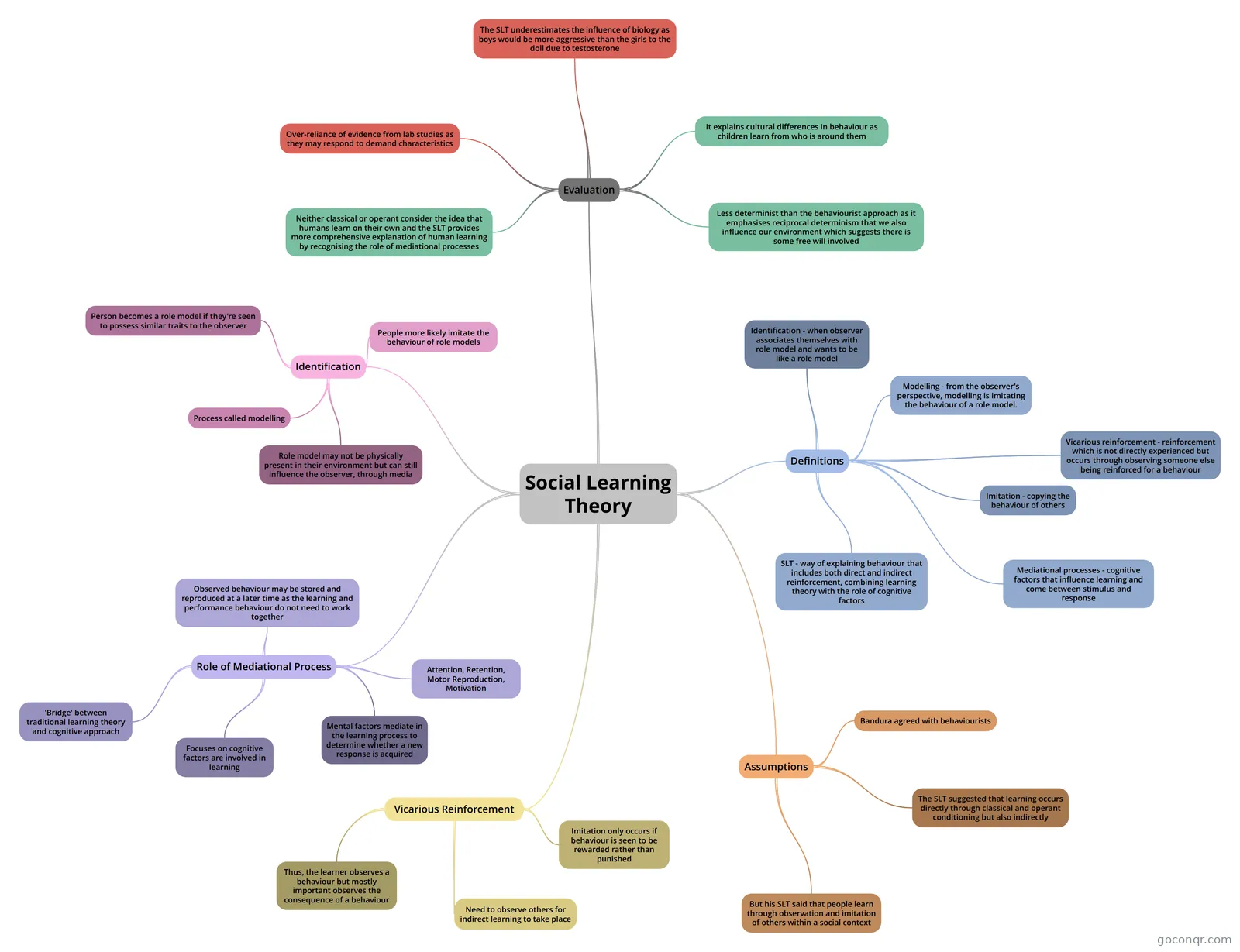
Mind map: Social Learning Theory
Contenido del mapa
Social Learning Theory
Definitions
- SLT - way of explaining behaviour that includes both direct and indirect reinforcement, combining learning theory with the role of cognitive factors
- Imitation - copying the behaviour of others
- Identification - when observer associates themselves with role model and wants to be like a role model
- Modelling - from the observer's perspective, modelling is imitating the behaviour of a role model.
- Vicarious reinforcement - reinforcement which is not directly experienced but occurs through observing someone else being reinforced for a behaviour
- Mediational processes - cognitive factors that influence learning and come between stimulus and response
Assumptions
- Bandura agreed with behaviourists
- But his SLT said that people learn through observation and imitation of others within a social context
- The SLT suggested that learning occurs directly through classical and operant conditioning but also indirectly
Vicarious Reinforcement
- Need to observe others for indirect learning to take place
- Imitation only occurs if behaviour is seen to be rewarded rather than punished
- Thus, the learner observes a behaviour but mostly important observes the consequence of a behaviour
Role of Mediational Process
- Attention, Retention, Motor Reproduction, Motivation
- 'Bridge' between traditional learning theory and cognitive approach
- Focuses on cognitive factors are involved in learning
- Mental factors mediate in the learning process to determine whether a new response is acquired
- Observed behaviour may be stored and reproduced at a later time as the learning and performance behaviour do not need to work together
Identification
- People more likely imitate the behaviour of role models
- Process called modelling
- Person becomes a role model if they're seen to possess similar traits to the observer
- Role model may not be physically present in their environment but can still influence the observer, through media
Evaluation
- Neither classical or operant consider the idea that humans learn on their own and the SLT provides more comprehensive explanation of human learning by recognising the role of mediational processes
- Over-reliance of evidence from lab studies as they may respond to demand characteristics
- The SLT underestimates the influence of biology as boys would be more aggressive than the girls to the doll due to testosterone
- It explains cultural differences in behaviour as children learn from who is around them
- Less determinist than the behaviourist approach as it emphasises reciprocal determinism that we also influence our environment which suggests there is some free will involved
Información
- Descripción
- AQA (Approaches) Psychology Mapa Mental sobre Social Learning Theory, creado por Jackson Maleary el 20/05/2021.
- Creado por
- Jackson Maleary
- Visitas
- 428
- Etiquetas
- Valoración