
Mapa mental
Theories of Deviance
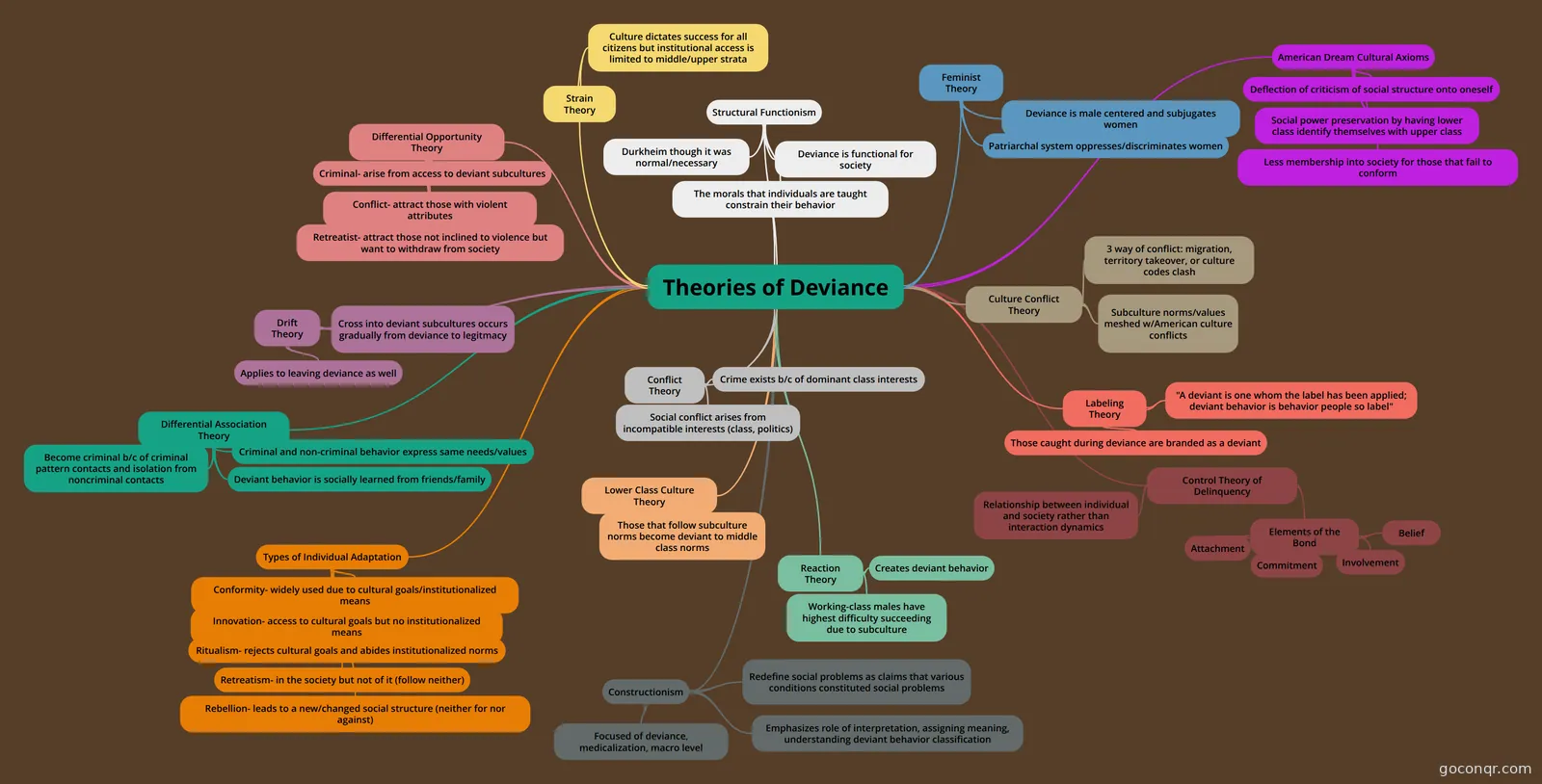
Mind map: theories of deviance
Contenido del mapa
Theories of Deviance
Structural Functionism
- The morals that individuals are taught constrain their behavior
- Deviance is functional for society
- Durkheim though it was normal/necessary
Strain Theory
- Culture dictates success for all citizens but institutional access is limited to middle/upper strata
Conflict Theory
- Social conflict arises from incompatible interests (class, politics)
- Crime exists b/c of dominant class interests
Feminist Theory
- Patriarchal system oppresses/discriminates women
- Deviance is male centered and subjugates women
Culture Conflict Theory
- Subculture norms/values meshed w/American culture conflicts
- 3 way of conflict: migration, territory takeover, or culture codes clash
Reaction Theory
- Working-class males have highest difficulty succeeding due to subculture
- Creates deviant behavior
Lower Class Culture Theory
- Those that follow subculture norms become deviant to middle class norms
Differential Opportunity Theory
- Criminal- arise from access to deviant subcultures
- Conflict- attract those with violent attributes
- Retreatist- attract those not inclined to violence but want to withdraw from society
Drift Theory
- Cross into deviant subcultures occurs gradually from deviance to legitmacy
- Applies to leaving deviance as well
Labeling Theory
- Those caught during deviance are branded as a deviant
- "A deviant is one whom the label has been applied; deviant behavior is behavior people so label"
Control Theory of Delinquency
- Relationship between individual and society rather than interaction dynamics
- Elements of the Bond
- Attachment
- Commitment
- Involvement
- Belief
Differential Association Theory
- Deviant behavior is socially learned from friends/family
- Criminal and non-criminal behavior express same needs/values
- Become criminal b/c of criminal pattern contacts and isolation from noncriminal contacts
American Dream Cultural Axioms
- Deflection of criticism of social structure onto oneself
- Social power preservation by having lower class identify themselves with upper class
- Less membership into society for those that fail to conform
Types of Individual Adaptation
- Conformity- widely used due to cultural goals/institutionalized means
- Innovation- access to cultural goals but no institutionalized means
- Ritualism- rejects cultural goals and abides institutionalized norms
- Retreatism- in the society but not of it (follow neither)
- Rebellion- leads to a new/changed social structure (neither for nor against)
Constructionism
- Redefine social problems as claims that various conditions constituted social problems
- Focused of deviance, medicalization, macro level
- Emphasizes role of interpretation, assigning meaning, understanding deviant behavior classification
Información
- Descripción
- Part II: Theories of Deviance
- Creado por
- emoghtader
- Visitas
- 75
- Etiquetas
- Valoración