
Mapa mental
Bacteria survey
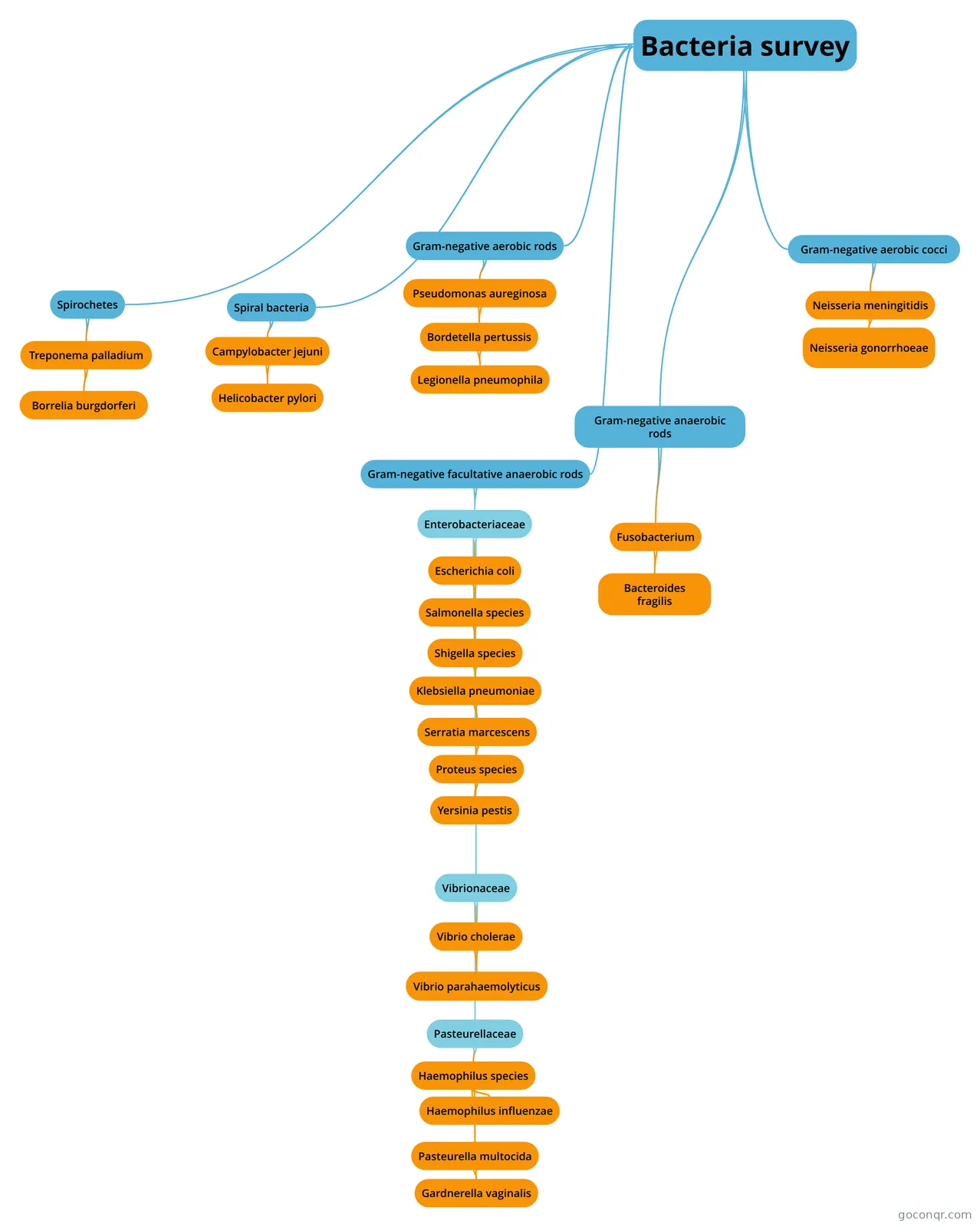
Mind map: Bacteria survey
Contenido del mapa
Bacteria survey
Spirochetes
- - AKA endoflagellum - spiral bacterial cells - very flexible bacteria
- Treponema palladium
- - most commonly associated with syphillis -
- Borrelia burgdorferi
- - most commonly associated with lyme disease (which si spread by deer tick)
Spiral bacteria
- Campylobacter jejuni
- - foodborne gastroenteritis viral bacteria associated with eating uncooked poultry
- Helicobacter pylori
- - associated with duodenal and peptic ulcers - it survives in the stomach's acidic environment by producing an enzyme called urease which breaks down urea into ammonia
- Campylobacter jejuni
Gram-negative aerobic rods
- Pseudomonas aureginosa
- - associated with burns, cystic fibrosis, wounds, and nonsocomal infections - known as an organism of "blue pus", due to production of blue-ish green pigment - very opportunistic bacteria - very resistant to antibiotics and disinfectants - Habitat = soil and moist environments
- Bordetella pertussis
- - associated with pertussis/whooping cough
- Legionella pneumophila
- - associated with Legionnaire's disease
- Pseudomonas aureginosa
Gram-negative aerobic cocci
- Neisseria meningitidis
- - associated with epidemic/ meningococcal meningitis
- Neisseria gonorrhoeae
- - associated with gonorrhoeae
- Neisseria meningitidis
Gram-negative facultative anaerobic rods
- : a large group divided into 3 families: 1. Enterobacteriaceae 2. Vibrionaceae 3. Pasteurellaceae
- Enterobacteriaceae
- bacteria in the intestine
- Escherichia coli
- - #1 cause of UTI, frequently as a nonsocomal infection as well - associated with traveller's diarrhea - indicator organism for fecally contaminated water E. coli O157: H7 - cook your hamburgers! - affects kidney function
- Salmonella species
- Normal flora of 1. Salmonella enteriditis-- bacteria transmitted in eggs, and other poultry (chicken/turkey); many states prohibit sale of Easter chicks and ducklings as a result 2. Morganella morganii-- PET (small ones < 4 inches) Diseases: Food poisoning and Typhoid fever (Salmonella typhi)
- Shigella species
- - associated with Shigellosis or bacillary dysentery= very potentially severe form of diarrhea
- Klebsiella pneumoniae
- - nonsocomal pneumonia - common in smokers
- Serratia marcescens
- - produces a red pigment - frequent nonsocomal infection, RESPIRATORY/WOUND INFECTION
- Proteus species
- - associated with UTI, WOUNDS, NONSOCOMAL INFECTIONS; known for its unique form of swarming on agar plates
- Yersinia pestis
- - associated with BUBONIC PLAGUE - transmission usually involves an oriental rat flea (Xenopsyllacheopis)- although transmission can be via respiratory droplets from infected individuals
- Vibrionaceae
- Vibrio cholerae
- - a curved rod - Cholera: a disease characterized by copious amounts of very watery diarrhea
- Vibrio parahaemolyticus
- - form of gastroenteritis caused by eating raw or uncooked shellfish (oysters, clams)
- Pasteurellaceae
- Haemophilus species
- - has specific growth requirements that need to be supplied in media= X and V factors X factor- heme from blood (chocolate agar or blood agar) V factor- NAD
- Haemophilus influenzae
- - Diseases/infections: childhood meningitis (vaccine known as Hib), otitis media, and pneumonia. - Symptoms of meningitis include stiffness of the neck.
- Pasteurella multocida
- - frequent infection from cat and dog bites
- Gardnerella vaginalis
- -- no family designation - cause of bacterial vaginitis (two other forms of vaginitis (more common) are caused by a yeast (candida) and a protozoan (Trichomonas vaginalis))
- Haemophilus species
- Vibrio cholerae
Gram-negative anaerobic rods
- Fusobacterium
- -- oral infections, frequently dental abscesses following invasive dental procedures (found in gums) - long, slender rods with pointed ends
- Bacteroides fragilis
- - extremely abundant in human intestines-- peritonitis resulting from puncture wounds or surgery in the area of the abdomen
- Fusobacterium
Información
- Descripción
- Undergraduate Microbiology Mapa Mental sobre Bacteria survey, creado por Deb A el 12/02/2025.
- Creado por
- Deb A
- Visitas
- 3
- Historial
-
- Creado por Deb A · 12 feb 2025
- Copiado por Deb A · 12 feb 2025
- Valoración