
Mapa mental
ccw - practices
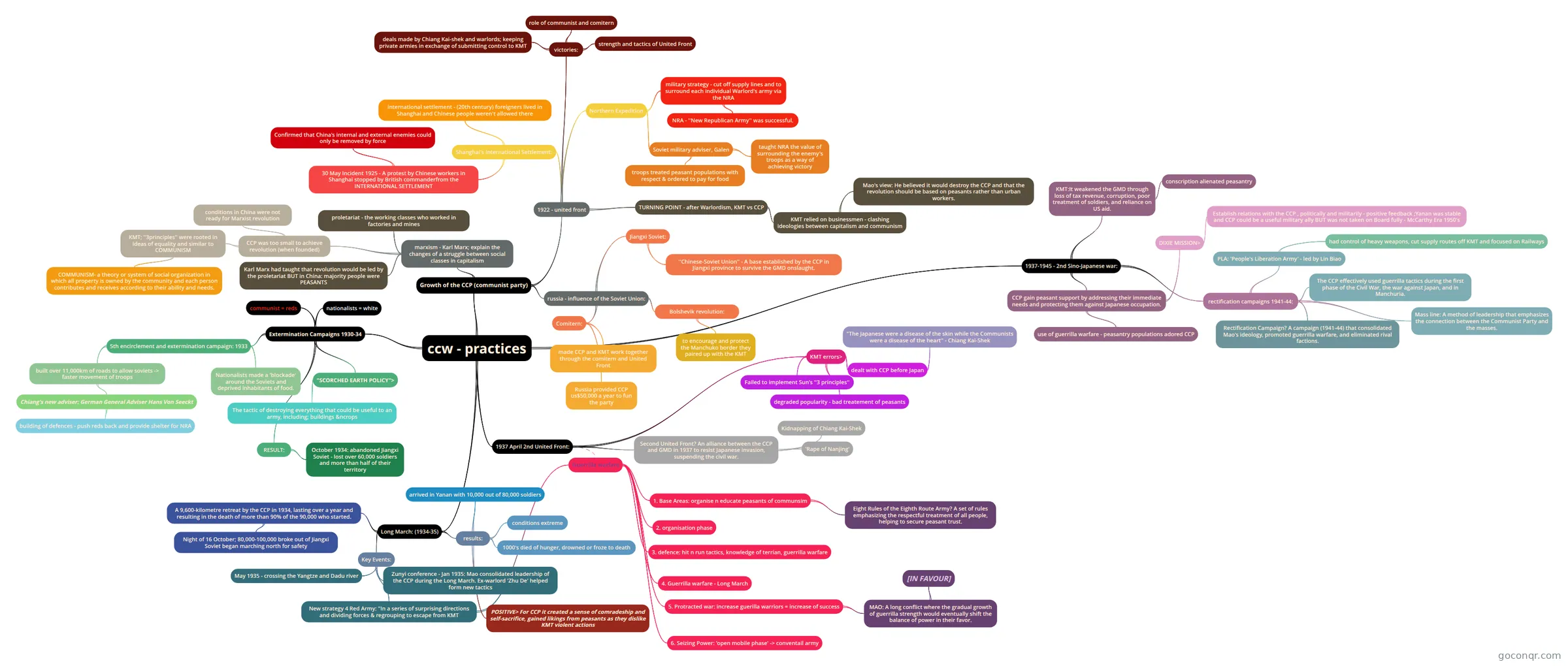
Mind map: growth of the CCP in China
Contenido del mapa
ccw - practices
Growth of the CCP (communist party)
- russia - influence of the Soviet Union:
- Bolshevik revolution:
- to encourage and protect the Manchuko border they paired up with the KMT
- Comitern:
- made CCP and KMT work together through the comitern and United Front
- Russia provided CCP us$50,000 a year to fun the party
- Jiangxi Soviet:
- ''Chinese-Soviet Union'' - A base established by the CCP in Jiangxi province to survive the GMD onslaught.
- Bolshevik revolution:
- marxism - Karl Marx; explain the changes of a struggle between social classes in capitalism
- proletariat - the working classes who worked in factories and mines
- CCP was too small to achieve revolution (when founded)
- conditions in China were not ready for Marxist revolution
- KMT; ''3principles'' were rooted in ideas of equality and similar to COMMUNISM
- COMMUNISM- a theory or system of social organization in which all property is owned by the community and each person contributes and receives according to their ability and needs.
- Karl Marx had taught that revolution would be led by the proletariat BUT in China: majority people were PEASANTS
- 1922 - united front
- Northern Expedition
- military strategy - cut off supply lines and to surround each individual Warlord's army via the NRA
- NRA - ''New Republican Army'' was successful.
- Soviet military adviser, Galen
- taught NRA the value of surrounding the enemy's troops as a way of achieving victory
- troops treated peasant populations with respect & ordered to pay for food
- military strategy - cut off supply lines and to surround each individual Warlord's army via the NRA
- Shanghai's International Settlement:
- 30 May Incident 1925 - A protest by Chinese workers in Shanghai stopped by British commanderfrom the INTERNATIONAL SETTLEMENT
- Confirmed that China's internal and external enemies could only be removed by force
- international settlement - (20th century) foreigners lived in Shanghai and Chinese people weren't allowed there
- 30 May Incident 1925 - A protest by Chinese workers in Shanghai stopped by British commanderfrom the INTERNATIONAL SETTLEMENT
- TURNING POINT - after Warlordism, KMT vs CCP
- KMT relied on businessmen - clashing ideologies between capitalism and communism
- Mao's view: He believed it would destroy the CCP and that the revolution should be based on peasants rather than urban workers.
- KMT relied on businessmen - clashing ideologies between capitalism and communism
- victories:
- strength and tactics of United Front
- role of communist and comitern
- deals made by Chiang Kai-shek and warlords; keeping private armies in exchange of submitting control to KMT
- Northern Expedition
- russia - influence of the Soviet Union:
Extermination Campaigns 1930-34
- 5th encirclement and extermination campaign: 1933
- Nationalists made a 'blockade' around the Soviets and deprived inhabitants of food.
- built over 11,000km of roads to allow soviets -> faster movement of troops
- Chiang's new adviser: German General Adviser Hans Von Seeckt
- building of defences - push reds back and provide shelter for NRA
- Chiang's new adviser: German General Adviser Hans Von Seeckt
- "SCORCHED EARTH POLICY">
- The tactic of destroying everything that could be useful to an army, including; buildings &ncrops
- communist = reds
- nationalists = white
- RESULT:
- October 1934: abandoned Jiangxi Soviet - lost over 60,000 soldiers and more than half of their territory
- 5th encirclement and extermination campaign: 1933
Long March: (1934-35)
- A 9,600-kilometre retreat by the CCP in 1934, lasting over a year and resulting in the death of more than 90% of the 90,000 who started.
- Night of 16 October; 80,000-100,000 broke out of Jiangxi Soviet began marching north for safety
- Key Events:
- Zunyi conference - Jan 1935: Mao consolidated leadership of the CCP during the Long March. Ex-warlord 'Zhu De' helped form new tactics
- New strategy 4 Red Army: "In a series of surprising directions and dividing forces & regrouping to escape from KMT
- Guerrilla warfare
- 1. Base Areas: organise n educate peasants of communsim
- Eight Rules of the Eighth Route Army? A set of rules emphasizing the respectful treatment of all people, helping to secure peasant trust.
- 2. organisation phase
- 3. defence: hit n run tactics, knowledge of terrian, guerrilla warfare
- 4. Guerrilla warfare - Long March
- 5. Protracted war: increase guerilla warriors = increase of success
- MAO: A long conflict where the gradual growth of guerrilla strength would eventually shift the balance of power in their favor.
- [IN FAVOUR]
- MAO: A long conflict where the gradual growth of guerrilla strength would eventually shift the balance of power in their favor.
- 6. Seizing Power: 'open mobile phase' -> conventail army
- 1. Base Areas: organise n educate peasants of communsim
- Guerrilla warfare
- May 1935 - crossing the Yangtze and Dadu river
- results:
- conditions extreme
- 1000's died of hunger, drowned or froze to death
- arrived in Yanan with 10,000 out of 80,000 soldiers
- POSITIVE> For CCP it created a sense of comradeship and self-sacrifice, gained likings from peasants as they dislike KMT violent actions
- A 9,600-kilometre retreat by the CCP in 1934, lasting over a year and resulting in the death of more than 90% of the 90,000 who started.
1937 April 2nd United Front:
- KMT errors>
- Failed to implement Sun's ''3 principles''
- degraded popularity - bad treatement of peasants
- dealt with CCP before Japan
- "The Japanese were a disease of the skin while the Communists were a disease of the heart" - Chiang Kai-Shek
- Second United Front? An alliance between the CCP and GMD in 1937 to resist Japanese invasion, suspending the civil war.
- Kidnapping of Chiang Kai-Shek
- 'Rape of Nanjing'
- KMT errors>
1937-1945 - 2nd Sino-Japanese war:
- KMT:It weakened the GMD through loss of tax revenue, corruption, poor treatment of soldiers, and reliance on US aid.
- conscription alienated peasantry
- CCP gain peasant support by addressing their immediate needs and protecting them against Japanese occupation.
- use of guerrilla warfare - peasantry populations adored CCP
- DIXIE MISSION>
- Establish relations with the CCP , politically and militarily - positive feedback ;Yanan was stable and CCP could be a useful military ally BUT was not taken on Board fully - McCarthy Era 1950's
- rectification campaigns 1941-44:
- Rectification Campaign? A campaign (1941-44) that consolidated Mao's ideology, promoted guerrilla warfare, and eliminated rival factions.
- The CCP effectively used guerrilla tactics during the first phase of the Civil War, the war against Japan, and in Manchuria.
- PLA: 'People's Liberation Army' - led by Lin Biao
- had control of heavy weapons, cut supply routes off KMT and focused on Railways
- Mass line: A method of leadership that emphasizes the connection between the Communist Party and the masses.
- KMT:It weakened the GMD through loss of tax revenue, corruption, poor treatment of soldiers, and reliance on US aid.
Información
- Descripción
- Mind map for the practices used during the civil war
- Creado por
- D K
- Visitas
- 20
- Etiquetas
- Valoración