
Mapa mental
Cognitive Approach to Psychology
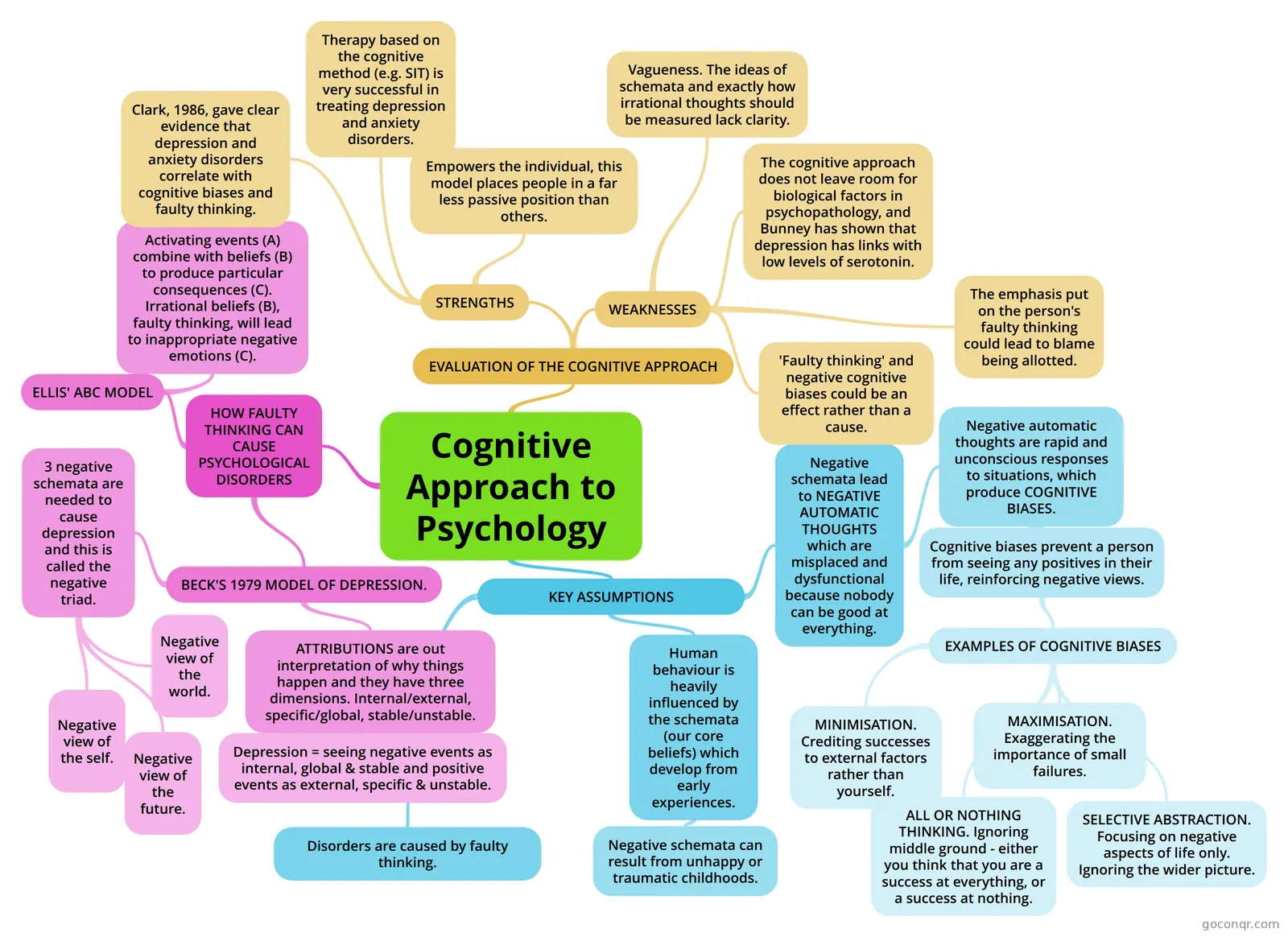
Mind map: Cognitive approach to psychology
Contenido del mapa
Cognitive Approach to Psychology
KEY ASSUMPTIONS
- Disorders are caused by faulty thinking.
- Human behaviour is heavily influenced by the schemata (our core beliefs) which develop from early experiences.
- Negative schemata can result from unhappy or traumatic childhoods.
- Negative schemata lead to NEGATIVE AUTOMATIC THOUGHTS which are misplaced and dysfunctional because nobody can be good at everything.
- Negative automatic thoughts are rapid and unconscious responses to situations, which produce COGNITIVE BIASES.
- Cognitive biases prevent a person from seeing any positives in their life, reinforcing negative views.
- EXAMPLES OF COGNITIVE BIASES
- MINIMISATION. Crediting successes to external factors rather than yourself.
- MAXIMISATION. Exaggerating the importance of small failures.
- SELECTIVE ABSTRACTION. Focusing on negative aspects of life only. Ignoring the wider picture.
- ALL OR NOTHING THINKING. Ignoring middle ground - either you think that you are a success at everything, or a success at nothing.
- EXAMPLES OF COGNITIVE BIASES
- Cognitive biases prevent a person from seeing any positives in their life, reinforcing negative views.
- Negative automatic thoughts are rapid and unconscious responses to situations, which produce COGNITIVE BIASES.
HOW FAULTY THINKING CAN CAUSE PSYCHOLOGICAL DISORDERS
- BECK'S 1979 MODEL OF DEPRESSION.
- 3 negative schemata are needed to cause depression and this is called the negative triad.
- Negative view of the self.
- Negative view of the world.
- Negative view of the future.
- ATTRIBUTIONS are out interpretation of why things happen and they have three dimensions. Internal/external, specific/global, stable/unstable.
- Depression = seeing negative events as internal, global & stable and positive events as external, specific & unstable.
- 3 negative schemata are needed to cause depression and this is called the negative triad.
- ELLIS' ABC MODEL
- Activating events (A) combine with beliefs (B) to produce particular consequences (C). Irrational beliefs (B), faulty thinking, will lead to inappropriate negative emotions (C).
- BECK'S 1979 MODEL OF DEPRESSION.
EVALUATION OF THE COGNITIVE APPROACH
- STRENGTHS
- Clark, 1986, gave clear evidence that depression and anxiety disorders correlate with cognitive biases and faulty thinking.
- Therapy based on the cognitive method (e.g. SIT) is very successful in treating depression and anxiety disorders.
- Empowers the individual, this model places people in a far less passive position than others.
- WEAKNESSES
- Vagueness. The ideas of schemata and exactly how irrational thoughts should be measured lack clarity.
- 'Faulty thinking' and negative cognitive biases could be an effect rather than a cause.
- The emphasis put on the person's faulty thinking could lead to blame being allotted.
- The cognitive approach does not leave room for biological factors in psychopathology, and Bunney has shown that depression has links with low levels of serotonin.
- STRENGTHS
Información
- Descripción
- AS Level Psychology Mapa Mental sobre Cognitive Approach to Psychology, creado por emilyoliviatapp el 02/12/2013.
- Creado por
- emilyoliviatapp
- Visitas
- 57
- Etiquetas
- Valoración