
Mapa mental
OT role in CMHT
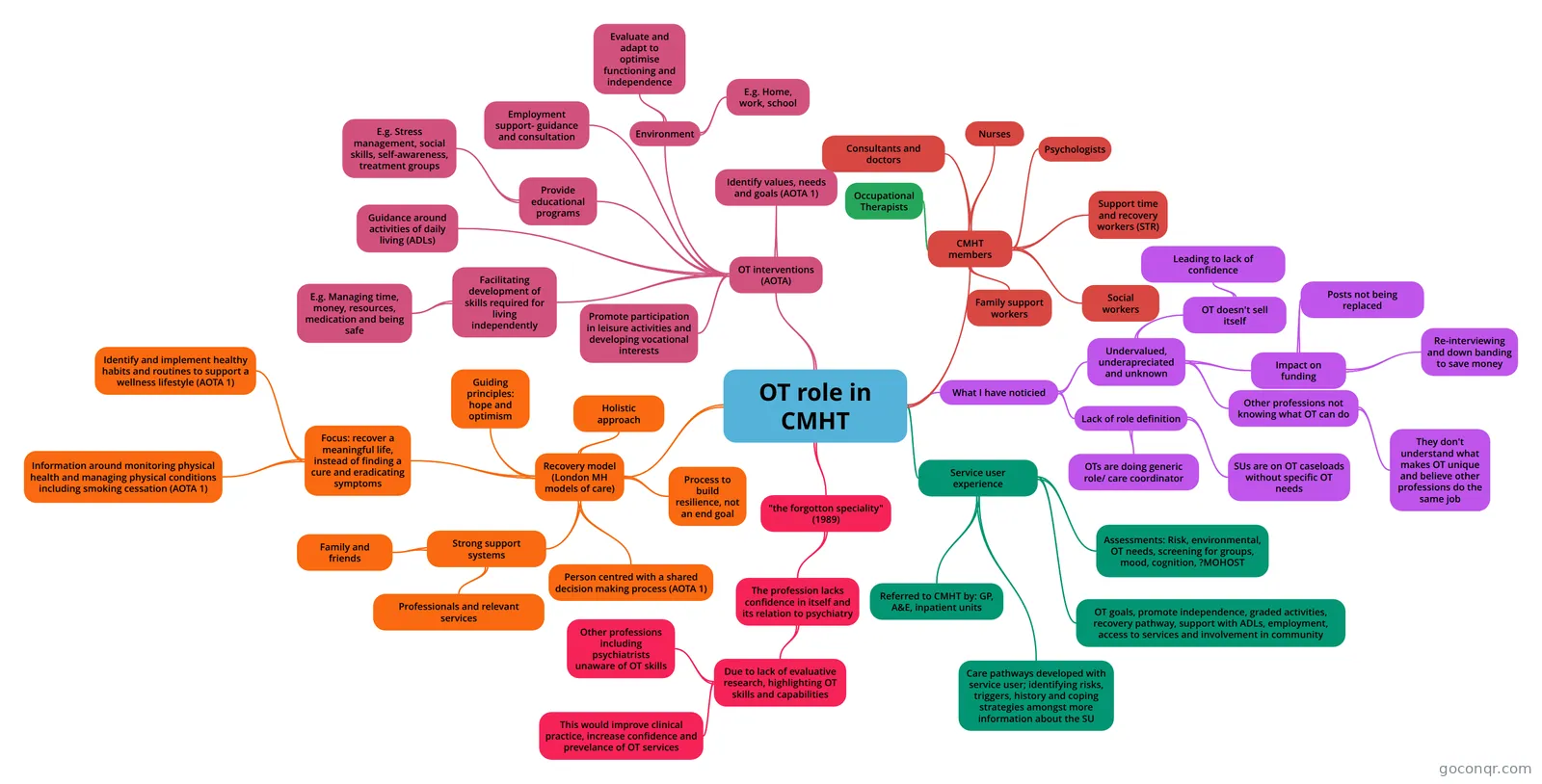
Mind map: OT role in CMHT
Contenido del mapa
OT role in CMHT
CMHT members
- Nurses
- Social workers
- Consultants and doctors
- Support time and recovery workers (STR)
- Family support workers
- Occupational Therapists
- Psychologists
What I have noticied
- Undervalued, underapreciated and unknown
- Other professions not knowing what OT can do
- They don't understand what makes OT unique and believe other professions do the same job
- OT doesn't sell itself
- Leading to lack of confidence
- Impact on funding
- Posts not being replaced
- Re-interviewing and down banding to save money
- Other professions not knowing what OT can do
- Lack of role definition
- OTs are doing generic role/ care coordinator
- SUs are on OT caseloads without specific OT needs
- Undervalued, underapreciated and unknown
Recovery model (London MH models of care)
- Holistic approach
- Focus: recover a meaningful life, instead of finding a cure and eradicating symptoms
- Identify and implement healthy habits and routines to support a wellness lifestyle (AOTA 1)
- Information around monitoring physical health and managing physical conditions including smoking cessation (AOTA 1)
- Guiding principles: hope and optimism
- Process to build resilience, not an end goal
- Strong support systems
- Family and friends
- Professionals and relevant services
- Person centred with a shared decision making process (AOTA 1)
OT interventions (AOTA)
- Employment support- guidance and consultation
- Provide educational programs
- E.g. Stress management, social skills, self-awareness, treatment groups
- Facilitating development of skills required for living independently
- E.g. Managing time, money, resources, medication and being safe
- Promote participation in leisure activities and developing vocational interests
- Guidance around activities of daily living (ADLs)
- Environment
- Evaluate and adapt to optimise functioning and independence
- E.g. Home, work, school
- Identify values, needs and goals (AOTA 1)
"the forgotton speciality" (1989)
- The profession lacks confidence in itself and its relation to psychiatry
- Due to lack of evaluative research, highlighting OT skills and capabilities
- Other professions including psychiatrists unaware of OT skills
- This would improve clinical practice, increase confidence and prevelance of OT services
- Due to lack of evaluative research, highlighting OT skills and capabilities
- The profession lacks confidence in itself and its relation to psychiatry
Service user experience
- Referred to CMHT by: GP, A&E, inpatient units
- OT goals, promote independence, graded activities, recovery pathway, support with ADLs, employment, access to services and involvement in community
- Assessments: Risk, environmental, OT needs, screening for groups, mood, cognition, ?MOHOST
- Care pathways developed with service user; identifying risks, triggers, history and coping strategies amongst more information about the SU
Información
- Descripción
- The role of Occupational therapy in CMHTs
- Creado por
- Georgia Joseph
- Visitas
- 121
- Etiquetas
- Valoración