
Mapa mental
Stanford Prison Experiment
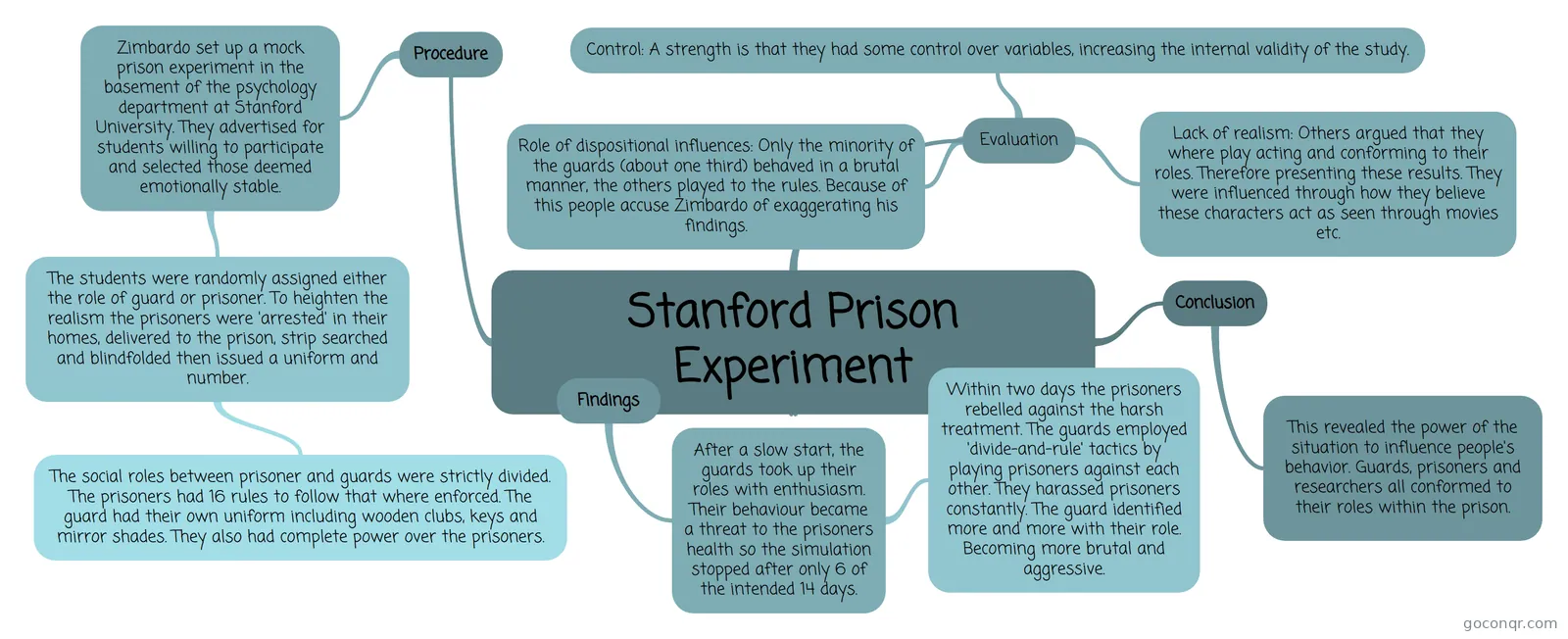
Mind map: Stanford Prison Experiment
Contenido del mapa
Stanford Prison Experiment
Procedure
- Zimbardo set up a mock prison experiment in the basement of the psychology department at Stanford University. They advertised for students willing to participate and selected those deemed emotionally stable.
- The students were randomly assigned either the role of guard or prisoner. To heighten the realism the prisoners were 'arrested' in their homes, delivered to the prison, strip searched and blindfolded then issued a uniform and number.
- The social roles between prisoner and guards were strictly divided. The prisoners had 16 rules to follow that where enforced. The guard had their own uniform including wooden clubs, keys and mirror shades. They also had complete power over the prisoners.
- The students were randomly assigned either the role of guard or prisoner. To heighten the realism the prisoners were 'arrested' in their homes, delivered to the prison, strip searched and blindfolded then issued a uniform and number.
- Zimbardo set up a mock prison experiment in the basement of the psychology department at Stanford University. They advertised for students willing to participate and selected those deemed emotionally stable.
Findings
- After a slow start, the guards took up their roles with enthusiasm. Their behaviour became a threat to the prisoners health so the simulation stopped after only 6 of the intended 14 days.
- Within two days the prisoners rebelled against the harsh treatment. The guards employed 'divide-and-rule' tactics by playing prisoners against each other. They harassed prisoners constantly. The guard identified more and more with their role. Becoming more brutal and aggressive.
- After a slow start, the guards took up their roles with enthusiasm. Their behaviour became a threat to the prisoners health so the simulation stopped after only 6 of the intended 14 days.
Conclusion
- This revealed the power of the situation to influence people's behavior. Guards, prisoners and researchers all conformed to their roles within the prison.
Evaluation
- Lack of realism: Others argued that they where play acting and conforming to their roles. Therefore presenting these results. They were influenced through how they believe these characters act as seen through movies etc.
- Control: A strength is that they had some control over variables, increasing the internal validity of the study.
- Role of dispositional influences: Only the minority of the guards (about one third) behaved in a brutal manner, the others played to the rules. Because of this people accuse Zimbardo of exaggerating his findings.
Información
- Descripción
- AS - Level (Social Influence ) Psychology Mapa Mental sobre Stanford Prison Experiment, creado por phoebepowe el 04/01/2016.
- Creado por
- phoebepowe
- Visitas
- 509
- Valoración