
Mapa mental
STRESS
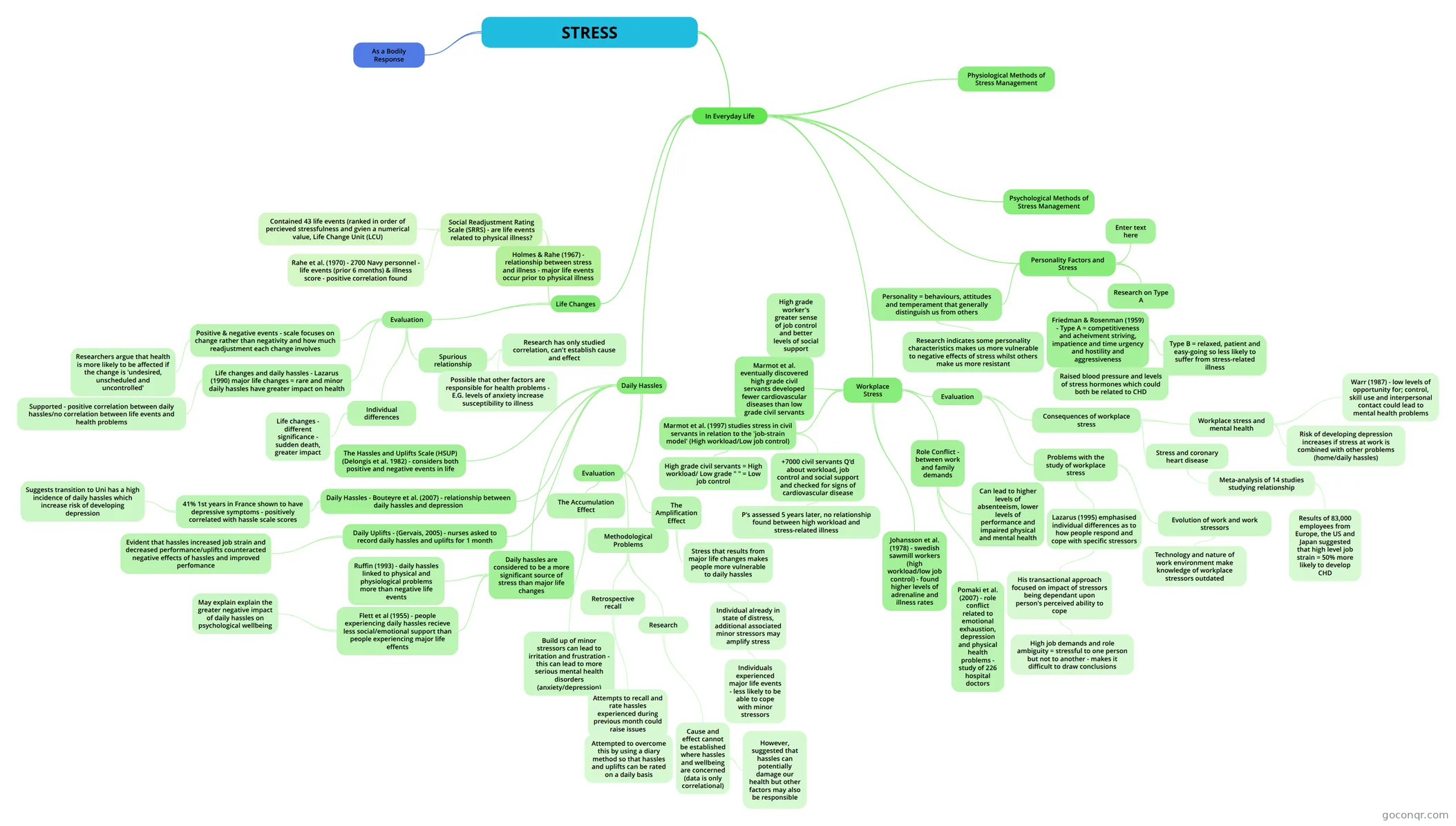
Mind map: stress
Contenido del mapa
STRESS
In Everyday Life
- Life Changes
- Holmes & Rahe (1967) - relationship between stress and illness - major life events occur prior to physical illness
- Social Readjustment Rating Scale (SRRS) - are life events related to physical illness?
- Contained 43 life events (ranked in order of percieved stressfulness and gvien a numerical value, Life Change Unit (LCU)
- Rahe et al. (1970) - 2700 Navy personnel - life events (prior 6 months) & illness score - positive correlation found
- Social Readjustment Rating Scale (SRRS) - are life events related to physical illness?
- Evaluation
- Positive & negative events - scale focuses on change rather than negativity and how much readjustment each change involves
- Researchers argue that health is more likely to be affected if the change is 'undesired, unscheduled and uncontrolled'
- Life changes and daily hassles - Lazarus (1990) major life changes = rare and minor daily hassles have greater impact on health
- Supported - positive correlation between daily hassles/no correlation between life events and health problems
- Individual differences
- Life changes - different significance - sudden death, greater impact
- Spurious relationship
- Research has only studied correlation, can't establish cause and effect
- Possible that other factors are responsible for health problems - E.G. levels of anxiety increase susceptibility to illness
- Research has only studied correlation, can't establish cause and effect
- Positive & negative events - scale focuses on change rather than negativity and how much readjustment each change involves
- Holmes & Rahe (1967) - relationship between stress and illness - major life events occur prior to physical illness
- Daily Hassles
- The Hassles and Uplifts Scale (HSUP) (Delongis et al. 1982) - considers both positive and negative events in life
- Daily Hassles - Bouteyre et al. (2007) - relationship between daily hassles and depression
- 41% 1st years in France shown to have depressive symptoms - positively correlated with hassle scale scores
- Suggests transition to Uni has a high incidence of daily hassles which increase risk of developing depression
- 41% 1st years in France shown to have depressive symptoms - positively correlated with hassle scale scores
- Daily Uplifts - (Gervais, 2005) - nurses asked to record daily hassles and uplifts for 1 month
- Evident that hassles increased job strain and decreased performance/uplifts counteracted negative effects of hassles and improved perfomance
- Daily hassles are considered to be a more significant source of stress than major life changes
- Ruffin (1993) - daily hassles linked to physical and physiological problems more than negative life events
- Flett et al (1955) - people experiencing daily hassles recieve less social/emotional support than people experiencing major life effents
- May explain explain the greater negative impact of daily hassles on psychological wellbeing
- Evaluation
- The Accumulation Effect
- Build up of minor stressors can lead to irritation and frustration - this can lead to more serious mental health disorders (anxiety/depression)
- The Amplification Effect
- Stress that results from major life changes makes people more vulnerable to daily hassles
- Individual already in state of distress, additional associated minor stressors may amplify stress
- Individuals experienced major life events - less likely to be able to cope with minor stressors
- Individual already in state of distress, additional associated minor stressors may amplify stress
- Stress that results from major life changes makes people more vulnerable to daily hassles
- Methodological Problems
- Retrospective recall
- Attempts to recall and rate hassles experienced during previous month could raise issues
- Attempted to overcome this by using a diary method so that hassles and uplifts can be rated on a daily basis
- Attempts to recall and rate hassles experienced during previous month could raise issues
- Research
- Cause and effect cannot be established where hassles and wellbeing are concerned (data is only correlational)
- However, suggested that hassles can potentially damage our health but other factors may also be responsible
- Cause and effect cannot be established where hassles and wellbeing are concerned (data is only correlational)
- Retrospective recall
- The Accumulation Effect
- Workplace Stress
- Marmot et al. (1997) studies stress in civil servants in relation to the 'job-strain model' (High workload/Low job control)
- High grade civil servants = High workload/ Low grade " " = Low job control
- +7000 civil servants Q'd about workload, job control and social support and checked for signs of cardiovascular disease
- P's assessed 5 years later, no relationship found between high workload and stress-related illness
- Johansson et al. (1978) - swedish sawmill workers (high workload/low job control) - found higher levels of adrenaline and illness rates
- Marmot et al. eventually discovered high grade civil servants developed fewer cardiovascular diseases than low grade civil servants
- High grade worker's greater sense of job control and better levels of social support
- Role Conflict - between work and family demands
- Can lead to higher levels of absenteeism, lower levels of performance and impaired physical and mental health
- Pomaki et al. (2007) - role conflict related to emotional exhaustion, depression and physical health problems - study of 226 hospital doctors
- Evaluation
- Consequences of workplace stress
- Stress and coronary heart disease
- Meta-analysis of 14 studies studying relationship
- Results of 83,000 employees from Europe, the US and Japan suggested that high level job strain = 50% more likely to develop CHD
- Meta-analysis of 14 studies studying relationship
- Workplace stress and mental health
- Risk of developing depression increases if stress at work is combined with other problems (home/daily hassles)
- Warr (1987) - low levels of opportunity for; control, skill use and interpersonal contact could lead to mental health problems
- Stress and coronary heart disease
- Problems with the study of workplace stress
- Lazarus (1995) emphasised individual differences as to how people respond and cope with specific stressors
- His transactional approach focused on impact of stressors being dependant upon person's perceived ability to cope
- High job demands and role ambiguity = stressful to one person but not to another - makes it difficult to draw conclusions
- His transactional approach focused on impact of stressors being dependant upon person's perceived ability to cope
- Evolution of work and work stressors
- Technology and nature of work environment make knowledge of workplace stressors outdated
- Lazarus (1995) emphasised individual differences as to how people respond and cope with specific stressors
- Consequences of workplace stress
- Marmot et al. (1997) studies stress in civil servants in relation to the 'job-strain model' (High workload/Low job control)
- Personality Factors and Stress
- Personality = behaviours, attitudes and temperament that generally distinguish us from others
- Research indicates some personality characteristics makes us more vulnerable to negative effects of stress whilst others make us more resistant
- Friedman & Rosenman (1959) - Type A = competitiveness and acheivment striving, impatience and time urgency and hostility and aggressiveness
- Raised blood pressure and levels of stress hormones which could both be related to CHD
- Type B = relaxed, patient and easy-going so less likely to suffer from stress-related illness
- Research on Type A
- Enter text here
- Personality = behaviours, attitudes and temperament that generally distinguish us from others
- Psychological Methods of Stress Management
- Physiological Methods of Stress Management
- Life Changes
As a Bodily Response
Información
- Descripción
- Psychology Mapa Mental sobre STRESS, creado por hannah_simons el 11/04/2013.
- Creado por
- hannah_simons
- Visitas
- 313
- Etiquetas
- Valoración