
Mapa mental
the biological approach to explaining OCD
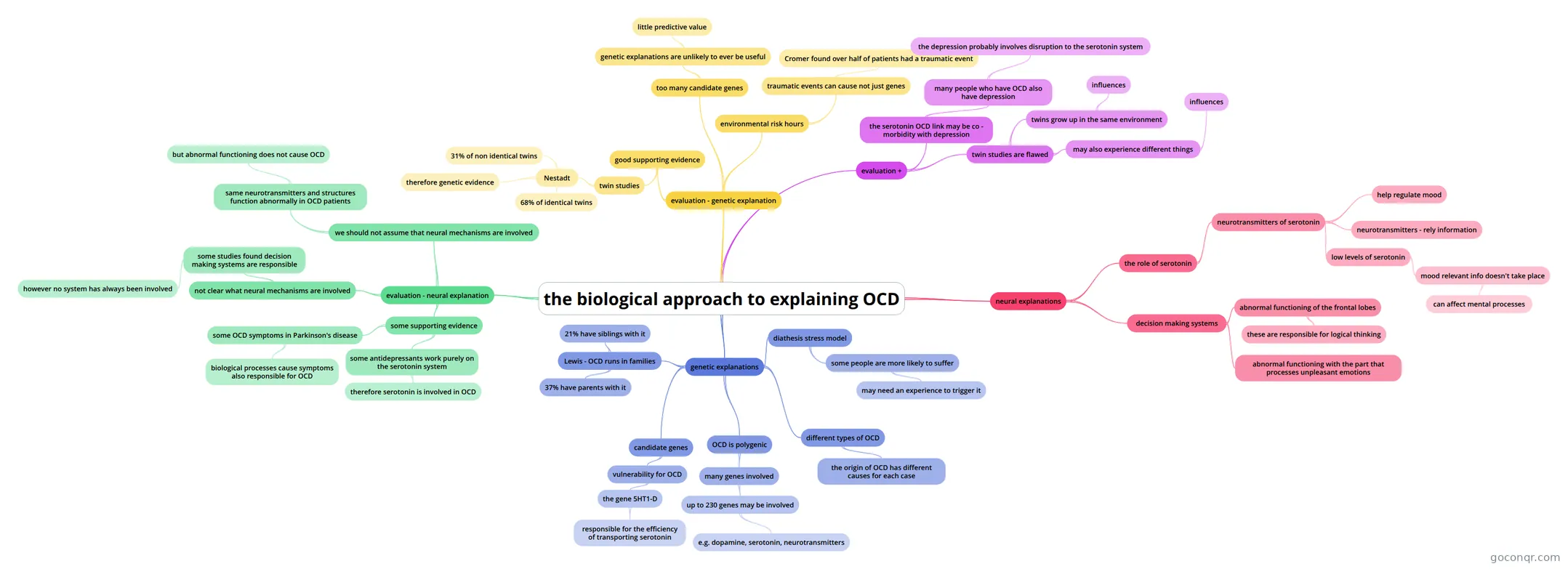
Mind map: biological approach to explaining OCD
Contenido del mapa
the biological approach to explaining OCD
genetic explanations
- Lewis - OCD runs in families
- 37% have parents with it
- 21% have siblings with it
- diathesis stress model
- some people are more likely to suffer
- may need an experience to trigger it
- some people are more likely to suffer
- candidate genes
- vulnerability for OCD
- the gene 5HT1-D
- responsible for the efficiency of transporting serotonin
- the gene 5HT1-D
- vulnerability for OCD
- OCD is polygenic
- many genes involved
- up to 230 genes may be involved
- e.g. dopamine, serotonin, neurotransmitters
- up to 230 genes may be involved
- many genes involved
- different types of OCD
- the origin of OCD has different causes for each case
- Lewis - OCD runs in families
evaluation - genetic explanation
- good supporting evidence
- twin studies
- Nestadt
- 68% of identical twins
- 31% of non identical twins
- therefore genetic evidence
- Nestadt
- twin studies
- too many candidate genes
- genetic explanations are unlikely to ever be useful
- little predictive value
- genetic explanations are unlikely to ever be useful
- environmental risk hours
- traumatic events can cause not just genes
- Cromer found over half of patients had a traumatic event
- traumatic events can cause not just genes
- good supporting evidence
neural explanations
- the role of serotonin
- neurotransmitters of serotonin
- help regulate mood
- neurotransmitters - rely information
- low levels of serotonin
- mood relevant info doesn't take place
- can affect mental processes
- mood relevant info doesn't take place
- neurotransmitters of serotonin
- decision making systems
- abnormal functioning of the frontal lobes
- these are responsible for logical thinking
- abnormal functioning with the part that processes unpleasant emotions
- abnormal functioning of the frontal lobes
- the role of serotonin
evaluation - neural explanation
- some supporting evidence
- some antidepressants work purely on the serotonin system
- therefore serotonin is involved in OCD
- some OCD symptoms in Parkinson's disease
- biological processes cause symptoms also responsible for OCD
- some antidepressants work purely on the serotonin system
- not clear what neural mechanisms are involved
- some studies found decision making systems are responsible
- however no system has always been involved
- some studies found decision making systems are responsible
- we should not assume that neural mechanisms are involved
- same neurotransmitters and structures function abnormally in OCD patients
- but abnormal functioning does not cause OCD
- same neurotransmitters and structures function abnormally in OCD patients
- some supporting evidence
evaluation +
- the serotonin OCD link may be co - morbidity with depression
- many people who have OCD also have depression
- the depression probably involves disruption to the serotonin system
- many people who have OCD also have depression
- twin studies are flawed
- twins grow up in the same environment
- influences
- may also experience different things
- influences
- twins grow up in the same environment
- the serotonin OCD link may be co - morbidity with depression
Información
- Descripción
- AS - Level (chapter 5 - psychopathology ) psychology Mapa Mental sobre the biological approach to explaining OCD, creado por Daisy U el 27/01/2016.
- Creado por
- Daisy U
- Visitas
- 87
- Valoración