
Mapa mental
Conservation methods
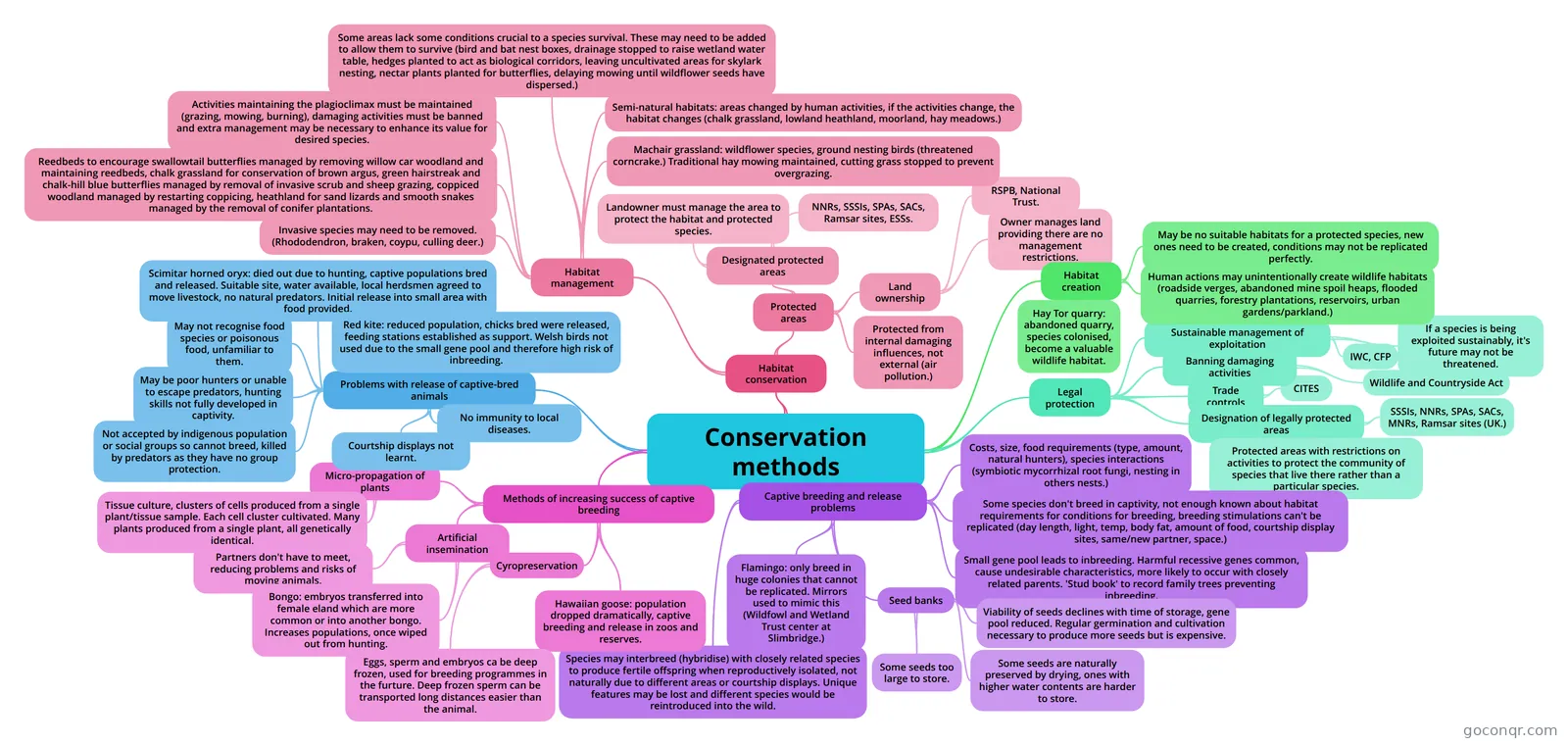
Mind map: Conservation methods
Contenido del mapa
Conservation methods
Legal protection
- Trade controls
- CITES
- Banning damaging activities
- Wildlife and Countryside Act
- Designation of legally protected areas
- Protected areas with restrictions on activities to protect the community of species that live there rather than a particular species.
- SSSIs, NNRs, SPAs, SACs, MNRs, Ramsar sites (UK.)
- Sustainable management of exploitation
- If a species is being exploited sustainably, it's future may not be threatened.
- IWC, CFP
- Trade controls
Captive breeding and release problems
- Costs, size, food requirements (type, amount, natural hunters), species interactions (symbiotic mycorrhizal root fungi, nesting in others nests.)
- Some species don't breed in captivity, not enough known about habitat requirements for conditions for breeding, breeding stimulations can't be replicated (day length, light, temp, body fat, amount of food, courtship display sites, same/new partner, space.)
- Flamingo: only breed in huge colonies that cannot be replicated. Mirrors used to mimic this (Wildfowl and Wetland Trust center at Slimbridge.)
- Small gene pool leads to inbreeding. Harmful recessive genes common, cause undesirable characteristics, more likely to occur with closely related parents. 'Stud book' to record family trees preventing inbreeding.
- Species may interbreed (hybridise) with closely related species to produce fertile offspring when reproductively isolated, not naturally due to different areas or courtship displays. Unique features may be lost and different species would be reintroduced into the wild.
- Seed banks
- Viability of seeds declines with time of storage, gene pool reduced. Regular germination and cultivation necessary to produce more seeds but is expensive.
- Some seeds too large to store.
- Some seeds are naturally preserved by drying, ones with higher water contents are harder to store.
Methods of increasing success of captive breeding
- Hawaiian goose: population dropped dramatically, captive breeding and release in zoos and reserves.
- Cyropreservation
- Eggs, sperm and embryos ca be deep frozen, used for breeding programmes in the furture. Deep frozen sperm can be transported long distances easier than the animal.
- Artificial insemination
- Partners don't have to meet, reducing problems and risks of moving animals.
- Bongo: embryos transferred into female eland which are more common or into another bongo. Increases populations, once wiped out from hunting.
- Micro-propagation of plants
- Tissue culture, clusters of cells produced from a single plant/tissue sample. Each cell cluster cultivated. Many plants produced from a single plant, all genetically identical.
Problems with release of captive-bred animals
- May not recognise food species or poisonous food, unfamiliar to them.
- May be poor hunters or unable to escape predators, hunting skills not fully developed in captivity.
- No immunity to local diseases.
- Not accepted by indigenous population or social groups so cannot breed, killed by predators as they have no group protection.
- Courtship displays not learnt.
- Scimitar horned oryx: died out due to hunting, captive populations bred and released. Suitable site, water available, local herdsmen agreed to move livestock, no natural predators. Initial release into small area with food provided.
- Red kite: reduced population, chicks bred were released, feeding stations established as support. Welsh birds not used due to the small gene pool and therefore high risk of inbreeding.
Habitat conservation
- Protected areas
- Protected from internal damaging influences, not external (air pollution.)
- Land ownership
- RSPB, National Trust.
- Owner manages land providing there are no management restrictions.
- Designated protected areas
- NNRs, SSSIs, SPAs, SACs, Ramsar sites, ESSs.
- Landowner must manage the area to protect the habitat and protected species.
- Habitat management
- Activities maintaining the plagioclimax must be maintained (grazing, mowing, burning), damaging activities must be banned and extra management may be necessary to enhance its value for desired species.
- Semi-natural habitats: areas changed by human activities, if the activities change, the habitat changes (chalk grassland, lowland heathland, moorland, hay meadows.)
- Machair grassland: wildflower species, ground nesting birds (threatened corncrake.) Traditional hay mowing maintained, cutting grass stopped to prevent overgrazing.
- Reedbeds to encourage swallowtail butterflies managed by removing willow car woodland and maintaining reedbeds, chalk grassland for conservation of brown argus, green hairstreak and chalk-hill blue butterflies managed by removal of invasive scrub and sheep grazing, coppiced woodland managed by restarting coppicing, heathland for sand lizards and smooth snakes managed by the removal of conifer plantations.
- Invasive species may need to be removed. (Rhododendron, braken, coypu, culling deer.)
- Some areas lack some conditions crucial to a species survival. These may need to be added to allow them to survive (bird and bat nest boxes, drainage stopped to raise wetland water table, hedges planted to act as biological corridors, leaving uncultivated areas for skylark nesting, nectar plants planted for butterflies, delaying mowing until wildflower seeds have dispersed.)
- Protected areas
Habitat creation
- Human actions may unintentionally create wildlife habitats (roadside verges, abandoned mine spoil heaps, flooded quarries, forestry plantations, reservoirs, urban gardens/parkland.)
- May be no suitable habitats for a protected species, new ones need to be created, conditions may not be replicated perfectly.
- Hay Tor quarry: abandoned quarry, species colonised, become a valuable wildlife habitat.
Información
- Descripción
- A-Level (Unit 1) Environmental Mapa Mental sobre Conservation methods, creado por amyct01 el 23/12/2013.
- Creado por
- amyct01
- Visitas
- 27
- Etiquetas
- Valoración
Más sobre Biodiversity conservation methods