
Mapa mental
Nuclear receptors
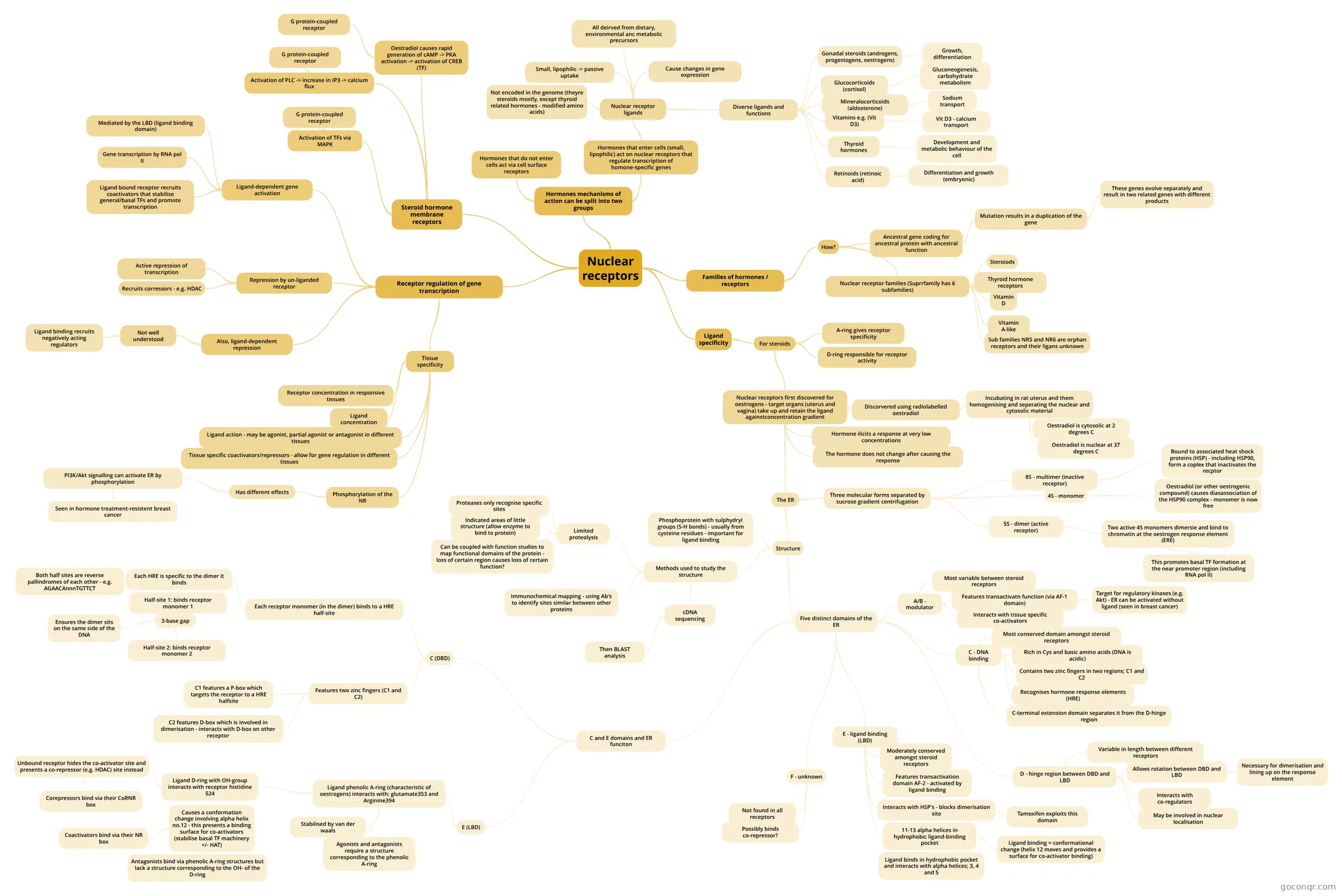
Mind map: nuclear receptors
Contenido del mapa
Nuclear receptors
Hormones mechanisms of action can be split into two groups
- Hormones that do not enter cells act via cell surface receptors
- Hormones that enter cells (small, lipophilic) act on nuclear receptors that regulate transcription of homone-specific genes
- Nuclear receptor ligands
- Not encoded in the genome (theyre steroids mostly, except thyroid related hormones - modified amino acids)
- Small, lipophilic -> passive uptake
- All deirved from dietary, environmental anc metabolic precursors
- Cause changes in gene expression
- Diverse ligands and functions
- Gonadal steroids (androgens, progestogens, oestrogens)
- Growth, differentiation
- Glucocorticoids (cortisol)
- Gluconeogenesis, carbohydrate metabolism
- Mineralocorticoids (aldosterone)
- Sodium transport
- Vitamins e.g. (Vit D3)
- Vit D3 - calcium transport
- Thyroid hormones
- Development and metabolic behaviour of the cell
- Retinoids (retinoic acid)
- Differentiation and growth (embryonic)
- Gonadal steroids (androgens, progestogens, oestrogens)
- Nuclear receptor ligands
Families of hormones / receptors
- How?
- Ancestral gene coding for ancestral protein with ancestral function
- Mutation results in a duplication of the gene
- These genes evolve separately and result in two related genes with different products
- Mutation results in a duplication of the gene
- Nuclear receptor families (Suprrfamily has 6 subfamilies)
- Steroiods
- Thyroid hormone receptors
- Vitamin D
- Vitamin A-like
- Sub families NR5 and NR6 are orphan receptors and their ligans unknown
- Ancestral gene coding for ancestral protein with ancestral function
- How?
Ligand specificity
- For steroids
- A-ring gives receptor specificity
- D-ring responsible for receptor activity
- Nuclear receptors first discovered for oestrogens - target organs (uterus and vagina) take up and retain the ligand againstconcentration gradient
- Discorvered using radiolabelled oestradiol
- Incubating in rat uterus and them homogenising and seperating the nuclear and cytosolic material
- Oestradiol is cytosolic at 2 degrees C
- Oestradiol is nuclear at 37 degrees C
- Incubating in rat uterus and them homogenising and seperating the nuclear and cytosolic material
- Hormone ilicits a response at very low concentrations
- The hormone does not change after causing the response
- The ER
- Three molecular forms separated by sucrose gradient centrifugation
- 8S - multimer (inactive receptor)
- Bound to associated heat shock proteins (HSP) - including HSP90, form a coplex that inactivates the recptor
- 4S - monomer
- Oestradiol (or other oestrogenic compound) causes diasassociation of the HSP90 complex - monomer is now free
- 5S - dimer (active receptor)
- Two active 4S monomers dimersie and bind to chromatin at the oestrogen response element (ERE)
- This promotes basal TF formation at the near promoter region (including RNA pol II)
- Two active 4S monomers dimersie and bind to chromatin at the oestrogen response element (ERE)
- 8S - multimer (inactive receptor)
- Structure
- Phosphoprotein with sulphydryl groups (S-H bonds) - usually from cysteine residues - important for ligand binding
- Methods used to study the structure
- Limited proteolysis
- Proteases only recognise specific sites
- Indicated areas of little structure (allow enzyme to bind to protein)
- Can be coupled with function studies to map functional domains of the protein - loss of certain region causes loss of certain function?
- Immunochemical mapping - using Ab's to identify sites similar between other proteins
- cDNA sequencing
- Then BLAST analysis
- Limited proteolysis
- Five distinct domains of the ER
- A/B - modulator
- Most variable between steroid receptors
- Features transactivatn function (via AF-1 domain)
- Target for regulatory kinases (e.g. Akt) - ER can be activated without ligand (seen in breast cancer)
- Interacts with tissue specific co-activators
- C - DNA binding
- Most conserved domain amongst steroid receptors
- Rich in Cys and basic amino acids (DNA is acidic)
- Contains two zinc fingers in two regions; C1 and C2
- Recognises hormone response elements (HRE)
- C-terminal extension domain separates it from the D-hinge region
- D - hinge region between DBD and LBD
- Variable in length between different receptors
- Allows rotation between DBD and LBD
- Necessary for dimerisation and lining up on the response element
- Interacts with co-regulators
- May be involved in nuclear localisation
- E - ligand binding (LBD)
- Moderately conserved amongst steroid receptors
- Features transactivation domain AF-2 - activated by ligand binding
- 11-13 alpha helices in hydrophobic ligand-binding pocket
- Ligand binding = conformational change (helix 12 moves and provides a surface for co-activator binding)
- Ligand binds in hydrophobic pocket and interacts with alpha helices; 3, 4 and 5
- Interacts with HSP's - blocks dimerisation site
- Tamoxifen exploits this domain
- F - unknown
- Not found in all receptors
- Possibly binds co-repressor?
- C and E domains and ER funciton
- C (DBD)
- Features two zinc fingers (C1 and C2)
- C1 features a P-box which targets the receptor to a HRE halfsite
- C2 features D-box which is involved in dimerisation - interacts with D-box on other receptor
- Each receptor monomer (in the dimer) binds to a HRE half-site
- Each HRE is specific to the dimer it binds
- Half-site 1: binds receptor monomer 1
- 3-base gap
- Half-site 2: binds receptor monomer 2
- Ensures the dimer sits on the same side of the DNA
- 3-base gap
- Both half sites are reverse pallindromes of each other - e.g. AGAACAnnnTGTTCT
- Half-site 1: binds receptor monomer 1
- Each HRE is specific to the dimer it binds
- Features two zinc fingers (C1 and C2)
- E (LBD)
- Ligand phenolic A-ring (characteristic of oestrogens) interacts with; glutamate353 and Arginine394
- Ligand D-ring with OH-group interacts with receptor histidine 524
- Causes a conformation change involving alpha helix no.12 - this presents a binding surface for co-activators (stabilise basal TF machinery +/- HAT)
- Antagonists bind via phenolic A-ring structures but lack a structure corresponding to the OH- of the D-ring
- Coactivators bind via their NR box
- Unbound receptor hides the co-activator site and presents a co-repressor (e.g. HDAC) site instead
- Corepressors bind via their CoRNR box
- Causes a conformation change involving alpha helix no.12 - this presents a binding surface for co-activators (stabilise basal TF machinery +/- HAT)
- Stabilised by van der waals
- Agonists and antagonists require a structure corresponding to the phenolic A-ring
- Ligand D-ring with OH-group interacts with receptor histidine 524
- Ligand phenolic A-ring (characteristic of oestrogens) interacts with; glutamate353 and Arginine394
- C (DBD)
- A/B - modulator
- Three molecular forms separated by sucrose gradient centrifugation
- Discorvered using radiolabelled oestradiol
- For steroids
Receptor regulation of gene transcription
- Ligand-dependent gene activation
- Mediated by the LBD (ligand binding domain)
- Gene transcription by RNA pol II
- Ligand bound receptor recruits coactivators that stabilise general/basal TFs and promote transcription
- Repression by un-liganded receptor
- Active repression of transcription
- Recruits corressors - e.g. HDAC
- Also, ligand-dependent repression
- Not well understood
- Ligand binding recruits negatively acting regulators
- Not well understood
- Tissue specificity
- Receptor concentration in responsive tissues
- Ligand concentration
- Ligand action - may be agonist, partial agonist or antagonist in different tissues
- Tissue specific coactivators/repressors - allow for gene regulation in different tissues
- Phosphorylation of the NR
- Has different effects
- PI3K/Akt signalling can activate ER by phosphorylation
- Seen in hormone treatment-resistent breast cancer
- PI3K/Akt signalling can activate ER by phosphorylation
- Has different effects
- Ligand-dependent gene activation
Steroid hormone membrane receptors
- Oestradiol causes rapid generation of cAMP -> PKA activation -> activation of CREB (TF)
- G protein-coupled receptor
- Activation of PLC -> increase in IP3 -> calcium flux
- G protein-coupled receptor
- Activation of TFs via MAPK
- G protein-coupled receptor
- Oestradiol causes rapid generation of cAMP -> PKA activation -> activation of CREB (TF)
Información
- Descripción
- Endocrinology Mapa Mental sobre Nuclear receptors, creado por maisie_oj el 15/04/2013.
- Creado por
- maisie_oj
- Visitas
- 961
- Etiquetas
- Valoración
Más sobre Cell Surface and Nuclear Receptors