
Mapa mental
Enterobacteriaceae and Gut Diseases
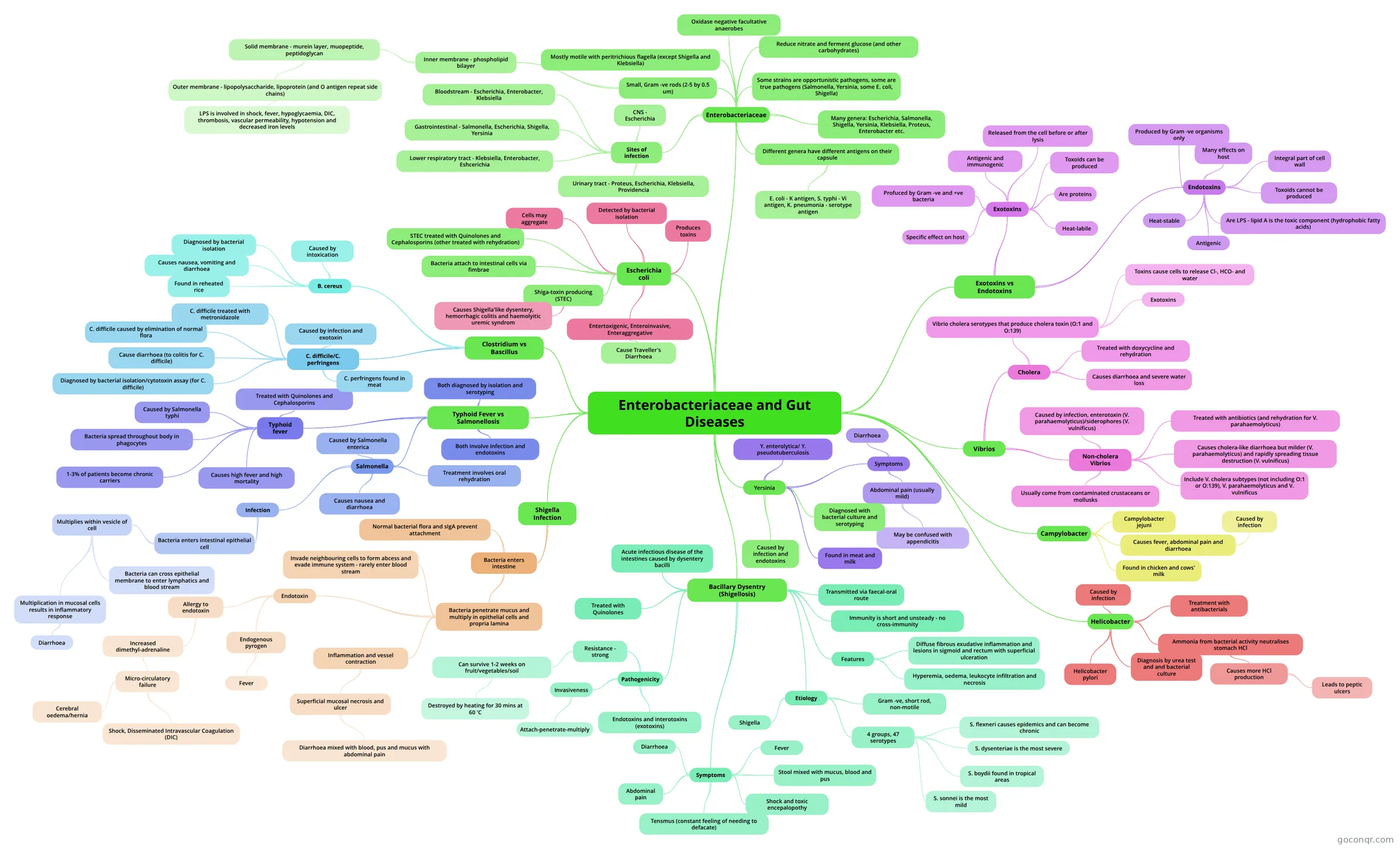
Mind map: Enterobacteriaceae and gut diseases
Contenido del mapa
Enterobacteriaceae and Gut Diseases
Enterobacteriaceae
- Small, Gram -ve rods (2-5 by 0.5 um)
- Inner membrane - phospholipid bilayer
- Solid membrane - murein layer, muopeptide, peptidoglycan
- Outer membrane - lipopolysaccharide, lipoprotein (and O antigen repeat side chains)
- LPS is involved in shock, fever, hypoglycaemia, DIC, thrombosis, vascular permeability, hypotension and decreased iron levels
- Outer membrane - lipopolysaccharide, lipoprotein (and O antigen repeat side chains)
- Solid membrane - murein layer, muopeptide, peptidoglycan
- Inner membrane - phospholipid bilayer
- Mostly motile with peritrichious flagella (except Shigella and Klebsiella)
- Oxidase negative facultative anaerobes
- Reduce nitrate and ferment glucose (and other carbohydrates)
- Some strains are opportunistic pathogens, some are true pathogens (Salmonella, Yersinia, some E. coli, Shigella)
- Many genera: Escherichia, Salmonella, Shigella, Yersinia, Klebsiella, Proteus, Enterobacter etc.
- Sites of infection
- CNS - Escherichia
- Bloodstream - Escherichia, Enterobacter, Klebsiella
- Lower respiratory tract - Klebsiella, Enterobacter, Eshcerichia
- Gastrointestinal - Salmonella, Escherichia, Shigella, Yersinia
- Urinary tract - Proteus, Escherichia, Klebsiella, Providencia
- Different genera have different antigens on their capsule
- E. coli - K antigen, S. typhi - Vi antigen, K. pneumonia - serotype antigen
- Small, Gram -ve rods (2-5 by 0.5 um)
Exotoxins vs Endotoxins
- Exotoxins
- Released from the cell before or after lysis
- Are proteins
- Heat-labile
- Antigenic and immunogenic
- Toxoids can be produced
- Specific effect on host
- Profuced by Gram -ve and +ve bacteria
- Endotoxins
- Integral part of cell wall
- Are LPS - lipid A is the toxic component (hydrophobic fatty acids)
- Heat-stable
- Antigenic
- Toxoids cannot be produced
- Many effects on host
- Produced by Gram -ve organisms only
- Exotoxins
Bacillary Dysentry (Shigellosis)
- Acute infectious disease of the intestines caused by dysentery bacilli
- Symptoms
- Fever
- Abdominal pain
- Diarrhoea
- Tensmus (constant feeling of needing to defacate)
- Stool mixed with mucus, blood and pus
- Shock and toxic encepalopothy
- Etiology
- Gram -ve, short rod, non-motile
- Shigella
- 4 groups, 47 serotypes
- S. dysenteriae is the most severe
- S. flexneri causes epidemics and can become chronic
- S. boydii found in tropical areas
- S. sonnei is the most mild
- Pathogenicity
- Endotoxins and interotoxins (exotoxins)
- Invasiveness
- Attach-penetrate-multiply
- Resistance - strong
- Can survive 1-2 weeks on fruit/vegetables/soil
- Destroyed by heating for 30 mins at 60 'C
- Can survive 1-2 weeks on fruit/vegetables/soil
- Transmitted via faecal-oral route
- Immunity is short and unsteady - no cross-immunity
- Treated with Quinolones
- Features
- Diffuse fibrous exudative inflammation and lesions in sigmoid and rectum with superficial ulceration
- Hyperemia, oedema, leukocyte infiltration and necrosis
Shigella Infection
- Bacteria enters intestine
- Normal bacterial flora and sIgA prevent attachment
- Bacteria penetrate mucus and multiply in epithelial cells and propria lamina
- Inflammation and vessel contraction
- Superficial mucosal necrosis and ulcer
- Diarrhoea mixed with blood, pus and mucus with abdominal pain
- Superficial mucosal necrosis and ulcer
- Endotoxin
- Endogenous pyrogen
- Fever
- Allergy to endotoxin
- Increased dimethyl-adrenaline
- Micro-circulatory failure
- Shock, Disseminated Intravascular Coagulation (DIC)
- Cerebral oedema/hernia
- Micro-circulatory failure
- Increased dimethyl-adrenaline
- Endogenous pyrogen
- Invade neighbouring cells to form abcess and evade immune system - rarely enter blood stream
- Inflammation and vessel contraction
- Bacteria enters intestine
Typhoid Fever vs Salmonellosis
- Salmonella
- Caused by Salmonella enterica
- Treatment involves oral rehydration
- Causes nausea and diarrhoea
- Infection
- Bacteria enters intestinal epithelial cell
- Multiplies within vesicle of cell
- Multiplication in mucosal cells results in inflammatory response
- Diarrhoea
- Bacteria can cross epithelial membrane to enter lymphatics and blood stream
- Multiplication in mucosal cells results in inflammatory response
- Multiplies within vesicle of cell
- Bacteria enters intestinal epithelial cell
- Typhoid fever
- Caused by Salmonella typhi
- Bacteria spread throughout body in phagocytes
- 1-3% of patients become chronic carriers
- Treated with Quinolones and Cephalosporins
- Causes high fever and high mortality
- Both involve infection and endotoxins
- Both diagnosed by isolation and serotyping
- Salmonella
Vibrios
- Cholera
- Vibrio cholera serotypes that produce cholera toxin (O:1 and O:139)
- Toxins cause cells to release Cl-, HCO- and water
- Exotoxins
- Causes diarrhoea and severe water loss
- Treated with doxycycline and rehydration
- Vibrio cholera serotypes that produce cholera toxin (O:1 and O:139)
- Non-cholera Vibrios
- Usually come from contaminated crustaceans or mollusks
- Include V. cholera subtypes (not including O:1 or O:139), V. parahaemolyticus and V. vulnificus
- Causes cholera-like diarrhoea but milder (V. parahaemolyticus) and rapidly spreading tissue destruction (V. vulnificus)
- Caused by infection, enterotoxin (V. parahaemolyticus)/siderophores (V. vulnificus)
- Treated with antibiotics (and rehydration for V. parahaemolyticus)
- Cholera
Campylobacter
- Campylobacter jejuni
- Causes fever, abdominal pain and diarrhoea
- Caused by infection
- Found in chicken and cows' milk
Helicobacter
- Helicobacter pylori
- Ammonia from bacterial activity neutralises stomach HCl
- Causes more HCl production
- Leads to peptic ulcers
- Causes more HCl production
- Diagnosis by urea test and and bacterial culture
- Caused by infection
- Treatment with antibacterials
Yersinia
- Y. enterolytica/ Y. pseudotuberculosis
- Symptoms
- Diarrhoea
- Abdominal pain (usually mild)
- May be confused with appendicitis
- Caused by infection and endotoxins
- Found in meat and milk
- Diagnosed with bacterial culture and serotyping
Clostridium vs Bascillus
- B. cereus
- Causes nausea, vomiting and diarrhoea
- Caused by intoxication
- Diagnosed by bacterial isolation
- Found in reheated rice
- C. difficile/C. perfringens
- Caused by infection and exotoxin
- Cause diarrhoea (to colitis for C. difficile)
- Diagnosed by bacterial isolation/cytotoxin assay (for C. difficile)
- C. perfringens found in meat
- C. difficile caused by elimination of normal flora
- C. difficile treated with metronidazole
- B. cereus
Escherichia coli
- Bacteria attach to intestinal cells via fimbrae
- Produces toxins
- Cells may aggregate
- Entertoxigenic, Enteroinvasive, Enteraggregative
- Cause Traveller's Diarrhoea
- Shiga-toxin producing (STEC)
- Causes Shigella'like dysentery, hemorrhagic colitis and haemolyitic uremic syndrom
- Detected by bacterial isolation
- STEC treated with Quinolones and Cephalosporins (other treated with rehydration)
Información
- Descripción
- Microbiology Mapa Mental sobre Enterobacteriaceae and Gut Diseases, creado por maisie_oj el 15/04/2013.
- Creado por
- maisie_oj
- Visitas
- 111
- Etiquetas
- Valoración