
Mapa mental
Memory
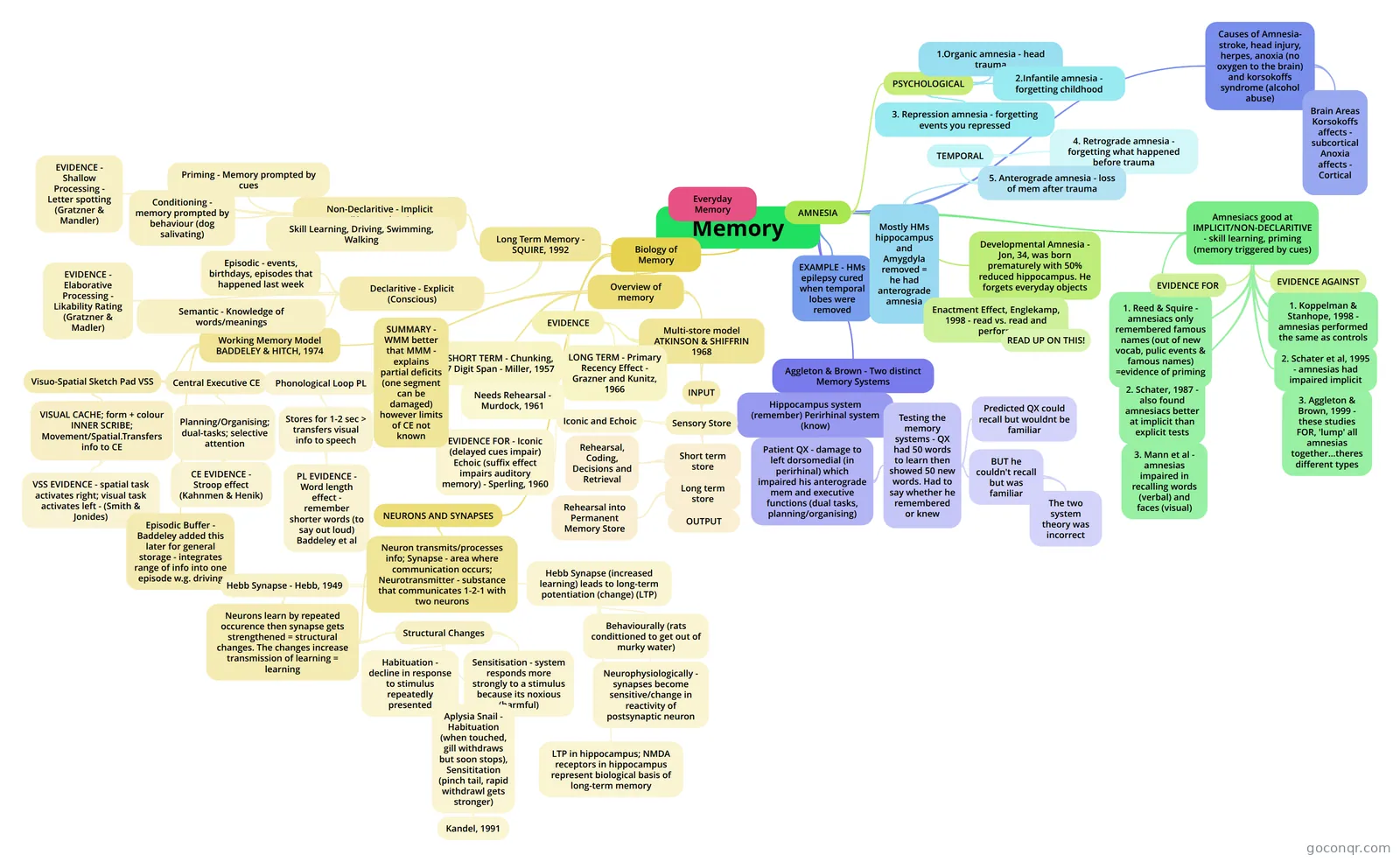
Mind map: Memory
Contenido del mapa
Memory
AMNESIA
- PSYCHOLOGICAL
- 1.Organic amnesia - head trauma
- 2.Infantile amnesia - forgetting childhood
- 3. Repression amnesia - forgetting events you repressed
- Causes of Amnesia- stroke, head injury, herpes, anoxia (no oxygen to the brain) and korsokoffs syndrome (alcohol abuse)
- Brain Areas Korsokoffs affects - subcortical Anoxia affects - Cortical
- EXAMPLE - HMs epilepsy cured when temporal lobes were removed
- Mostly HMs hippocampus and Amygdyla removed = he had anterograde amnesia
- 5. Anterograde amnesia - loss of mem after trauma
- TEMPORAL
- 4. Retrograde amnesia - forgetting what happened before trauma
- TEMPORAL
- 5. Anterograde amnesia - loss of mem after trauma
- Mostly HMs hippocampus and Amygdyla removed = he had anterograde amnesia
- Amnesiacs good at IMPLICIT/NON-DECLARITIVE - skill learning, priming (memory triggered by cues)
- 3. Mann et al - amnesias impaired in recalling words (verbal) and faces (visual)
- 1. Reed & Squire - amnesiacs only remembered famous names (out of new vocab, pulic events & famous names) =evidence of priming
- 2. Schater, 1987 - also found amnesiacs better at implicit than explicit tests
- EVIDENCE FOR
- 1. Koppelman & Stanhope, 1998 - amnesias performed the same as controls
- 2. Schater et al, 1995 - amnesias had impaired implicit
- 3. Aggleton & Brown, 1999 - these studies FOR, 'lump' all amnesias together...theres different types
- EVIDENCE AGAINST
- Developmental Amnesia - Jon, 34, was born prematurely with 50% reduced hippocampus. He forgets everyday objects
- Enactment Effect, Englekamp, 1998 - read vs. read and perform
- READ UP ON THIS!
- Enactment Effect, Englekamp, 1998 - read vs. read and perform
- Aggleton & Brown - Two distinct Memory Systems
- Hippocampus system (remember) Perirhinal system (know)
- Patient QX - damage to left dorsomedial (in perirhinal) which impaired his anterograde mem and executive functions (dual tasks, planning/organising)
- Testing the memory systems - QX had 50 words to learn then showed 50 new words. Had to say whether he remembered or knew
- Predicted QX could recall but wouldnt be familiar
- BUT he couldn't recall but was familiar
- The two system theory was incorrect
- Testing the memory systems - QX had 50 words to learn then showed 50 new words. Had to say whether he remembered or knew
- Patient QX - damage to left dorsomedial (in perirhinal) which impaired his anterograde mem and executive functions (dual tasks, planning/organising)
- Hippocampus system (remember) Perirhinal system (know)
- PSYCHOLOGICAL
Everyday Memory
Biology of Memory
- Overview of memory
- Multi-store model ATKINSON & SHIFFRIN 1968
- INPUT
- Sensory Store
- Short term store
- Long term store
- OUTPUT
- Rehearsal into Permanent Memory Store
- Rehearsal, Coding, Decisions and Retrieval
- Long term store
- Iconic and Echoic
- EVIDENCE FOR - Iconic (delayed cues impair) Echoic (suffix effect impairs auditory memory) - Sperling, 1960
- Short term store
- Sensory Store
- EVIDENCE
- SHORT TERM - Chunking, 7 Digit Span - Miller, 1957
- Needs Rehearsal - Murdock, 1961
- LONG TERM - Primary Recency Effect - Grazner and Kunitz, 1966
- SHORT TERM - Chunking, 7 Digit Span - Miller, 1957
- INPUT
- Working Memory Model BADDELEY & HITCH, 1974
- Visuo-Spatial Sketch Pad VSS
- Central Executive CE
- Phonological Loop PL
- Stores for 1-2 sec > transfers visual info to speech
- PL EVIDENCE - Word length effect - remember shorter words (to say out loud) Baddeley et al
- Stores for 1-2 sec > transfers visual info to speech
- Planning/Organising; dual-tasks; selective attention
- CE EVIDENCE - Stroop effect (Kahnmen & Henik)
- Phonological Loop PL
- VISUAL CACHE; form + colour INNER SCRIBE; Movement/Spatial.Transfers info to CE
- VSS EVIDENCE - spatial task activates right; visual task activates left - (Smith & Jonides)
- Central Executive CE
- Episodic Buffer - Baddeley added this later for general storage - integrates range of info into one episode w.g. driving
- Visuo-Spatial Sketch Pad VSS
- Long Term Memory - SQUIRE, 1992
- Declaritive - Explicit (Conscious)
- Episodic - events, birthdays, episodes that happened last week
- Semantic - Knowledge of words/meanings
- EVIDENCE - Elaborative Processing - Likability Rating (Gratzner & Madler)
- Non-Declaritive - Implicit (Unconscious)
- Skill Learning, Driving, Swimming, Walking
- Priming - Memory prompted by cues
- Conditioning - memory prompted by behaviour (dog salivating)
- EVIDENCE - Shallow Processing - Letter spotting (Gratzner & Mandler)
- Declaritive - Explicit (Conscious)
- SUMMARY - WMM better that MMM - explains partial deficits (one segment can be damaged) however limits of CE not known
- Multi-store model ATKINSON & SHIFFRIN 1968
- NEURONS AND SYNAPSES
- Neuron transmits/processes info; Synapse - area where communication occurs; Neurotransmitter - substance that communicates 1-2-1 with two neurons
- Neurons learn by repeated occurence then synapse gets strengthened = structural changes. The changes increase transmission of learning = learning
- Hebb Synapse - Hebb, 1949
- Hebb Synapse (increased learning) leads to long-term potentiation (change) (LTP)
- Behaviourally (rats condittioned to get out of murky water)
- Neurophysiologically - synapses become sensitive/change in reactivity of postsynaptic neuron
- LTP in hippocampus; NMDA receptors in hippocampus represent biological basis of long-term memory
- Hebb Synapse (increased learning) leads to long-term potentiation (change) (LTP)
- Structural Changes
- Habituation - decline in response to stimulus repeatedly presented
- Sensitisation - system responds more strongly to a stimulus because its noxious (harmful)
- Aplysia Snail - Habituation (when touched, gill withdraws but soon stops), Sensititation (pinch tail, rapid withdrawl gets stronger)
- Kandel, 1991
- Hebb Synapse - Hebb, 1949
- Neurons learn by repeated occurence then synapse gets strengthened = structural changes. The changes increase transmission of learning = learning
- Neuron transmits/processes info; Synapse - area where communication occurs; Neurotransmitter - substance that communicates 1-2-1 with two neurons
- Overview of memory
Información
- Descripción
- Masters Mind Body Brain Mapa Mental sobre Memory, creado por Amberlee Green el 18/04/2013.
- Creado por
- Amberlee Green
- Visitas
- 76
- Etiquetas
- Valoración