
Mapa mental
Food Aid
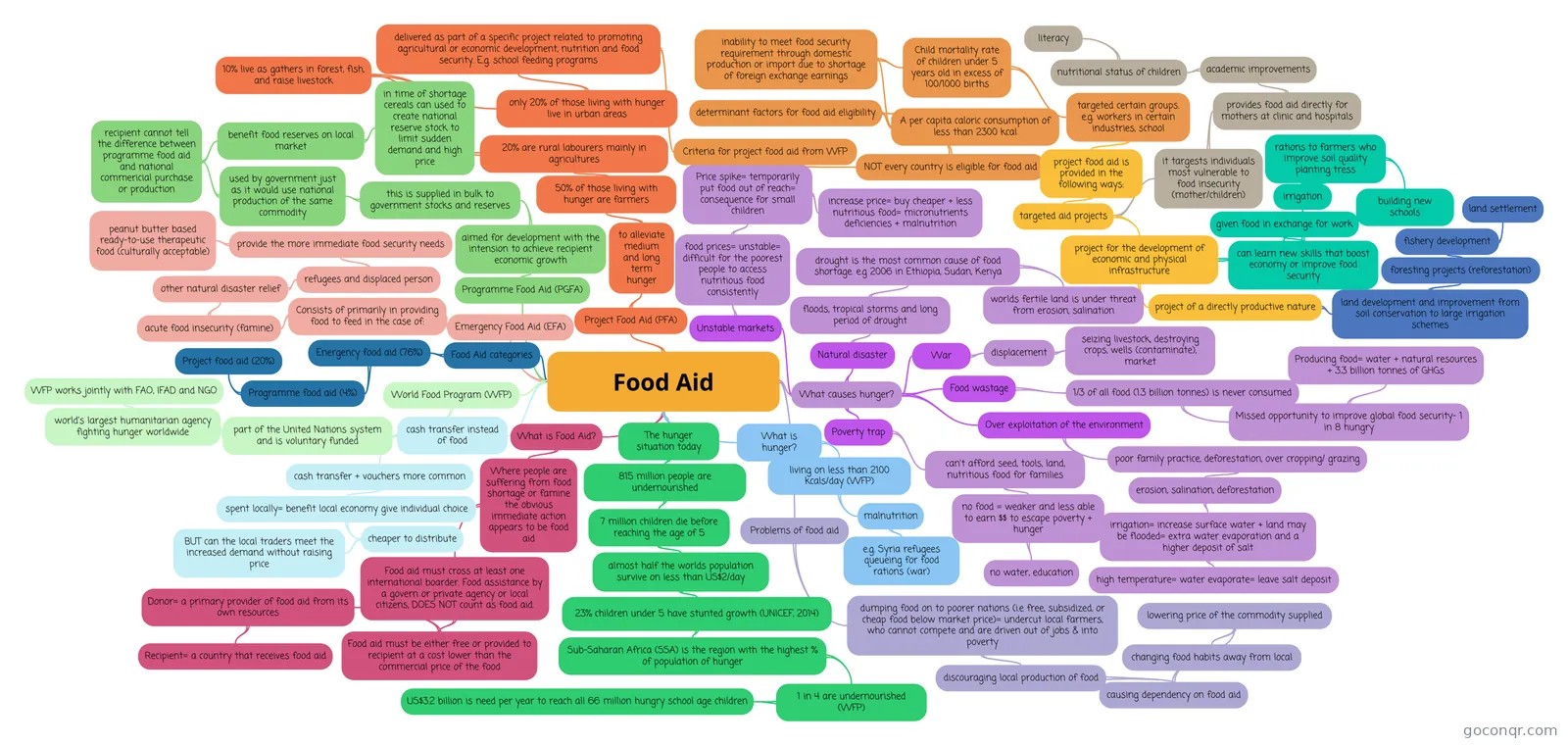
Mind map: Food aid
Contenido del mapa
Food Aid
What is hunger?
- living on less than 2100 kcals/day (WFP)
- malnutrition
- e.g. Syria refugees queueing for food rations (war)
- malnutrition
- living on less than 2100 kcals/day (WFP)
The hunger situation today
- 815 million people are undernourished
- 7 million children die before reaching the age of 5
- almost half the worlds population survive on less than US$2/day
- 23% children under 5 have stunted growth (UNICEF, 2014)
- Sub-Saharan Africa (SSA) is the region with the highest % of population of hunger
- 1 in 4 are undernourished (WFP)
- US$3.2 billion is need per year to reach all 66 million hungry school age children
- 1 in 4 are undernourished (WFP)
- Sub-Saharan Africa (SSA) is the region with the highest % of population of hunger
- 23% children under 5 have stunted growth (UNICEF, 2014)
- almost half the worlds population survive on less than US$2/day
- 7 million children die before reaching the age of 5
- 815 million people are undernourished
What causes hunger?
- Poverty trap
- can't afford seed, tools, land, nutritious food for families
- no food = weaker and less able to earn $$ to escape poverty + hunger
- no water, education
- no food = weaker and less able to earn $$ to escape poverty + hunger
- can't afford seed, tools, land, nutritious food for families
- Over exploitation of the environment
- poor family practice, deforestation, over cropping/ grazing
- erosion, salination, deforestation
- irrigation= increase surface water + land may be flooded= extra water evaporation and a higher deposit of salt
- high temperature= water evaporate= leave salt deposit
- irrigation= increase surface water + land may be flooded= extra water evaporation and a higher deposit of salt
- erosion, salination, deforestation
- poor family practice, deforestation, over cropping/ grazing
- War
- displacement
- seizing livestock, destroying crops, wells (contaminate), market
- displacement
- Natural disaster
- floods, tropical storms and long period of drought
- drought is the most common cause of food shortage. e.g 2006 in Ethiopia, Sudan, Kenya
- worlds fertile land is under threat from erosion, salination
- drought is the most common cause of food shortage. e.g 2006 in Ethiopia, Sudan, Kenya
- floods, tropical storms and long period of drought
- Unstable markets
- food prices= unstable= difficult for the poorest people to access nutritious food consistently
- Price spike= temporarily put food out of reach= consequence for small children
- increase price= buy cheaper + less nutritious food= micronutrients deficiencies + malnutrition
- Price spike= temporarily put food out of reach= consequence for small children
- food prices= unstable= difficult for the poorest people to access nutritious food consistently
- Food wastage
- 1/3 of all food (1.3 billion tonnes) is never consumed
- Missed opportunity to improve global food security- 1 in 8 hungry
- Producing food= water + natural resources + 3.3 billion tonnes of GHGs
- Missed opportunity to improve global food security- 1 in 8 hungry
- 1/3 of all food (1.3 billion tonnes) is never consumed
- Poverty trap
What is Food Aid?
- Where people are suffering from food shortage or famine the obvious immediate action appears to be food aid
- Food aid must cross at least one international boarder. Food assistance by a govern or private agency or local citizens, DOES NOT count as food aid.
- Food aid must be either free or provided to recipient at a cost lower than the commercial price of the food
- Donor= a primary provider of food aid from its own resources
- Recipient= a country that receives food aid
- Donor= a primary provider of food aid from its own resources
- Food aid must be either free or provided to recipient at a cost lower than the commercial price of the food
- Food aid must cross at least one international boarder. Food assistance by a govern or private agency or local citizens, DOES NOT count as food aid.
- Where people are suffering from food shortage or famine the obvious immediate action appears to be food aid
World Food Program (WFP)
- part of the United Nations system and is voluntary funded
- world's largest humanitarian agency fighting hunger worldwide
- WFP works jointly with FAO, IFAD and NGO
- world's largest humanitarian agency fighting hunger worldwide
- part of the United Nations system and is voluntary funded
Food Aid categories
- Energency food aid (76%)
- Programme food aid (4%)
- Project food aid (20%)
- Programme food aid (4%)
- Energency food aid (76%)
Emergency Food Aid (EFA)
- Consists of primarily in providing food to feed in the case of:
- acute food insecurity (famine)
- other natural disaster relief
- refugees and displaced person
- provide the more immediate food security needs
- peanut butter based ready-to-use therapeutic food (culturally acceptable)
- provide the more immediate food security needs
- refugees and displaced person
- other natural disaster relief
- acute food insecurity (famine)
- Consists of primarily in providing food to feed in the case of:
Programme Food Aid (PGFA)
- aimed for development with the intension to achieve recipient economic growth
- this is supplied in bulk to government stocks and reserves
- used by government just as it would use national production of the same commodity
- recipient cannot tell the difference between programme food aid and national commericial purchase or production
- benefit food reserves on local market
- in time of shortage cereals can used to create national reserve stock to limit sudden demand and high price
- benefit food reserves on local market
- recipient cannot tell the difference between programme food aid and national commericial purchase or production
- used by government just as it would use national production of the same commodity
- this is supplied in bulk to government stocks and reserves
- aimed for development with the intension to achieve recipient economic growth
Project Food Aid (PFA)
- to alleviate medium and long term hunger
- 50% of those living with hunger are farmers
- 20% are rural labourers mainly in agricultures
- 10% live as gathers in forest, fish, and raise livestock
- only 20% of those living with hunger live in urban areas
- delivered as part of a specific project related to promoting agricultural or economic development, nutrition and food security. E.g. school feeding programs
- Criteria for project food aid from WFP
- NOT every country is eligible for food aid
- determinant factors for food aid eligibility
- A per capita caloric consumption of less than 2300 kcal
- inability to meet food security requirement through domestic production or import due to shortage of foreign exchange earnings
- Child mortality rate of children under 5 years old in excess of 100/1000 births
- targeted certain groups. e.g. workers in certain industries, school
- project food aid is provided in the following ways:
- targeted aid projects
- project for the development of economic and physical infrastructure
- project of a directly productive nature
- land development and improvement from soil conservation to large irrigation schemes
- foresting projects (reforestation)
- fishery development
- land settlement
- fishery development
- foresting projects (reforestation)
- land development and improvement from soil conservation to large irrigation schemes
- given food in exchange for work
- can learn new skills that boost economy or improve food security
- irrigation
- rations to farmers who improve soil quality planting tress
- building new schools
- rations to farmers who improve soil quality planting tress
- irrigation
- can learn new skills that boost economy or improve food security
- project of a directly productive nature
- it targests individuals most vulnerable to food insecurity (mother/children)
- provides food aid directly for mothers at clinic and hospitals
- academic improvements
- nutritional status of children
- literacy
- nutritional status of children
- academic improvements
- provides food aid directly for mothers at clinic and hospitals
- project for the development of economic and physical infrastructure
- targeted aid projects
- project food aid is provided in the following ways:
- targeted certain groups. e.g. workers in certain industries, school
- Child mortality rate of children under 5 years old in excess of 100/1000 births
- inability to meet food security requirement through domestic production or import due to shortage of foreign exchange earnings
- A per capita caloric consumption of less than 2300 kcal
- determinant factors for food aid eligibility
- NOT every country is eligible for food aid
- Criteria for project food aid from WFP
- delivered as part of a specific project related to promoting agricultural or economic development, nutrition and food security. E.g. school feeding programs
- only 20% of those living with hunger live in urban areas
- 10% live as gathers in forest, fish, and raise livestock
- 20% are rural labourers mainly in agricultures
- 50% of those living with hunger are farmers
- to alleviate medium and long term hunger
Problems of food aid
- dumping food on to poorer nations (i.e free, subsidized, or cheap food below market price)= undercut local farmers, who cannot compete and are driven out of jobs & into poverty
- discouraging local production of food
- causing dependency on food aid
- lowering price of the commodity supplied
- changing food habits away from local
- lowering price of the commodity supplied
- causing dependency on food aid
- discouraging local production of food
- dumping food on to poorer nations (i.e free, subsidized, or cheap food below market price)= undercut local farmers, who cannot compete and are driven out of jobs & into poverty
cash transfer instead of food
- cash transfer + vouchers more common
- spent locally= benefit local economy give individual choice
- cheaper to distribute
- BUT can the local traders meet the increased demand without raising price
- cheaper to distribute
- spent locally= benefit local economy give individual choice
- cash transfer + vouchers more common