
Mapa mental
Pack 12 - Inheritance

Contenido del mapa
Pack 12 - Inheritance
Genotype:
- Genetic makeup of an organism, all alleles an organism has.
- Phenotype:
- Observable or biochemical characteristics
What is a gene
- A sequence of nucleotide bases coding for a polypeptide or functional RNA
- An allele is a different version of the same gene
- Each gene of diploid cells should have 2 alleles, unless sex chromosones
The locus is the position of a gene on a chromosome
Types of chromosomes:
- Homozygous
- Alleles on each chromosome are the same
- Heterozygous
- 2 alleles on the chromosome are different
- Homozygous
Types of alleles:
- Dominant
- When present in genotype it's always expressed in phenotype
- Recessive
- Only expressed when homozygous recessive
- Dominant
Codominance
- This is when two alleles both contribute to the phenotype
Monohybrid Inheritance
- This is the inheritance of a single gene
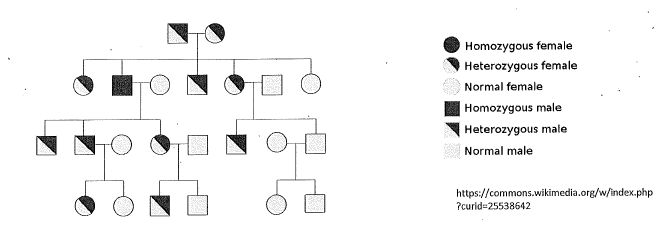
Pedigree Diagrams
- Diagrams show ancestral relationships and transmission of genetic traits
- Exam hint:
- If asked whether an allele is dominant or recessive, look for two parents that do not have the characteristic but have children that do have it
- Shows it is recessive
- If asked whether an allele is dominant or recessive, look for two parents that do not have the characteristic but have children that do have it
Dihybrid Inheritance
- Two different characters, determine by different genes located on two different chromosomes are inherited
Mendel's Laws
- Law of segregation:
- Characteristics of an organism are controlled by genes that occur in pairs, only one of each pair can be carried in a gamete
- Law of independent assortment
- Each member of a pair of alleles may combine randomly with either of another pair
- In terms of meiosis:
- Homologous chromosomes pair up in prophase 1
- In metaphase 1:
- Homologous chromosomes line up on equator in pairs
- Random segregation of c'somes either side of equator leads to different combinations and so different alleles in gametes
- Homologous chromosomes separated in Anaphase 1
- Law of segregation:
Autosomal linkage
- An autosome is a chromosome that is not a sex chromosome
- Any two genes occuring on the same chromosome are said to be linked
- Autosomal linkage is when two or more genes are carried on the same autosome
Sickle cell anaemia
- Due to single base substitution.
- Results in one amino acid being altered in the 146 long Beta polypeptide chain
- Due to single base substitution.
Multiple alleles
- Some genes have more than two alleles
- Only two of these alleles can be present in an individual at one time
- e.g. human blood groups
- Some genes have more than two alleles
Epistasis
- This is where an allele of one gene affects or masks the expression of another in the phenotype
- Example: Coat colour in mice
- Gene A controls melanin distribution in hair
- Dominant = black bands
- Recessive when homozygous = uniformly black
- Gene B determines the expression of gene A:
- Dominant allele = production of melanin
- Recessive = when homozygous no melanin produced.
- Gene A controls melanin distribution in hair
Sex inheritance in humans
- Humans have 22 pairs of autosomes and a pair of sex chromosomes
- Females have two X's
- Males have one X one Y
- Produce gametes with X and Y
- Produce gametes of only X
- Males have one X one Y
- Sex Linkage
- All genes carried on the sex chromosomes are transmitted along with those during sex
- Because Y is smaller than X, there is no equivalent part of X to half of Y
- This means that in males, recessive alleles on non-homologous part of X will be expressed
- This is because there is no equivalent dominant allele
- This means that in males, recessive alleles on non-homologous part of X will be expressed
- Expressed as: X^N X^a and X^N Y
Haemophilia
- This is the failure of the blood to clot and is potentially fatal if not treated.
- One cause is the recessive allele of a gene that codes for a protein needed in the clotting process
Stats Tests
- The chi-squared test
- Used to test whether deviations between observed and expected numbers are significant or not
- Null Hypothesis:
- No statistically significant difference between observed and expected frequency, any difference is due to chance
- Cut off point where p=0.05 is whether you accept or reject null hypothesis
- If X^2>critical value or equal too, reject null hypothesis
- The probability that the differences occured by chance is less than or equal to 0.05
- If X^2<critical value, accept null hypothesis
- No significant difference, probability that difference is due to chance is greater and 0.05
- If X^2>critical value or equal too, reject null hypothesis
- Then, calculate degrees of freedom (number of categories minus one)
- The chi-squared test
Imágenes y archivos del mapa


Información
- Descripción
- Mindmap of Inheritance
- Creado por
- Jacob Shepherd
- Visitas
- 40
- Etiquetas
- Valoración