
Mapa mental
Savage-Rumbaugh 1986
Contenido del mapa
Savage-Rumbaugh 1986
Background
- Associative symbol learning occurs when an individual learns to associate specific symbols with specific objects, for example naming pictures in a book.
- It has been demonstrated that a more sophisticated type of learning can appear when chimps are systematically taught how to request, label and comprehend objects.
Evaluation
- Strengths
- Longitudinal- allows in depth data to be collected about development over time. For example, utterances made by Kanzi was documented over a 17 month period.
- Data was gathered under rigorous controls (e.g. the formal tests) and is therefore are less likely to be open to bias and subjectivity. This improves reliability and validity.
- Triangulation- Both qualitative and quantitative data was gathered which improves the richness of the study and allows for analysis and comparison.
- Weaknesses
- Ecological validity is low as the subjects were not reared in their natural environment.
- Ethical issues- it could be considered unethical and unnecessary to remove chimpanzees from the wild and study them in a human environment and to test their language skills in a formal way.
- Strengths
Results/Findings
- Kanzi and Mulika spontaneously began to use gestures to communicate between 6-16 months, it took Sherman and Austin between 2-4yrs.
- Kanzi and Mulika’s gestures were more explicit than Austin and Sherman's.
- Kanzi and Mulika did well on formal tests from the beginning - Austin and Sherman became confused, so they had to slow down the process.
- Kanzi and Mulika had a better understanding of spoken language, used the lexigram spontaneously and could distinguish between categories and refer to requests involving others.
- Kanzi's recognition of symbols preceded his production of them for 63% of the words in his vocabulary. More than 80% of Kanzi's utterances were spontaneous, with only 11% being imitated or prompted.
- Kanzi produced 2,540 combinations within 17 months, 764 of which were unique.
- This was 6% of his total utterances. All of his three word utterances were to instruct someone else (eg Person tickle Kanzi).
- 36% of the time it was initiated by Kanzi and not imitated.
Method
- Aim: to investigate the language acquisition of two pygmy chimpanzees and two common chimpanzees.
- Subjects
- Principal subject: a male pygmy chimpanzee called Kanzi aged 30-47 months.
- Kanzi was born in captivity and assigned at 6 months old with his mother (Matata), a wild caught chimp.
- Studies suggest that they are a more social species with more developed social skills. This suggests that they may be more able to acquire language.
- Mulika was Kanzi's younger sister, aged 11-21 months. Both Kanzi and Mulika spent several hours a day with their mother, but they appeared to prefer human company.
- Two common chimpanzees were used for comparison: Austin and Sherman. They were assigned at 1.5 and 2.5 years of age. They were removed from their mothers before the study.
- Principal subject: a male pygmy chimpanzee called Kanzi aged 30-47 months.
- Longitudinal Quazi experiment
- IV= Species (bonobo/common)
- DV= Language Acquisition
- Procedure
- Utterances were recorded in three categories.
- Spontaneous- without prompting.
- Imitated- containing words from the researcher's utterance.
- Structured- in response to a question/request.
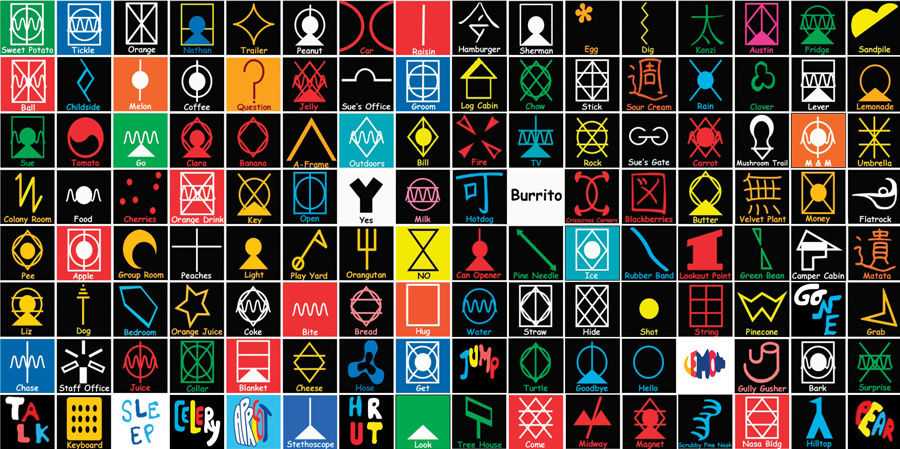
- Lexigram: a system of geometric symbols. Kanzi's was connected to a speech synthesiser which speaks the words when the symbols are touched.
- Researchers also used ASL (American Sign Language) gestures to accompany the lexigrams. Approximately 100 ASL gestures were used by the experimenters. None of the experimenters were fluent in ASL.
- Kanzi and Mulika were tested by 4 tests: Photograph to lexigram/ Spoken English to photograph/ Spoken English to lexigram /Synthesised speech to lexigram
- Utterances were recorded in three categories.
Conclusions
- Pygmy chimps can learn in a very similar way to humans but the language may not be uniquely human.
- Similar to children: taught by parents and teachers/trainers. Observations- symbols and images from picture books, etc.
- Showed that pygmy chimps have the ability to acquire symbol use to a greater extent than other species of apes.
- Pygmy chimps can learn in a very similar way to humans but the language may not be uniquely human.
Imágenes y archivos del mapa
Información
- Descripción
- Savage-Rumbaugh, S., MacDonald, K., Sevcik, R. A., Hopkins, W. D. and Rubert, E. (1986) Spontaneous symbol acquisition and communication use by pygmy chimpanzees (Pan paniscus)
- Creado por
- katherine.crick
- Visitas
- 205
- Etiquetas
- Valoración