
Mapa mental
Sensation & Perception
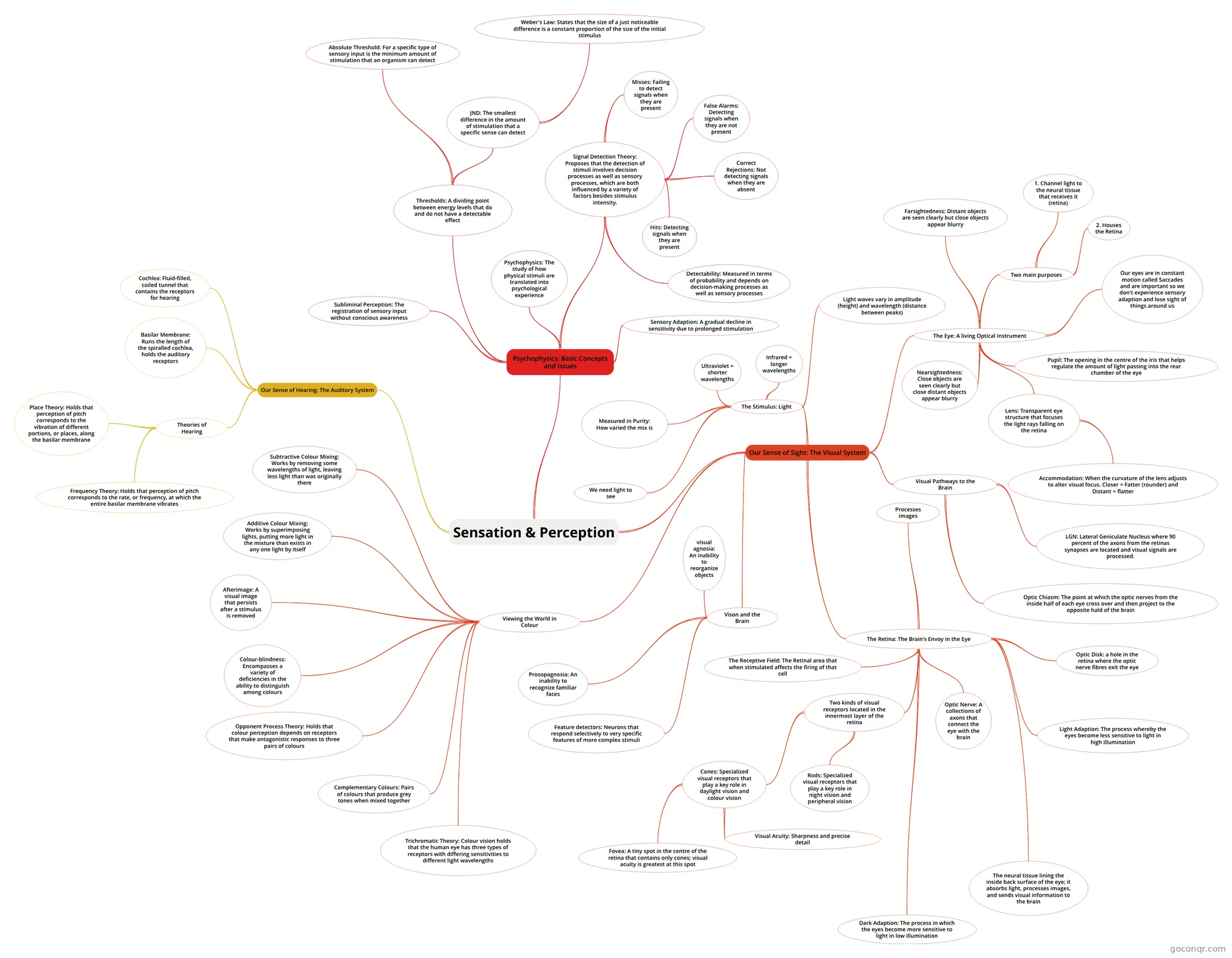
Mind map: Sensation and perception
Contenido del mapa
Sensation & Perception
Psychophysics: Basic Concepts and Issues
- Psychophysics: The study of how physical stimuli are translated into psychological experience
- Thresholds: A dividing point between energy levels that do and do not have a detectable effect
- Absolute Threshold: For a specific type of sensory input is the minimum amount of stimulation that an organism can detect
- JND: The smallest difference in the amount of stimulation that a specific sense can detect
- Weber's Law: States that the size of a just noticeable difference is a constant proportion of the size of the initial stimulus
- Signal Detection Theory: Proposes that the detection of stimuli involves decision processes as well as sensory processes, which are both influenced by a variety of factors besides stimulus intensity.
- Hits: Detecting signals when they are present
- Misses: Failing to detect signals when they are present
- False Alarms: Detecting signals when they are not present
- Correct Rejections: Not detecting signals when they are absent
- Detectability: Measured in terms of probability and depends on decision-making processes as well as sensory processes
- Subliminal Perception: The registration of sensory input without conscious awareness
- Sensory Adaption: A gradual decline in sensitivity due to prolonged stimulation
Our Sense of Sight: The Visual System
- The Stimulus: Light
- We need light to see
- Light waves vary in amplitude (height) and wavelength (distance between peaks)
- Measured in Purity: How varied the mix is
- Ultraviolet = shorter wavelengths
- Infrared = longer wavelengths
- The Eye: A living Optical Instrument
- Two main purposes
- 1. Channel light to the neural tissue that receives it (retina)
- 2. Houses the Retina
- Lens: Transparent eye structure that focuses the light rays falling on the retina
- Accommodation: When the curvature of the lens adjusts to alter visual focus. Closer = Fatter (rounder) and Distant = flatter
- Nearsightedness: Close objects are seen clearly but close distant objects appear blurry
- Farsightedness: Distant objects are seen clearly but close objects appear blurry
- Pupil: The opening in the centre of the iris that helps regulate the amount of light passing into the rear chamber of the eye
- Our eyes are in constant motion called Saccades and are important so we don't experience sensory adaption and lose sight of things around us
- Two main purposes
- The Retina: The Brain's Envoy in the Eye
- The neural tissue lining the inside back surface of the eye; it absorbs light, processes images, and sends visual information to the brain
- Processes images
- Optic Disk: a hole in the retina where the optic nerve fibres exit the eye
- Two kinds of visual receptors located in the innermost layer of the retina
- Cones: Specialized visual receptors that play a key role in daylight vision and colour vision
- Visual Acuity: Sharpness and precise detail
- Fovea: A tiny spot in the centre of the retina that contains only cones; visual acuity is greatest at this spot
- Rods: Specialized visual receptors that play a key role in night vision and peripheral vision
- Cones: Specialized visual receptors that play a key role in daylight vision and colour vision
- Dark Adaption: The process in which the eyes become more sensitive to light in low illumination
- Light Adaption: The process whereby the eyes become less sensitive to light in high illumination
- Optic Nerve: A collections of axons that connect the eye with the brain
- The Receptive Field: The Retinal area that when stimulated affects the firing of that cell
- Visual Pathways to the Brain
- Optic Chiasm: The point at which the optic nerves from the inside half of each eye cross over and then project to the opposite hald of the brain
- LGN: Lateral Geniculate Nucleus where 90 percent of the axons from the retinas synapses are located and visual signals are processed.
- Viewing the World in Colour
- Subtractive Colour Mixing: Works by removing some wavelengths of light, leaving less light than was originally there
- Additive Colour Mixing: Works by superimposing lights, putting more light in the mixture than exists in any one light by itself
- Trichromatic Theory: Colour vision holds that the human eye has three types of receptors with differing sensitivities to different light wavelengths
- Colour-blindness: Encompasses a variety of deficiencies in the ability to distinguish among colours
- Complementary Colours: Pairs of colours that produce grey tones when mixed together
- Afterimage: A visual image that persists after a stimulus is removed
- Opponent Process Theory: Holds that colour perception depends on receptors that make antagonistic responses to three pairs of colours
- Vison and the Brain
- Feature detectors: Neurons that respond selectively to very specific features of more complex stimuli
- visual agnosia: An inability to reorganize objects
- Prosopagnosia: An inability to recognize familiar faces
- The Stimulus: Light
Our Sense of Hearing: The Auditory System
- Cochlea: Fluid-filled, coiled tunnel that contains the receptors for hearing
- Basilar Membrane: Runs the length of the spiralled cochlea, holds the auditory receptors
- Theories of Hearing
- Place Theory: Holds that perception of pitch corresponds to the vibration of different portions, or places, along the basilar membrane
- Frequency Theory: Holds that perception of pitch corresponds to the rate, or frequency, at which the entire basilar membrane vibrates
Información
- Descripción
- Psychology 104 chapter 4 mind map
- Creado por
- Darby Milman
- Visitas
- 117
- Etiquetas
- Valoración