Mapa mental
Attachment
Contenido del mapa
Attachment
strange situation
- secure attachment insecure resistant insecure avoidant
multiple attachments role of dad
Stages of attachment
- Asocial- recognise and form bonds with carer but behaviour towards non humans and human is similer first few weeks
- indiscriminate attachment- preference to famililar people, no stranger anxiety accept attention from anyone 2-7 months
- specific attachment- primary attachment figure from 7 months old
- multiple attachments- after primary attachment they can form new attachments by age of 1 most children have multiple attachments
Influences Internal Working model
- rocky mountains newpaper secure attachment relationships lasted twice as long as insecure
Maternal deprivation
- critical period, emotional harm and intellectual harm (Goldbarb)
- 44 thieves
Cross cultural differences
- VK- 32 studies 8 countries- secure most common, cultural practises affect attachment
Instutionalisation
- romaninan orphanages
- intellectual- the longer they were there before they wereadopted the lower their IQ
- attachment effects- attention seeking, clinginess, indiscriminate social behaviour
- Zeanah
- attachment effects- attention seeking, clinginess, indiscriminate social behaviour
- intellectual- the longer they were there before they wereadopted the lower their IQ
- romaninan orphanages
interactions
- reciprocity
- care giver and baby have intense interaction which is the basis of attachment and babies are alert for periods when they are ready for interaction
- Feldman and Eidelman- mothers normally respond to the alertness 2/3 of time
- care giver and baby have intense interaction which is the basis of attachment and babies are alert for periods when they are ready for interaction
- interactional synchrony
- coordination on micro social level. actions and emoitons mirror eachother
- reciprocity
Animal studies
- Harlow: monkeys
- lorenz: imprinting (attach) to the first thing they see moving after hatching and follow it
- critical period first few hours and it is automatic
Bowlby's theory
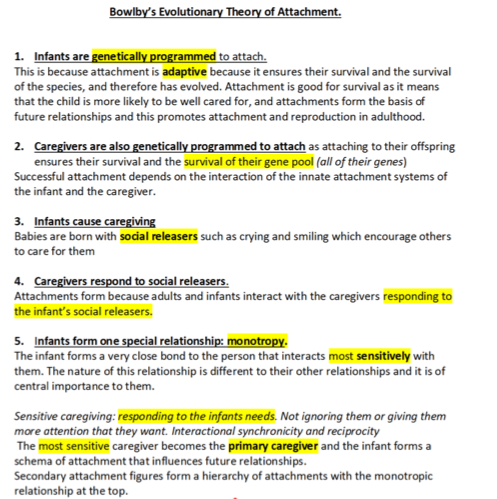
- claimed humans imprint
- evolved to attach to main care giver- usually mother
- having special attachment monotropy- this attachment to survive because staying close to mother ensures food and survival
- strong attahcment is a safe base for confidence to explore and gives us a template for future relationships to trust other cricital period of first 3 years to attach this way or they may never do
- if there is no attachment it may damage the child's social and emotional development
- strong attahcment is a safe base for confidence to explore and gives us a template for future relationships to trust other cricital period of first 3 years to attach this way or they may never do
- having special attachment monotropy- this attachment to survive because staying close to mother ensures food and survival
- evolved to attach to main care giver- usually mother
- claimed humans imprint
attachment- a close emotional relationship between infants and care givers
attached- infants show desire to be close to primary care giver and distress when seperated and pleasure when reunited
Maccoby
- seeking proximity distress on separation joy on reunion orientation of behaviour towards other people
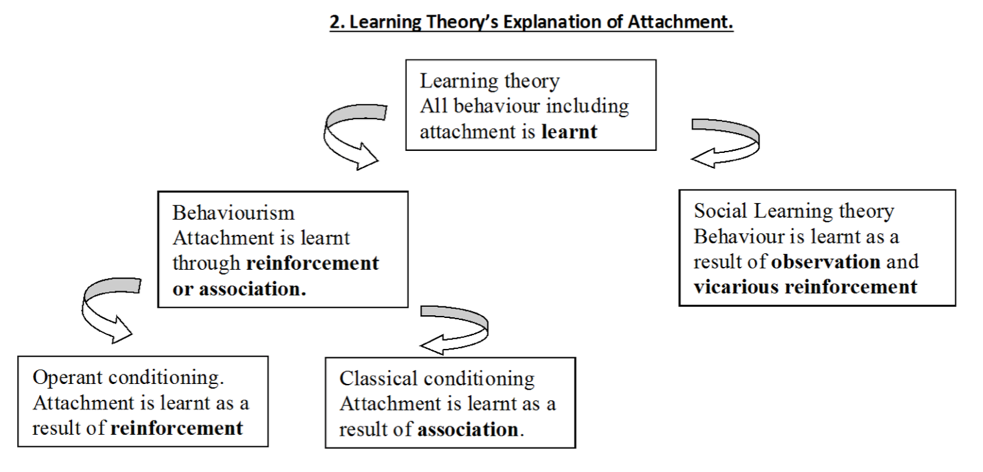
Learning theory
- Behaviourist theory
- operant conditions- Dollard and Miller- removal of discomfort negative reinforcment
- Classical condtion- Watson Raynor, association
- SLT
- Vicarious reinforcment
- Behaviourist theory