
Mapa mental
Authentic Assessments for ELLs Grades K-12
Contenido del mapa
Authentic Assessments for ELLs Grades K-12
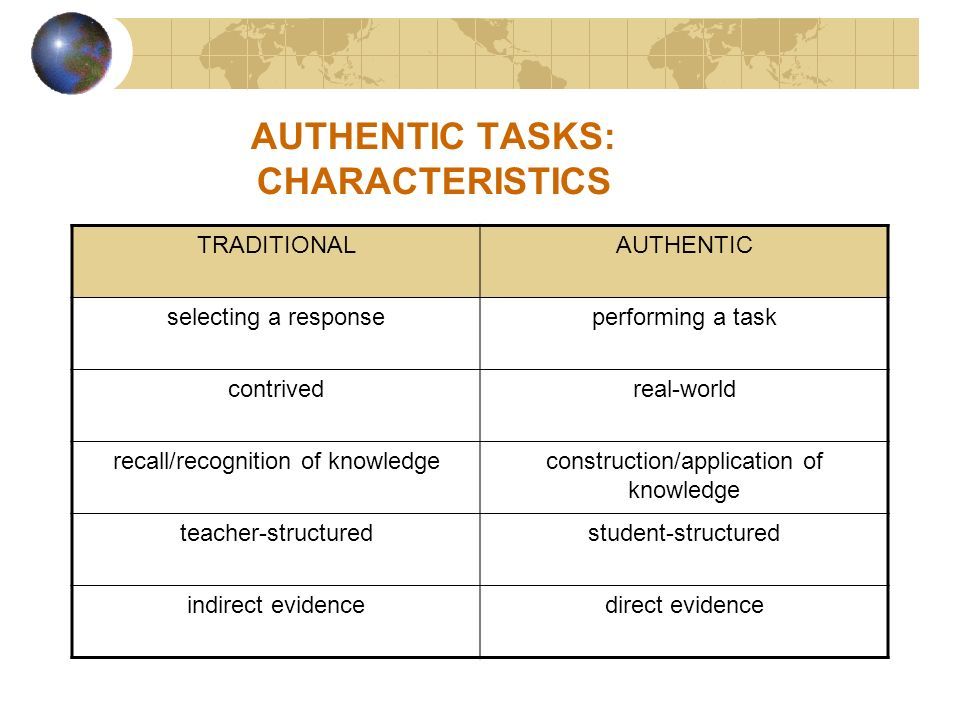
Authentic v. Traditional
- Authentic uses performance-based tasks
- ask to perform v. asking a multiple-choice question, etc.
- Authentic uses Real-life tasks v. Contrived tasks
- helps create more meaningful learning and performance
- Authentic uses construction and application
- task shows the accuracy of constructed meaning
- Authentic is student-structured v. Traditional is teacher-structured
- students are allowed the freedom to construct responses to task based on own understanding
- Authentic provides Direct Evidence v. Indirect Evidence
- students are asked to apply concepts learned v. testing the theory and assuming that they can apply
- Authentic uses performance-based tasks
Steps to Constructing an Authentic Assessment
- 1. Identify Standard(s)
- must be SMART
- Use Can-Do statements or SWBAT
- Reflect, Review, Write
- 2. Select Authentic Task
- Look at Standard(s)
- Look at the Real World
- must be transferrable to rubric
- 3. Criteria
- Must be clear, brief, observable, behavior-based, student-friendly
- indicators of performance
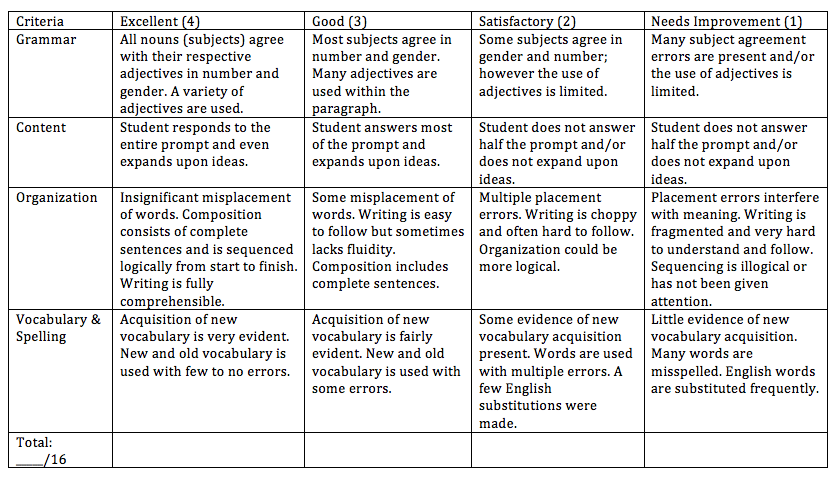
- 4. Rubrics
- 1. Identify Standard(s)
Authentic Assessment Rubrics
- criteria & level of performance (small number @1st)
- includes descriptors for further understanding of task
- reviewed by other colleagues, adjusted by teacher, and imagine if student score makes sense
- Holistic v. Analytical
- Holistic
- considers all criteria together
- performance shows behavior across all criteria
- Analytical
- performance based on each criteria individually
- distinguishes between what work effectively completes and doesn't complete the task
- Holistic
- Rubric I will be using:
Initial Assessment of Diverse Learners
- legally obligated to identify, assess, & provide appropriate services to all ELLs
- need team effort to L1 literacy & proficiency testing
- administer of test must be well-knowledgeable of the test being given
- Need Home Language Survey in L1
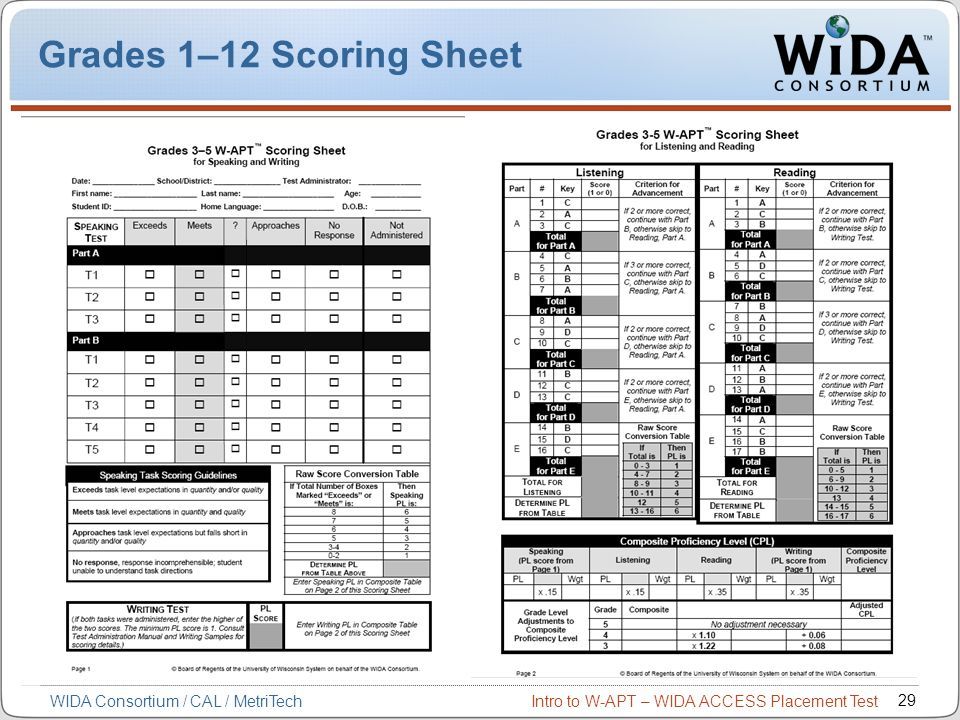
- Language proficiency assessment must be given & students receive ESL services & support
- show that we value students home culture
- administer documents & test in L1
- literacy skills should be improved & tested in both L1 & L2
- QTNA: previous schooling? How long ago? Type of school? Reason unable to attend school? curriculum? educational background of parents or guardians? Health information?
On-going Assessment of Diverse Learners
- Performance-based Portfolio
- Must be: comprehensive, predetermined & systematic, tailored, informative, authentic
- Oral Proficiency Assessemtn
- based on all aspects of communcation and academic language
- Receptive Oral Language Skills
- listen & respond to basic commands or instructions
- Expressive Language Skills
- Holistic v. Analytical
- Must observe both Receptive and Expressive Lang. Skills in order to attain a comprehensive view on the students Oral Proficiency
- allow for activities to be completed in L1
- reading, book reports, projects, etc.
- Account for cultural differences in the final product of a specific task
- Writing Prompts
- comment on language usage rather than grammatical errors
- general comments of overall effort or grammar usage rather than specifics
- clear instructions, context, real world performance
- Performance-based Portfolio
High-Stakes Testing of Diverse Learners
- Possible Testing Accomodations
- for ELLs
- For ELLs with LDs
- AYP
- growth must be shown by school according to standards given by the government & NCLB
- Can substitute Reading Proficiency testing for English Language Proficiency if student is an ELL & still be counted in 95% student participation in High-Stakes Testing for the school
- Keep scored of students that are no longer LEP for up to 2 years after gaining English Proficient
- ensure you are using the state-based, content-based standards for ELLs
- Ensure that the test is culturally-responsive
- comprehensible for learner
- no elements that convey cultural bias
- Special Needs that may need attention in addition to the ESL modifications
- Communication Disfluency
- Academic Disfluency
- Hearing and Vision Issues
- Trouble Paying Attention
- Trouble Communicating Verbally
- Trouble Adhering to Behavioral Expectations
- Possible Testing Accomodations
Imágenes y archivos del mapa
Información
- Descripción
- This is a thorough explanation for the concept of Authentic Assessments used to assess ELL proficiency in the target language.
- Creado por
- Charity Jackson
- Visitas
- 55
- Etiquetas
- Valoración