
Mapa mental
objectives of foreign policy from 1890
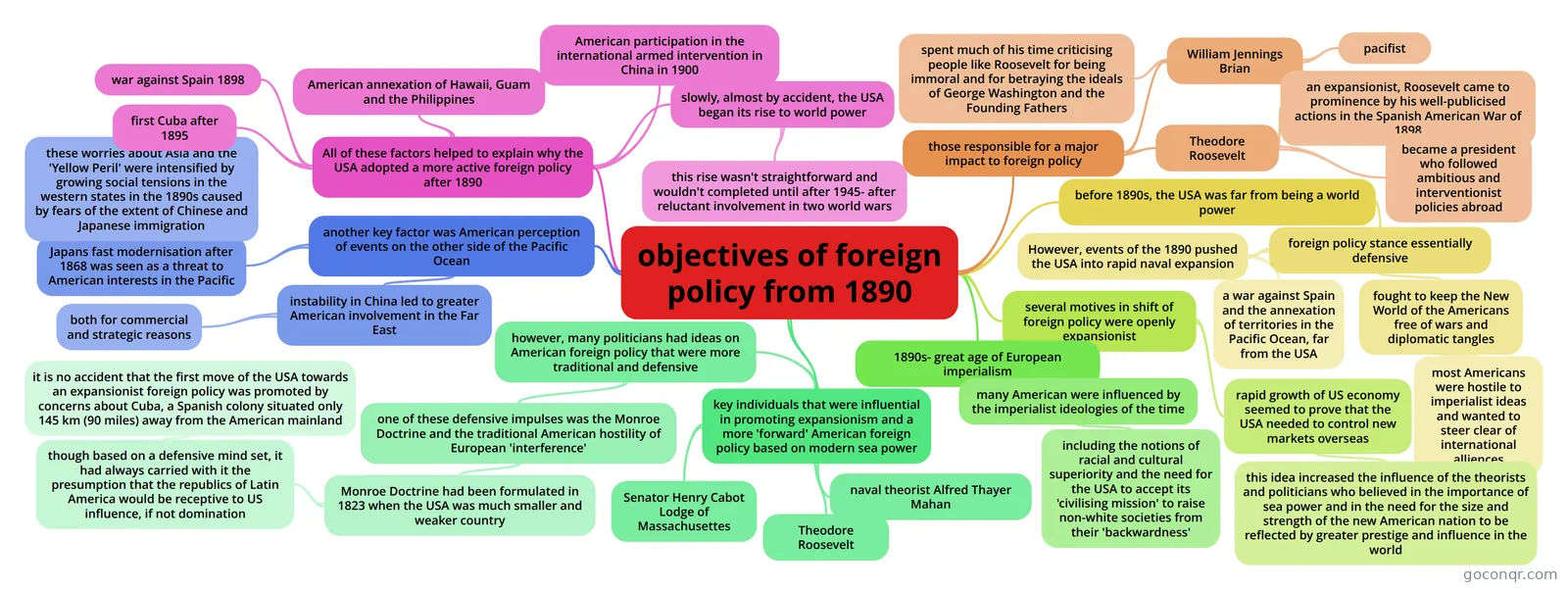
Mind map: objectives of foreign policy from 1890
Contenido del mapa
objectives of foreign policy from 1890
those responsible for a major impact to foreign policy
- Theodore Roosevelt
- an expansionist, Roosevelt came to prominence by his well-publicised actions in the Spanish American War of 1898
- became a president who followed ambitious and interventionist policies abroad
- William Jennings Brian
- pacifist
- spent much of his time criticising people like Roosevelt for being immoral and for betraying the ideals of George Washington and the Founding Fathers
- Theodore Roosevelt
before 1890s, the USA was far from being a world power
- foreign policy stance essentially defensive
- fought to keep the New World of the Americans free of wars and diplomatic tangles
- most Americans were hostile to imperialist ideas and wanted to steer clear of international alliences
- However, events of the 1890 pushed the USA into rapid naval expansion
- a war against Spain and the annexation of territories in the Pacific Ocean, far from the USA
- fought to keep the New World of the Americans free of wars and diplomatic tangles
- foreign policy stance essentially defensive
several motives in shift of foreign policy were openly expansionist
- rapid growth of US economy seemed to prove that the USA needed to control new markets overseas
- this idea increased the influence of the theorists and politicians who believed in the importance of sea power and in the need for the size and strength of the new American nation to be reflected by greater prestige and influence in the world
- rapid growth of US economy seemed to prove that the USA needed to control new markets overseas
1890s- great age of European imperialism
- many American were influenced by the imperialist ideologies of the time
- including the notions of racial and cultural superiority and the need for the USA to accept its 'civilising mission' to raise non-white societies from their 'backwardness'
- many American were influenced by the imperialist ideologies of the time
key individuals that were influential in promoting expansionism and a more 'forward' American foreign policy based on modern sea power
- Senator Henry Cabot Lodge of Massachusettes
- Theodore Roosevelt
- naval theorist Alfred Thayer Mahan
- however, many politicians had ideas on American foreign policy that were more traditional and defensive
- one of these defensive impulses was the Monroe Doctrine and the traditional American hostility of European 'interference'
- Monroe Doctrine had been formulated in 1823 when the USA was much smaller and weaker country
- though based on a defensive mind set, it had always carried with it the presumption that the republics of Latin America would be receptive to US influence, if not domination
- it is no accident that the first move of the USA towards an expansionist foreign policy was promoted by concerns about Cuba, a Spanish colony situated only 145 km (90 miles) away from the American mainland
- though based on a defensive mind set, it had always carried with it the presumption that the republics of Latin America would be receptive to US influence, if not domination
- Monroe Doctrine had been formulated in 1823 when the USA was much smaller and weaker country
- one of these defensive impulses was the Monroe Doctrine and the traditional American hostility of European 'interference'
another key factor was American perception of events on the other side of the Pacific Ocean
- instability in China led to greater American involvement in the Far East
- both for commercial and strategic reasons
- Japans fast modernisation after 1868 was seen as a threat to American interests in the Pacific
- these worries about Asia and the 'Yellow Peril' were intensified by growing social tensions in the western states in the 1890s caused by fears of the extent of Chinese and Japanese immigration
- instability in China led to greater American involvement in the Far East
All of these factors helped to explain why the USA adopted a more active foreign policy after 1890
- first Cuba after 1895
- war against Spain 1898
- American annexation of Hawaii, Guam and the Philippines
- American participation in the international armed intervention in China in 1900
- slowly, almost by accident, the USA began its rise to world power
- this rise wasn't straightforward and wouldn't completed until after 1945- after reluctant involvement in two world wars
Información
- Descripción
- Mapa Mental sobre objectives of foreign policy from 1890, creado por Bethan Stevenson el 15/04/2014.
- Creado por
- Bethan Stevenson
- Visitas
- 121
- Etiquetas
- Valoración