
Mapa mental
C2
Contenido del mapa
C2
Polymers
- Polymerisation
- Small molecules (monomers) join to make long molecules (polymers)
- Type of polymers depends on type of monomers
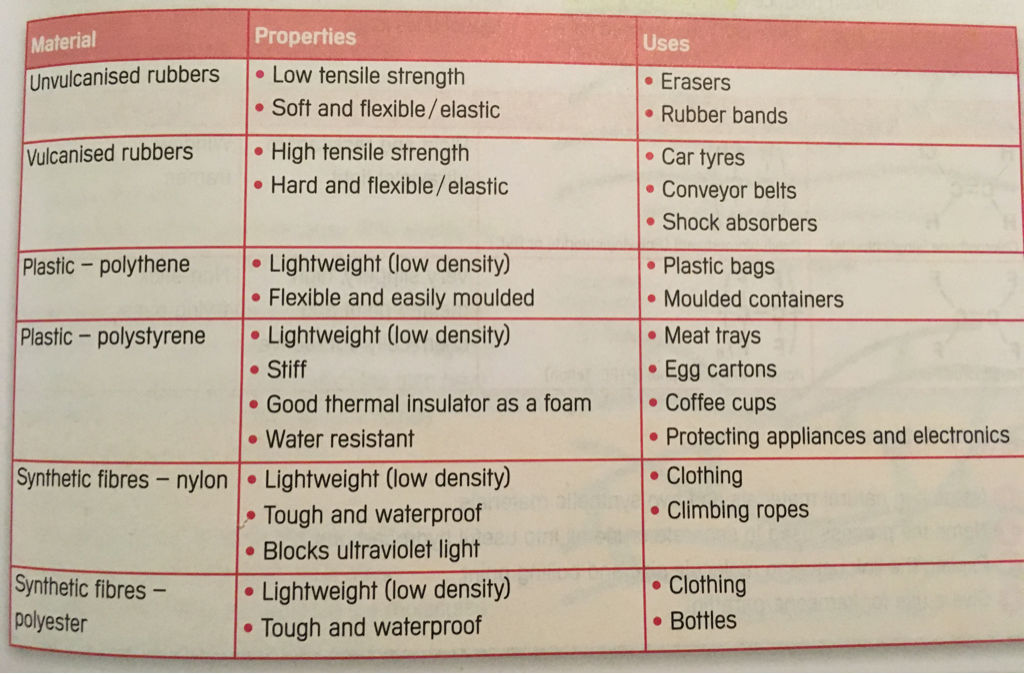
- Can create a wide range of different materials with different uses
- Many natural materials have been replaced with superior polymers
- Carrier bags were made of paper
- Now they're made of polythene
- Carrier bags were made of paper
- Many natural materials have been replaced with superior polymers
- Small molecules (monomers) join to make long molecules (polymers)
- Molecular structure
- Properties of materials depend on how the particles are held together
- Natural rubber
- Vulcanisation
- Mass of tangled molecules
- Atoms in chain are held together by strong covalent bonds
- Molecules also have cross-links
- Sulfur atoms form cross links between rubber molecules
- Rubber becomes rigid and hard to stretch
- Needs a high melting point as well
- Mass of long-chain molecules
- Atoms in the chains are held together by strong convolent bonds
- However there are weak forces between the molecules
- This means it has a low melting point as not a lot of energy is needed
- However there are weak forces between the molecules
- The long polymer molecules can slide over each other
- This makes the material very stretchy and flexible
- Vulcanisation
- Polymerisation
Materials
- Synthetic
- Produced by chemical synthesis
- Made as alternatives
- Starting with materials extracted go the earths crust
- Petrochemical industry refines crude oil
- Only a small proportion is used though
- The rest is used for fuels
- Only a small proportion is used though
- Natural
- Comes from living things
- Cotton (plants)
- Paper (trees)
- Silk (spiders)
- Wool (sheep)
- Comes from living things
- Synthetic
Crude oil
- Raw material found in earths crust
- Mixture of hydrocarbons
- Some have small molecules and others have longer chain molecules
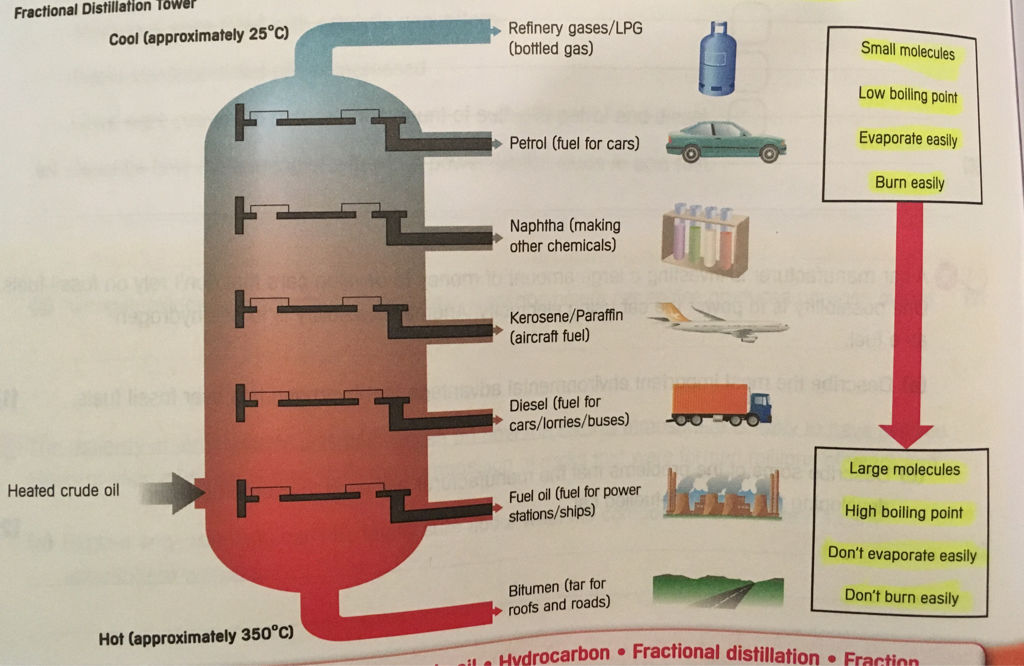
- Separated by fractional distillation
- Hydrocarbons in a fraction have similar boiling points
- Heated to evaporate all the hydrocarbons
- Vapour passes into the fractioning column near the bottom
- Fractions condense to liquids and run off once they cool below their boiling point
- Any remaining gases leave the tower at the top
- Used as gaseous fuels
- Any remaining gases leave the tower at the top
- Fractions condense to liquids and run off once they cool below their boiling point
- Vapour passes into the fractioning column near the bottom
Boiling point
- All molecules have forces between them
- Intermolecular forces
- The longer the hydrocarbon molecules, the stronger the forces
- Strong forces need more energy to overcome them
- So a higher temperature is needed
- All molecules have forces between them
Properties
- Different materials have different properties
- Different melting points
- Rigid or flexible
- Better suited for different uses
- Properties affect the durability and effectiveness
- Different materials have different properties
Modifications
- Produce changes to properties of polymers
- Increasing the chain length makes more contact between molecules
- Forces become stronger
- Plasticisers
- Small molecule that sits between molecules to force them apart
- Forces are weaker so molecules move easily
- Small molecule that sits between molecules to force them apart
- Packing molecules more closely together to form crystalline polymers
- Forces are slightly stronger
- Polymer is stronger, denser and has a slightly higher melting point
- Forces are slightly stronger
Nanotechnology
- Nanometre is one millionth of a millimetre
- Particles can...
- Occur naturally (sea spray)
- Occur as an accidental result of human activity
- Made deliberately by scientists
- Called nanotechnology
- Particles have different properties
- Smaller particles so have a much larger surface area
- Production, study and control of nanoparticules
- Modify properties of other polymers
- Silver nanoparticles give clothes antibacterial properties
- Carbon nanotubes to sports equipment makes it lighter and stronger
- Risks
- New technology
- Haven't been thoroughly tested
- Possible health problems in future
Imágenes y archivos del mapa
Información
- Descripción
- Mapa Mental sobre C2, creado por Olivia Evenson el 20/03/2017.
- Creado por
- Olivia Evenson · mar 2017
- Actualizado
- 17 may 2017
- Visitas
- 0
- Valoración