
Polymers
327 resources created by 296 users
This Polymers page on GoConqr gathers community-made mind maps, flashcards, quizzes and notes, from definitions of monomers and macromolecules to addition and condensation polymerisation, polyesters, biopolymers and plastic waste. It's built for school students, university students and professional candidates revising a topic, plus teachers after ready-made material. There are over 300 resources here, including more than 200 mind maps, over 80 flashcard sets and 8 quizzes, mostly at secondary level with some for university. Pick a mind map, test yourself with a quiz, then make your own.
Select topic
- Monomers and polymer structure9
- Classification of polymers26
- Natural and synthetic polymers15
- Polymer raw materials14
- Polymerisation21
- Addition polymerisation23
- Polymerisation mechanisms5
- Condensation polymerisation17
- Polymer properties21
- Plastics and elastomers29
- Uses of polymers10
- Designer polymers18
- Polymers and nanotechnology6
- Polymer waste and recycling20
Top Polymers resources
-
15 questionsWhat do you know about Polyester and Condensation Polymerisation? Test yourself on condensation polymerisation and polyesters in this quiz.
-
Mind map Polymers All about Polymers for Class XII CBSE
-
Mind map Polymers Classification
-
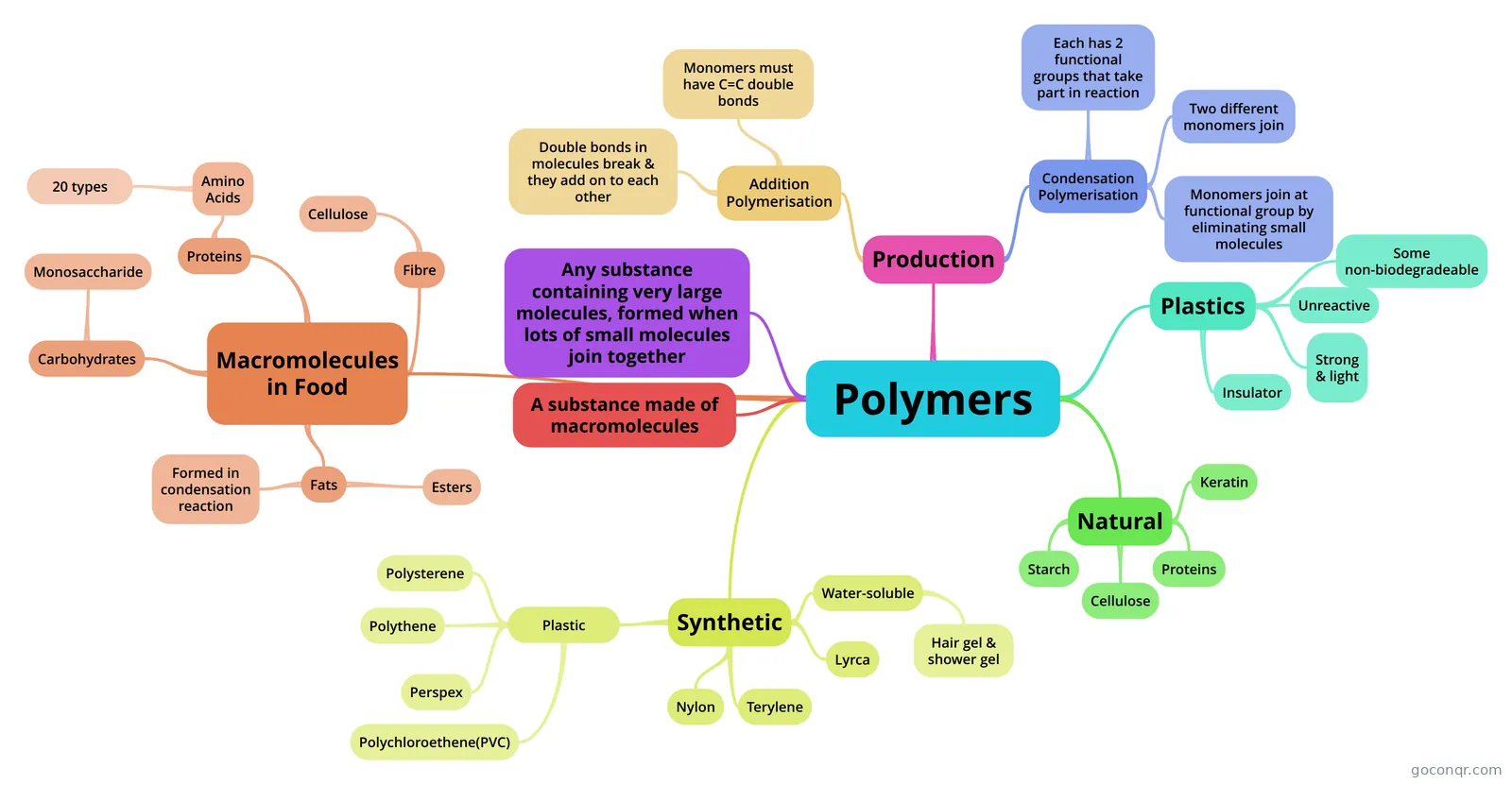 Mind map Polymers
-
Mind map Biopolymers
-
19 cardsOrganic Chem: Macromolecules Proteins, polypeptides, polymerisation, primary/secondary/tertiary structure
-
43 cardsChemistry 1b What is cracking and what does it do?
-
87 cardsPolymers What is the repeating unit of polyethylene?
Quizzes
See all 10 quizzes-
15 questionsWhat do you know about Polyester and Condensation Polymerisation? Test yourself on condensation polymerisation and polyesters in this quiz.
-
17 questionsC2 Quiz Melting Point is....
-
32 questionsPolymers What does this ID Code stand for PET?
-
6 questionsPolymers How are natural fertilizers made?
-
4 questionsPolymers What is the meaning of the word synthetic?
-
5 questionsUntitled What is a Plastic?
-
5 questionsPlastics Teflon is used to make non-stick coating in cooking vessels.
-
5 questionsPolymers What type of polymer is Poly(ethene)
Mind maps
See all 211 mind mapsFlashcards
See all 91 flashcards-
19 cardsOrganic Chem: Macromolecules Proteins, polypeptides, polymerisation, primary/secondary/tertiary structure
-
43 cardsChemistry 1b What is cracking and what does it do?
-
87 cardsPolymers What is the repeating unit of polyethylene?
-
104 cardsFree-Radical polymerization why are tertiary radicals the most stable
-
43 cardsPolymers- Chemistry Materials are chosen for specific jobs because of their properties
-
32 cardsC2 Where does rubber come from?
-
48 cardsPolymer revolution What is a polymer?
-
10 cardsChemistry Part 2 - Class 2& 3; Biodegradable Plastic - Casein Plastic Chemistry Part 2 Class 2 & 3 Casein (milk) Plastic You will need SENIOR CLASSES: YEARS 3-6: One or two bott...
Flowcharts
Notes
See all 11 notes-
C2 Natural & Synthetic Materials1. Natural materials come from living things e.g. cotton, paper, wool, silk2. Synthetic materials are produced by chemical synthesis from materials from the Earth's crust e.g. crude oil us...
-
C2 - Polymers Polymers Forces between molecules determine the properties of Plastics Weak forces: Individual chains of molecules are held together by weak inter-molecular forces. (They are free to slide over one another)
-
Summary 1: Ehylene and Addition polymer chapter Petroleum contains gas fractions ethylene; ethene. 2 ways to crack petroleum; catalytic and thermal catalytic cracking; invoves a ctalsyt (zeolite) and temperatres around 500 degrees celscius; using both temperature a...
-
Polymer Waste Polymer Waste Uses of Polymers: Polystyrene - foam packaging, insulation, model-making. Being replaced with biodegradable materials. Polypropylene - food packaging, dishwasher-safe containers, laboratory equipment: re...
-
Condensation Polymers Condensation Polymers Include Polyamides, Polyesters and Polypeptides Condensation polymerisation usually involves two different types of monomer, each with at least two functional groups. Each functional group reacts...
-
COPOLYMERS - created from Mind Map Graft Block Random
-
Plastic - created from Mind Map What is? Chemical properties Physical properties
-
Advantages and disadvantages of using polyethene Plastic shopping bags made from poly(ethane)Advantages 1. Simple properties e.g. strong, low density, water resistant2. Bags can be reused3. Money charged for bags can encourage reuse4. Poly(ethane) bags can be recycl...
Slides
Topics in Polymers
More Chemistry topics
About Polymers
GoConqr OriginalWhat this page covers
The resources here follow polymers from first definitions to the chemistry of how they are made. Many are mind maps. The mind map Polymers Classification sorts polymers into plastics, elastomers, fibres, paints and varnishes, and also by source. Another mind map, Definitions, separates monomer, oligomer, polymer and mer unit.
Where to start
Begin with the overview maps. Polymers Classification and the first Polymers mind map explain that polymers are very large molecules formed when many small ones join together. They also name examples such as nylon, Terylene and polystyrene. Then move to the Definitions cards flashcards, which drill the same vocabulary, including functionality and end group.
Making polymers
Next, look at how polymers form. The flashcard deck Organic Chem: Macromolecules covers addition polymerisation, polyethene in its HDPE and LDPE forms, Teflon, condensation polymerisation, polyesters and PET. For a closer look at one family, take the quiz What do you know about Polyester and Condensation Polymerisation?. It asks you to fill in blanks about repeating units and ester linkages.
Using maps and quizzes together
Read a map first, then close it and try a quiz or flashcard deck from memory. Anything you miss tells you which branch to go back to. Exam-focused material is here too, such as OCR AS Chemistry - Polymers and National 5 Chemistry-Plastics, alongside many GCSE-style decks on designer polymers and products from oil. Notes such as Polymer Waste and the mind map Plastics and disposal cover what happens to plastics afterwards.
Where it fits
This unit sits in the Organic Chemistry strand of Chemistry. It links naturally with the cracking and alkene decks listed here, because those explain where polymer building blocks come from. Choose a resource that suits your level, work through it, and then build your own maps or flashcards to fill any gaps.
Frequently asked questions
Which resource should I open first?
Start with the mind map Polymers Classification. It lays out what polymers are, why they are called macromolecules and how they are grouped into plastics, elastomers and fibres. After that, the Definitions cards flashcards help you remember the key terms before you move on to polymerisation.
What do the quizzes on this page cover?
There are 8 quizzes. One of them, What do you know about Polyester and Condensation Polymerisation?, asks you to complete sentences about repeating units and ester linkages. Others are titled Polymers, Plastics and C2 Quiz, so you can check general understanding after reading a map.
Which exams are these resources suitable for?
Most of the resources are at secondary level, with a smaller share for university. The listed material mentions GCSE Chemistry, A-level Chemistry, OCR AS Chemistry and National 5 Chemistry. Check each title to see which course it follows, since the community made them for different syllabuses.
Are the resources free to use?
Yes. Every resource listed here is free to open, study and take, with no account needed. They were made by GoConqr users rather than by GoConqr itself. A free account also saves your quiz scores and lets you create your own quizzes, mind maps, flashcards and notes.
Is there anything on plastic waste and disposal?
Yes. The Polymer Waste notes and the Plastics and disposal mind map look at what happens to plastics after use. The Advantages and disadvantages of using polyethene notes also weigh up a common polymer, which is useful for balanced exam answers.
What if I can't find the topic I need?
Try nearby titles first, such as Polymerisation, Addition polymers or Condensation Polymers, since topics are often grouped differently. If your topic is still missing, you can make your own mind map, flashcards or notes and use them for revision.