
Mapa mental
Business and Globalisation
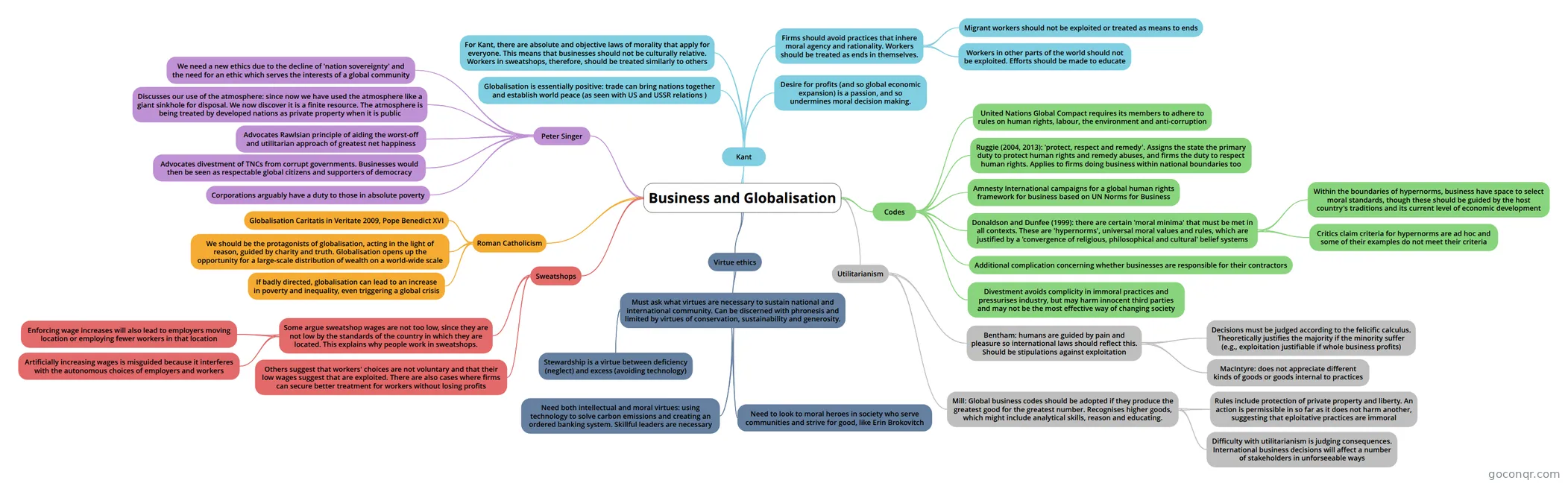
Mind map: Business and Globalisation
Contenido del mapa
Business and Globalisation
Codes
- United Nations Global Compact requires its members to adhere to rules on human rights, labour, the environment and anti-corruption
- Ruggie (2004, 2013): 'protect, respect and remedy'. Assigns the state the primary duty to protect human rights and remedy abuses, and firms the duty to respect human rights. Applies to firms doing business within national boundaries too
- Amnesty International campaigns for a global human rights framework for business based on UN Norms for Business
- Donaldson and Dunfee (1999): there are certain 'moral minima' that must be met in all contexts. These are 'hypernorms', universal moral values and rules, which are justified by a 'convergence of religious, philosophical and cultural' belief systems
- Within the boundaries of hypernorms, business have space to select moral standards, though these should be guided by the host country's traditions and its current level of economic development
- Critics claim criteria for hypernorms are ad hoc and some of their examples do not meet their criteria
- Additional complication concerning whether businesses are responsible for their contractors
- Divestment avoids complicity in immoral practices and pressurises industry, but may harm innocent third parties and may not be the most effective way of changing society
Sweatshops
- Some argue sweatshop wages are not too low, since they are not low by the standards of the country in which they are located. This explains why people work in sweatshops.
- Artificially increasing wages is misguided because it interferes with the autonomous choices of employers and workers
- Enforcing wage increases will also lead to employers moving location or employing fewer workers in that location
- Others suggest that workers' choices are not voluntary and that their low wages suggest that are exploited. There are also cases where firms can secure better treatment for workers without losing profits
- Some argue sweatshop wages are not too low, since they are not low by the standards of the country in which they are located. This explains why people work in sweatshops.
Kant
- Globalisation is essentially positive: trade can bring nations together and establish world peace (as seen with US and USSR relations )
- For Kant, there are absolute and objective laws of morality that apply for everyone. This means that businesses should not be culturally relative. Workers in sweatshops, therefore, should be treated similarly to others
- Firms should avoid practices that inhere moral agency and rationality. Workers should be treated as ends in themselves.
- Migrant workers should not be exploited or treated as means to ends
- Workers in other parts of the world should not be exploited. Efforts should be made to educate
- Desire for profits (and so global economic expansion) is a passion, and so undermines moral decision making.
Roman Catholicism
- Globalisation Caritatis in Veritate 2009, Pope Benedict XVI
- We should be the protagonists of globalisation, acting in the light of reason, guided by charity and truth. Globalisation opens up the opportunity for a large-scale distribution of wealth on a world-wide scale
- If badly directed, globalisation can lead to an increase in poverty and inequality, even triggering a global crisis
Peter Singer
- We need a new ethics due to the decline of 'nation sovereignty' and the need for an ethic which serves the interests of a global community
- Discusses our use of the atmosphere: since now we have used the atmosphere like a giant sinkhole for disposal. We now discover it is a finite resource. The atmosphere is being treated by developed nations as private property when it is public
- Advocates Rawlsian principle of aiding the worst-off and utilitarian approach of greatest net happiness
- Advocates divestment of TNCs from corrupt governments. Businesses would then be seen as respectable global citizens and supporters of democracy
- Corporations arguably have a duty to those in absolute poverty
Utilitarianism
- Bentham: humans are guided by pain and pleasure so international laws should reflect this. Should be stipulations against exploitation
- Decisions must be judged according to the felicific calculus. Theoretically justifies the majority if the minority suffer (e.g., exploitation justifiable if whole business profits)
- MacIntyre: does not appreciate different kinds of goods or goods internal to practices
- Mill: Global business codes should be adopted if they produce the greatest good for the greatest number. Recognises higher goods, which might include analytical skills, reason and educating.
- Rules include protection of private property and liberty. An action is permissible in so far as it does not harm another, suggesting that eploitative practices are immoral
- Difficulty with utilitarianism is judging consequences. International business decisions will affect a number of stakeholders in unforseeable ways
- Bentham: humans are guided by pain and pleasure so international laws should reflect this. Should be stipulations against exploitation
Virtue ethics
- Must ask what virtues are necessary to sustain national and international community. Can be discerned with phronesis and limited by virtues of conservation, sustainability and generosity.
- Stewardship is a virtue between deficiency (neglect) and excess (avoiding technology)
- Need to look to moral heroes in society who serve communities and strive for good, like Erin Brokovitch
- Need both intellectual and moral virtues: using technology to solve carbon emissions and creating an ordered banking system. Skillful leaders are necessary
- Must ask what virtues are necessary to sustain national and international community. Can be discerned with phronesis and limited by virtues of conservation, sustainability and generosity.
Información
- Descripción
- AS - Level (Ethics) Philosophy and Ethics Mapa Mental sobre Business and Globalisation, creado por Joe Allen el 10/04/2017.
- Creado por
- Joe Allen
- Visitas
- 1
- Valoración