
Mapa mental
P1
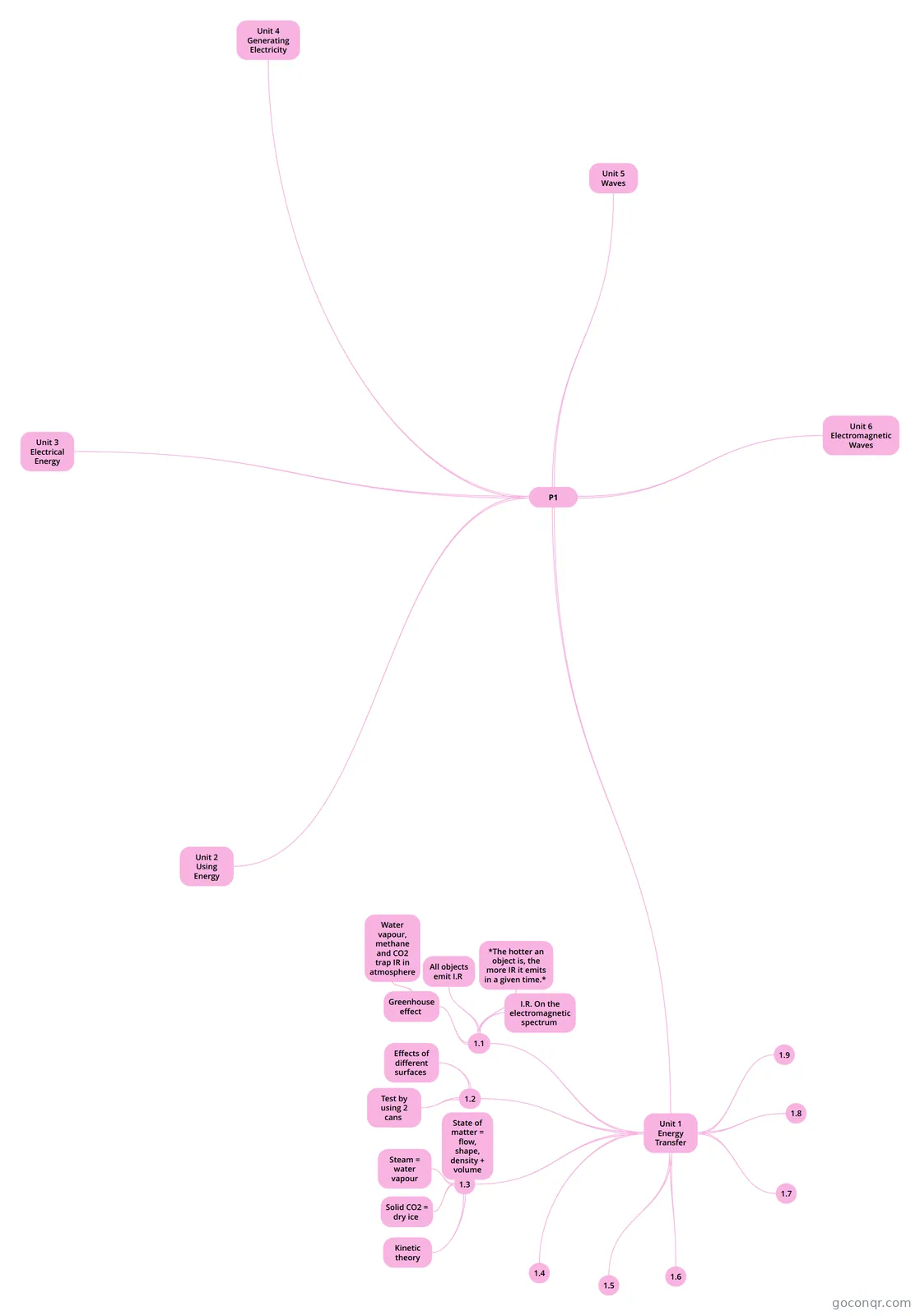
Mind map: P1
Contenido del mapa
P1
Unit 1 Energy Transfer
- 1.1
- Infrared radiation
- I.R. On the electromagnetic spectrum
- The sun emits all types of electromagnetic radiation but the atmosphere blocks most of it out.
- All objects emit I.R
- *The hotter an object is, the more IR it emits in a given time.*
- Greenhouse effect
- - short wavelength infrared radiation from sun can pass through glass to warm the objects inside the greenhouse - infrared radiation from these warm objects is trapped by the glass because the objects emit infrared radiation of longer wavelengths that can't pass through glass
- Water vapour, methane and CO2 trap IR in atmosphere
- Global warming - polar ice caps - sea levels rise Reducing use of fossil fuels reduces production of greenhouse gases
- 1.2
- Surfaces and radiation
- Effects of different surfaces
- - Dark matt surfaces are better at emitting radiation than light shiny surfaces - light shiny surfaces absorb less radiation than dark Matt surfaces - light shiny surfaces reflect more radiation than dark matt surfaces
- Test by using 2 cans
- To compare the radiation from 2 different surfaces, you can measure how fast 2 cans of hot water cool. Start temperature and volume of water must be the same.
- 1.3
- States of matter
- State of matter = flow, shape, density + volume
- Steam = water vapour
- When it touches a cold surface, the steam condenses and turns to water.
- Solid CO2 = dry ice
- Kinetic theory
- 1. The particles in a solid are held next to each other in fixed positions and vibrate so it keeps its shape.
- 2. The particles in a liquid are in contact with each other and move about randomly so it can flow.
- The particles in a gas move about at random much faster and are much further apart from each other than in a liquid. So the density of a gas is much less than both solids and liquids.
- The particles in solids, liquids and gases have different amounts of energy. In general, gas particles have more than liquid particles and they have more energy than solid particles.
- 1.6
- Evaporation and condensation
- 1.5
- Convection
- 1.4
- Conduction
- 1.7
- Energy transfer by design
- 1.8
- Specific heat capacity
- 1.9
- Heating and insulating buildings
- 1.1
Unit 2 Using Energy
Unit 3 Electrical Energy
Unit 4 Generating Electricity
Unit 5 Waves
Unit 6 Electromagnetic Waves
Información
- Descripción
- Mind Map on B1, created by Ciara Pedro on 18/04/2017.
- Creado por
- Ciara Pedro
- Visitas
- 13
- Valoración