
Mapa mental
Environmental Science
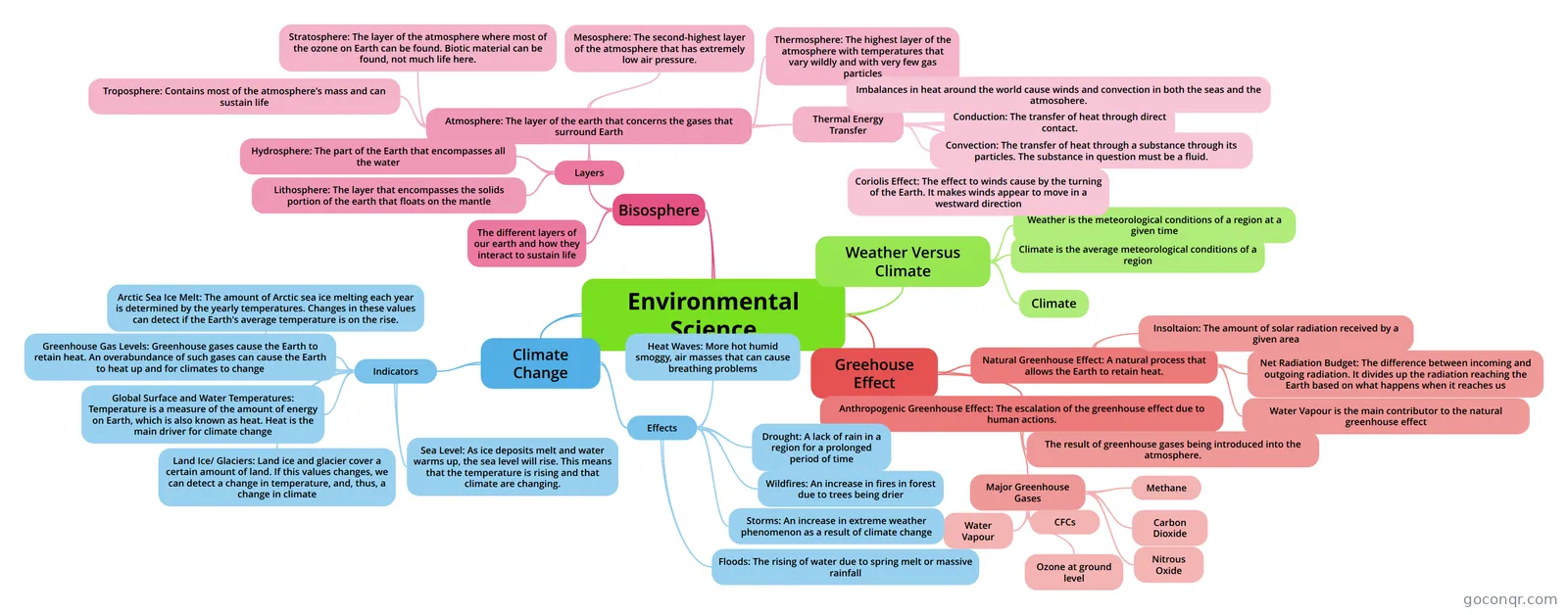
Mind map: Environmental science
Contenido del mapa
Environmental Science
Weather Versus Climate
- Weather is the meteorological conditions of a region at a given time
- Climate is the average meteorological conditions of a region
- Climate
Bisosphere
- The different layers of our earth and how they interact to sustain life
- Layers
- Lithosphere: The layer that encompasses the solids portion of the earth that floats on the mantle
- Hydrosphere: The part of the Earth that encompasses all the water
- Atmosphere: The layer of the earth that concerns the gases that surround Earth
- Troposphere: Contains most of the atmosphere's mass and can sustain life
- Stratosphere: The layer of the atmosphere where most of the ozone on Earth can be found. Biotic material can be found, not much life here.
- Mesosphere: The second-highest layer of the atmosphere that has extremely low air pressure.
- Thermosphere: The highest layer of the atmosphere with temperatures that vary wildly and with very few gas particles
- Thermal Energy Transfer
- Imbalances in heat around the world cause winds and convection in both the seas and the atmosphere.
- Conduction: The transfer of heat through direct contact.
- Convection: The transfer of heat through a substance through its particles. The substance in question must be a fluid.
- Coriolis Effect: The effect to winds cause by the turning of the Earth. It makes winds appear to move in a westward direction
Greehouse Effect
- Natural Greenhouse Effect: A natural process that allows the Earth to retain heat.
- Insoltaion: The amount of solar radiation received by a given area
- Net Radiation Budget: The difference between incoming and outgoing radiation. It divides up the radiation reaching the Earth based on what happens when it reaches us
- Water Vapour is the main contributor to the natural greenhouse effect
- Anthropogenic Greenhouse Effect: The escalation of the greenhouse effect due to human actions.
- The result of greenhouse gases being introduced into the atmosphere.
- Major Greenhouse Gases
- Methane
- Carbon Dioxide
- Nitrous Oxide
- CFCs
- Ozone at ground level
- Water Vapour
- Natural Greenhouse Effect: A natural process that allows the Earth to retain heat.
Climate Change
- Indicators
- Arctic Sea Ice Melt: The amount of Arctic sea ice melting each year is determined by the yearly temperatures. Changes in these values can detect if the Earth's average temperature is on the rise.
- Greenhouse Gas Levels: Greenhouse gases cause the Earth to retain heat. An overabundance of such gases can cause the Earth to heat up and for climates to change
- Global Surface and Water Temperatures: Temperature is a measure of the amount of energy on Earth, which is also known as heat. Heat is the main driver for climate change
- Land Ice/ Glaciers: Land ice and glacier cover a certain amount of land. If this values changes, we can detect a change in temperature, and, thus, a change in climate
- Sea Level: As ice deposits melt and water warms up, the sea level will rise. This means that the temperature is rising and that climate are changing.
- Effects
- Heat Waves: More hot humid smoggy, air masses that can cause breathing problems
- Drought: A lack of rain in a region for a prolonged period of time
- Wildfires: An increase in fires in forest due to trees being drier
- Storms: An increase in extreme weather phenomenon as a result of climate change
- Floods: The rising of water due to spring melt or massive rainfall
- Indicators
Información
- Descripción
- Mapa Mental sobre Environmental Science, creado por justin03 el 20/05/2014.
- Creado por
- justin03
- Visitas
- 88
- Valoración