
Mapa mental
Brain functions
Contenido del mapa
Brain functions
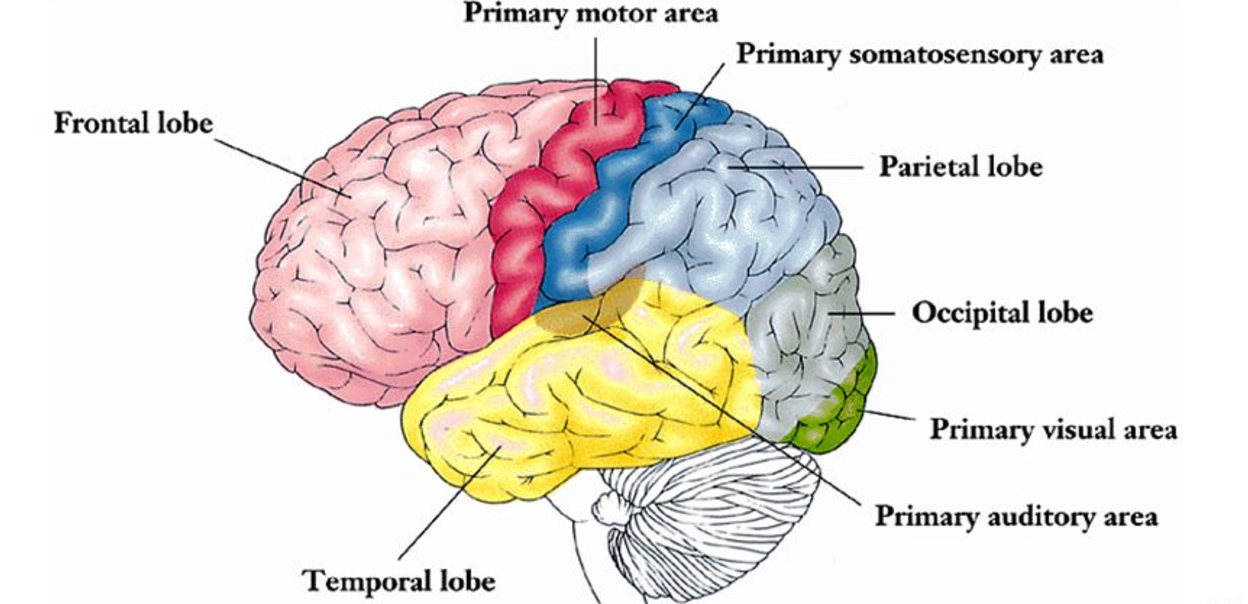
Localisation of brain function
- The theory that specific areas of the brain are associated with particular physical and psychological functions.
- Motor cortex - Controls voluntary movements
- Somatosensory cortex - processes information about touch, temperature and pain.
- Visual cortex - Processes information from the eyes.
- Auditory cortex - processes information from the ears.
- Broca's area - Located in the left hemisphere in the frontal lobe. This is responsible for the production of speech.
- Wernickes's area - Located in the left hemisphere in the temperal lobe. This is responsible for the understanding of language.
- Strengths
- Brain scan evidence supports the idea that neurological functions are localised - Tulving revealed that somantic long-term memories and episodic memories are located in different parts of the prefrontal cortex.
- Case studies of neurological damage supports the localisation theory.
- Phineas Gage - Had an accident which hurled a pole through his skull which took out most of his left frontal lobe. He survived but turned into someone who used to be polite, calm and reserved to someone quick tempered, rude and used vulgar language. This suggests that the frontal lobe is responsible for regulating mood.
- Weaknesses
- Most research into the localisation of brain function is carried out in case studies of damaged brains - not ethical to recreate so the sample is small and results cannot be generalised.
Lateralisation of brain function
- The brain is divided into 2 hemispheres - The left and right. Each hemisphere is responsible for specific functions.
- The left hemisphere - Processes information from the right side of the body (right visual field and controls right hand). It is also the language centre of the brain with the two language centres (Broca's and Wernicke's areas) located here.
- The right hemisphere - Processes information from the left side of the body (controls left hand and left visual field). It also focusses on visual-spatial tasks.
- The two hemispheres are separate but connected by a series of fibres, known as the corpus callosum.
- A surgery, known as a commissurotomy can be done to divide theses hemispheres. Usually done to improve severe epilepsy.
- Sperry and Gazzinga - Split brain research
- The study involved 11 patients who had gone through a commissurotomy to disconnect the two hemispheres. A control group was used to who had an intect corpus callosum. The participants were asked to cover one eye and look at a fixed point on a projection screen. Pictures were presented on either the left or right side of the screen at high speeds (no time for eye movement).
- Findings - If the picture was shown in the right visual field the participants could write or say what it was without an issue. If it was presented to the left visual field they couldn't say or write what they'd seen however they could select a corresponding object with their left hand, which represented what they'd seen with their left eye, even though they didn't know why they'd selected it.
- Conclusion - Shows that different areas of the brain specialises in different functions. The left hemisphere can convert sight into spoken and written work. Usually this information can cross over to the left hemisphere from the right. But as the results show, this can't happen in split brains, so information going to the right hemisphere can't be converted into speech at all. The right hemisphere can still produce a non-verbal response however.
- Findings - If the picture was shown in the right visual field the participants could write or say what it was without an issue. If it was presented to the left visual field they couldn't say or write what they'd seen however they could select a corresponding object with their left hand, which represented what they'd seen with their left eye, even though they didn't know why they'd selected it.
- Strengths
- Case studies used meant that qualitative and quantitative was obtained to gain a better understanding.
- Using more than one research method (experiments and case studies) meant that the reliability and validity of the results was increased.
- Weaknesses
- Only a very small sample was used (11 participants) which means the results cannot be generalised to everyone. It is also difficult to generalise it to real life situations as the ecological validity was low due to the experiment occuring in controlled conditions.
- It is unknown whether these people would process information as a 'normal' person as the epilepsy or medication could have affected their brains beforehand.
- The study involved 11 patients who had gone through a commissurotomy to disconnect the two hemispheres. A control group was used to who had an intect corpus callosum. The participants were asked to cover one eye and look at a fixed point on a projection screen. Pictures were presented on either the left or right side of the screen at high speeds (no time for eye movement).
- The brain is divided into 2 hemispheres - The left and right. Each hemisphere is responsible for specific functions.
Imágenes y archivos del mapa
Información
- Descripción
- A level (Biopsychology) Psychology Mapa Mental sobre Brain functions, creado por Natalie Bond el 13/06/2017.
- Creado por
- Natalie Bond · jun 2017
- Actualizado
- 13 jun 2017
- Visitas
- 5
- Valoración