
Mapa mental
Science Vs Ethics
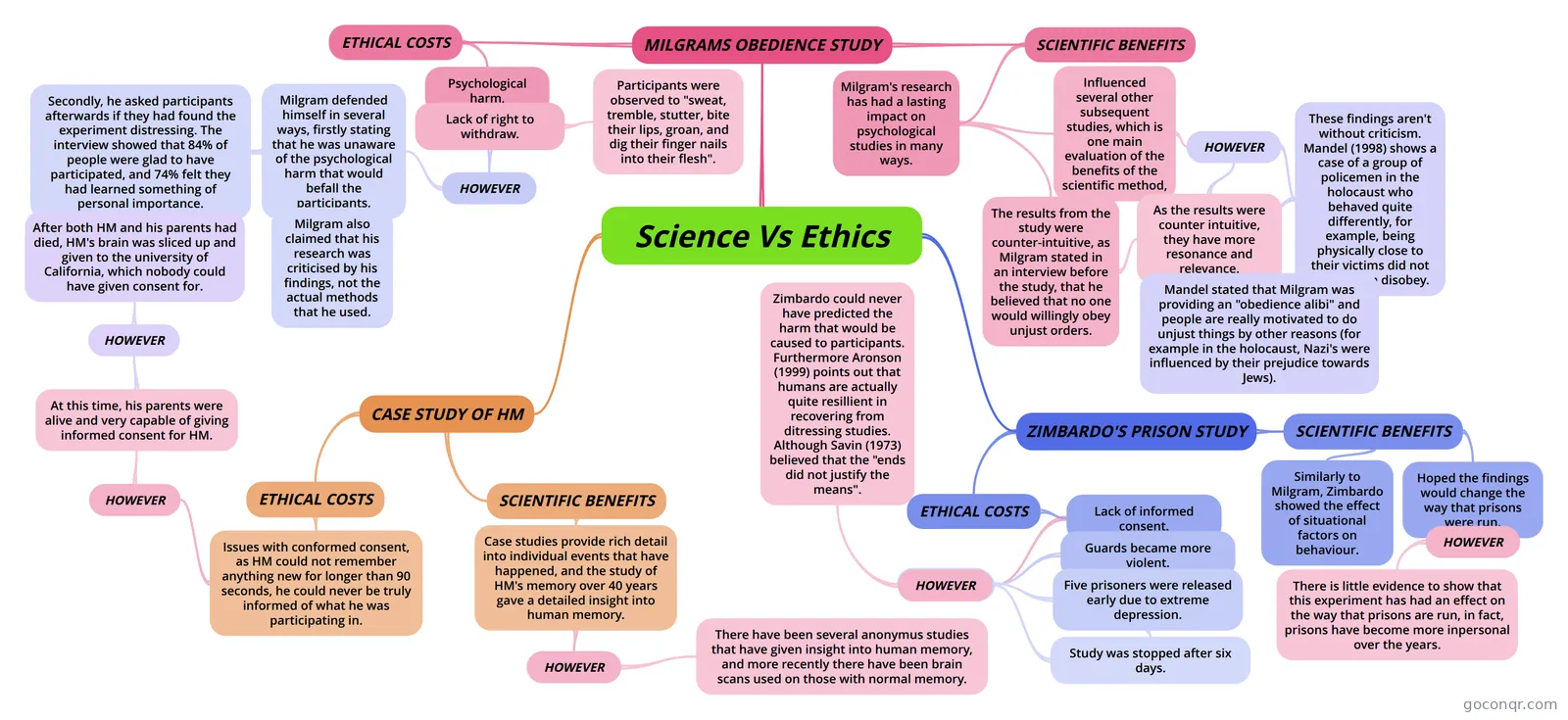
Mind map: Science vs ethics in psychology
Contenido del mapa
Science Vs Ethics
MILGRAMS OBEDIENCE STUDY
- SCIENTIFIC BENEFITS
- Milgram's research has had a lasting impact on psychological studies in many ways.
- Influenced several other subsequent studies, which is one main evaluation of the benefits of the scientific method,
- The results from the study were counter-intuitive, as Milgram stated in an interview before the study, that he believed that no one would willingly obey unjust orders.
- As the results were counter intuitive, they have more resonance and relevance.
- HOWEVER
- These findings aren't without criticism. Mandel (1998) shows a case of a group of policemen in the holocaust who behaved quite differently, for example, being physically close to their victims did not make them disobey.
- Mandel stated that Milgram was providing an "obedience alibi" and people are really motivated to do unjust things by other reasons (for example in the holocaust, Nazi's were influenced by their prejudice towards Jews).
- These findings aren't without criticism. Mandel (1998) shows a case of a group of policemen in the holocaust who behaved quite differently, for example, being physically close to their victims did not make them disobey.
- HOWEVER
- As the results were counter intuitive, they have more resonance and relevance.
- Influenced several other subsequent studies, which is one main evaluation of the benefits of the scientific method,
- Milgram's research has had a lasting impact on psychological studies in many ways.
- ETHICAL COSTS
- Psychological harm,
- Lack of right to withdraw.
- Participants were observed to "sweat, tremble, stutter, bite their lips, groan, and dig their finger nails into their flesh".
- HOWEVER
- Milgram defended himself in several ways, firstly stating that he was unaware of the psychological harm that would befall the participants.
- Secondly, he asked participants afterwards if they had found the experiment distressing. The interview showed that 84% of people were glad to have participated, and 74% felt they had learned something of personal importance.
- Milgram also claimed that his research was criticised by his findings, not the actual methods that he used.
- Secondly, he asked participants afterwards if they had found the experiment distressing. The interview showed that 84% of people were glad to have participated, and 74% felt they had learned something of personal importance.
- Milgram defended himself in several ways, firstly stating that he was unaware of the psychological harm that would befall the participants.
- Lack of right to withdraw.
- Psychological harm,
- SCIENTIFIC BENEFITS
ZIMBARDO'S PRISON STUDY
- SCIENTIFIC BENEFITS
- Similarly to Milgram, Zimbardo showed the effect of situational factors on behaviour.
- Hoped the findings would change the way that prisons were run.
- HOWEVER
- There is little evidence to show that this experiment has had an effect on the way that prisons are run, in fact, prisons have become more inpersonal over the years.
- HOWEVER
- ETHICAL COSTS
- Lack of informed consent.
- Guards became more violent.
- Five prisoners were released early due to extreme depression.
- Study was stopped after six days.
- Study was stopped after six days.
- Five prisoners were released early due to extreme depression.
- HOWEVER
- Zimbardo could never have predicted the harm that would be caused to participants. Furthermore Aronson (1999) points out that humans are actually quite resillient in recovering from ditressing studies. Although Savin (1973) believed that the "ends did not justify the means".
- Guards became more violent.
- Lack of informed consent.
- SCIENTIFIC BENEFITS
CASE STUDY OF HM
- SCIENTIFIC BENEFITS
- Case studies provide rich detail into individual events that have happened, and the study of HM's memory over 40 years gave a detailed insight into human memory.
- HOWEVER
- There have been several anonymus studies that have given insight into human memory, and more recently there have been brain scans used on those with normal memory.
- HOWEVER
- Case studies provide rich detail into individual events that have happened, and the study of HM's memory over 40 years gave a detailed insight into human memory.
- ETHICAL COSTS
- Issues with conformed consent, as HM could not remember anything new for longer than 90 seconds, he could never be truly informed of what he was participating in.
- HOWEVER
- At this time, his parents were alive and very capable of giving informed consent for HM.
- HOWEVER
- After both HM and his parents had died, HM's brain was sliced up and given to the university of California, which nobody could have given consent for.
- HOWEVER
- At this time, his parents were alive and very capable of giving informed consent for HM.
- HOWEVER
- Issues with conformed consent, as HM could not remember anything new for longer than 90 seconds, he could never be truly informed of what he was participating in.
- SCIENTIFIC BENEFITS
Información
- Descripción
- A-Levels (PY4 - Controversies) Psychology Mapa Mental sobre Science Vs Ethics, creado por tomrees6 el 16/05/2013.
- Creado por
- tomrees6
- Visitas
- 155
- Etiquetas
- Valoración