
Apuntes
China 1949-57
Contenido del apunte (1)
Página 1
Consolidation Of Power
once Mao was in power, he didn't reform china right away, he was careful. He took control of banks and public utilities also all foreign assets except the USSR's. Mao also offered compensation to land owners and share holders who were willing to work with the new China. Mao also knew how important the middle class was although they were far less in numbers than the peasants
Structure of the PRC
China was divided into six regions each governed by a bureau of four major officials:
Chairman
Party secretary
Military commander
political commissar
since the last two posts were filled by officers of the army, China was basically under military control. Something that Mao thought would give him the most stability.
Imposition of Military Control
A sign of the ruthless of the army cam be seen in how they dealt with the outlying areas of China. In a series of reunification campaigns three separate PLA armies were sent west and south.
One army went into Tibet (October 1950)
A second went to Xinjiang
A third went south to Guangdong
The "anti-movements"
Now that Mao had a successful military grip on China, he turned to extending his political control. in 1951, he announced the three anti-movements with the targets being:
Waste
Corruption
Inefficiency
It was later expanded to include
industrial sabotage
tax evasion
bribery
fraud
theft of government property
The aim of the anti-movements was to tear down what remained of the "bureaucratic capitalist class" which Mao had to tolerate during his first 3 years.
The First Five Year Plan (1925-6)
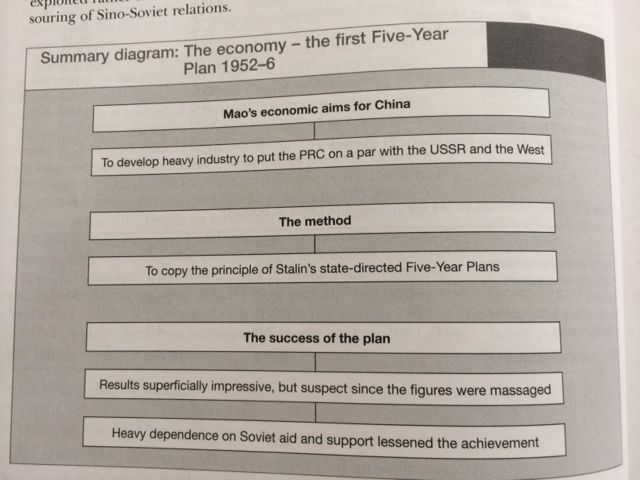
Mao's first five year was inspired by Stalin's success in the USSR with a similar plan. The main goals of the plan was to increase production of coal, steel and petrochemicals. There was also development of the Chinese automobile and transport industry. there was a tendency for officials to slightly exaggerate output figure to impress the government.
The Hundred Flowers Campaign
In early 1957, Mao told party officials to prepare themselves for criticism from the people. He called upon people in the government to openly state where they thought they had gone wrong. Once they had overcome their fear, members rushed to point out mistakes made, people complained about people and policies on the ground of corruption and inefficiency. some even went as far to include mild criticism of Mao.
New Page
Información
- Descripción
- International Baccalaureate History Apunte sobre China 1949-57, creado por Callum Paton el 09/05/2014.
- Creado por
- Callum Paton
- Visitas
- 572
- Valoración