
Apuntes
B1d: The nervous system
Contenido del apunte (6)
Página 1
Receptors
What are receptors?
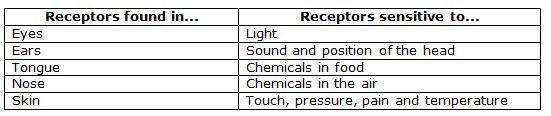
Receptors are groups of specialised cells. They can detect changes
(stimuli) in the environment. Receptors are often located in the sense organs,
such as the ear, eye and skin.
Página 2
The Eye
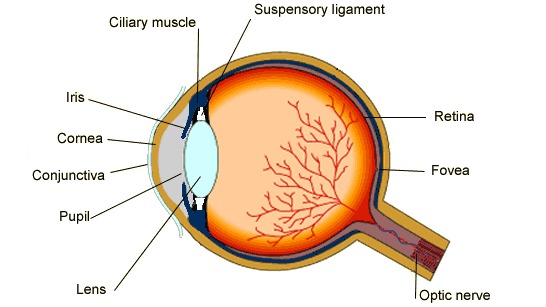
Here is a labelled diagram of an eye:
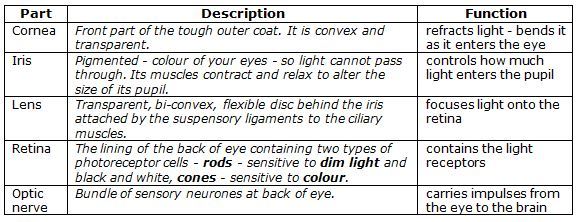
This table shows parts of the eye an their individual functions:
Página 3
Vision
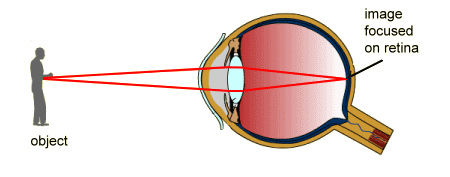
Pathway of light
Light is refracted by the cornea and lens, so that it is brought to a
focus on the retina.
What is binocular vision?
Predators (eg. humans) have eyes that are side by side, each eye captures a slightly
different view. This is called binocular vision.
When signals from the
two eyes reach the brain, they are compared and processed into a
single picture with depth.
As a result, predators get a 3D picture and are able
to judge distances well.
What is monocular vision?
Preys (eg. zebras) have monocular
vision - their eyes are on each side of their head.
This gives them a
greater field of view, which is useful for spotting predators. However,
they have poor depth perception.
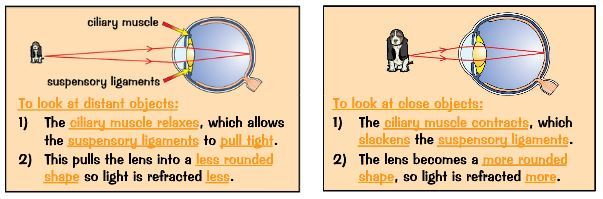
How does the eye focus on near and distant objects?
The lens is elastic, so the eye can focus light by changing the shape of the lens - this is known as accommodation.
Página 4
Vision defects
How is myopia developed?
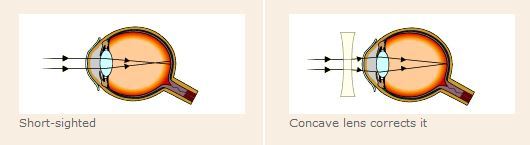
Myopia - short-sight
Someone with short-sight can see near objects
clearly, but can't focus properly on distant objects.
This is caused by
the eyeball being elongated, so that the distance between the lens and
the retina is too great.
It can be corrected by placing a concave lens
in front of the eye.
How is hypermetropia developed?
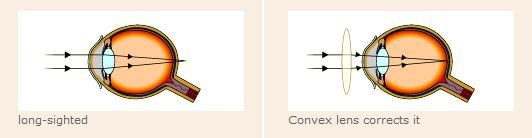
Hypermetropia - long-sight
Someone with long-sight can see distant objects
clearly, but can't focus properly on near objects. This is because the
lens focuses the image behind the retina, instead of on it.
This defect is often age-related, and due to a loss of elasticity in the
lens.
It is corrected by putting a convex lens in front of the eye.
Long and short-sight can be corrected by corneal surgery.
What is colour blindness?
Colour blindness is an inherited condition.
The retina contains cells that are sensitive to red, green or blue
light. People with colour blindness have a lack of receptors, or defects
in them.
People with red-green colour blindness, for example, have
difficulty distinguishing shades of red and green.
Página 5
The nervous system
What does the nervous system consists of?
The main parts of the nervous system are the central nervous system (CNS) - the brain and spinal cord - and the peripheral nervous system.
Nerve
impulses are mainly electrical and carried in neurones.
What are neurones?
Neurones are nerve cells. They carry information as
tiny electrical signals. There are three different types of neurones,
each with a different function:
sensory neurones carry signals from receptors to the spinal cord and brain
relay neurones carry messages from one part of the CNS to another
motor neurones carry signals from the CNS to effectors.
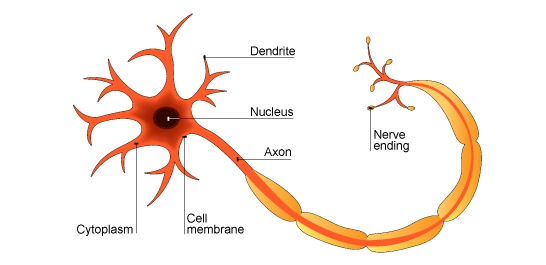
The
diagram below shows a typical motor neurone:
How do neurones transmit information around the body as electrical impulses?
Receptors detect changes in their environment (stimuli) and generates nerve impulses.
The electrical impulses are passed along the axon of the cell.
The sheath acts as an electrical insulator, which speeds up electrical impulse.
They are also long, which speeds up the impulse.
Neurones have branched endings (dendrites) so they can connect with lots of other neurones.
The impulses then travel between two neurones. This is a tiny gap called the synapse.
The electrical impulses triggers the release of transmitter chemicals, which diffuse across the gap
These chemicals bind to receptor molecules in the membrane of the next neurone. This sets off a new electrical impulse.
Página 6
Reflex actions
What is a reflex action?
When a receptor is stimulated, it sends a signal to the central nervous system, where the brain co-ordinates the response.
But sometimes a very quick response is needed, one that does not need the involvement of the brain. This is a reflex action.
What is the reflex sequence?
In a simple reflex action:stimulus → receptor → sensory neurone → relay neurone → motor neurone → effector
What happens during a reflex arc?
Reflex
actions are rapid and happen without us thinking. This is what happens:
Receptor detects a stimulus - change in the environment
Sensory neurone sends signal to relay neurone
Motor neurone sends signal to effector
Effector (muscle or gland) produces a response.
The way the iris in our eye adjusts the size of the pupil in response to bright or dim light is also a reflex action.
Información
- Descripción
- GCSE (Module B1: Understanding Organisms) Biology Apunte sobre B1d: The nervous system, creado por Carina C el 04/04/2016.
- Creado por
- Carina C
- Visitas
- 175
- Etiquetas
- Valoración