
Fichas
Vet 405 Exam 1

Fichas del conjunto (48)
- 1Nutrition - Energy Intake1) Animals eat primarily to meet their energy requirement
2) Less than 25% of the diet is typically needed to meet an animal's essential nutrient requirements - 2What are the main sources of energy in the diet?1) Carbohydrates (3.5 kcal AAFCO)
2) Fats (8.5 kcal AAFCO)
3) Proteins (3.5 kcal AAFCO)
4) Fiber (a form of carbohydrate) also can be a source of energy. The amount of energy provided by fiber depends on the composition of the fiber and the animal species (i.e. ruminant vs mono gastric). Ends up being metabolized like a fat
5) Vitamins and some minerals contribute to energy metabolism by serving as regulators, coenzymes or prosthetic groups for enzymes in major metabolic pathways. ex: Niacin --> NAD - 3What is the hormonal response to feeding?
- 4What is the hormonal response to fasting? (Hormones Increased)

- 5What is the hormonal response to fasting? (Hormones Decreased)

- 6How does a dog consuming a low carb diet supply glucose for RBCs, brain, and other tissues?Gluconeogenesis!
- The dog consuming the low carb diet will use the excess amino acids for gluconeogenesis (synthesis of glucose). Some glycerol from dietary lipids may also be used for gluconeogenesis
- The liver and kidneys are the only tissues capable of synthesizing glucose that can be released into the circulation. In the fed state, the liver will be the major site of gluconeogenesis in the dog consuming the low CHO diet - 7How does a dog consuming the high carb diet deal with the excess carbs in its diet?Lipogenesis!
- Glycogen is bulky since a substantial amount of water is associated with the hydroxyl groups in the glycogen molecule. Thus, only a limited amount of glucose can be stored as glycogen
- The dog consuming the high carb diet will need to activate lipogenesis to convert some of the glucose from this diet to fatty acids which can readily be stored in triglycerides
- In dogs, lipogenesis occurs primarily in the liver
- Activation of lipogenesis will be much greater with the high carb versus low carb diet - 8What changes in metabolism occur following digestion and absorption of carbs, proteins, and lipids from a meal?- There is a switch in metabolism when meal ends
- Not as much coming into the small intestine
- Start to use stored glucose
- Needs stimulus to break down liver glycogen and ramp up gluconeogenesis - 9GLUT-1A generic transporter found in almost every cell; Km for glucose of about 1mM
- 10GLUT-2A glucose transporter found in liver and alpha and beta cells of the pancreas with a high binding constant for glucose
- 11GLUT-4A glucose transporter with a low binding constant, high affinity for glucose, that is known to move from intracellular to membrane locations, especially in response to insulin. It is present in muscle and adipose tissue
- 12Hexokinase-2- Km for glucose = 250 um
- Inhibited by G6P
- Found mostly in insulin-sensitive cells, such as muscle and adipose tissue
- It is adaptable
- Phosphorylates glucose - 13Hexokinase-4- Km for glucose = 20,000 uM or 20 mM
- NOT inhibited by G6P
- Found in liver >>> B cells >>> kidney
- It is adaptable and especially sensitive to insulin
- Phosphorylates glucose, will keep acting as long as there is glucose available - 14Oropharyngeal phase of swallowingOral - prehension, aboral transport to tongue base
Pharyngeal - transport of bolus from oropharynx to hypopharynx
Cricopharyngeal - transport of bolus through upper esophageal sphincter - 15Esophageal phase of swallowingBolus transport from upper to lower esophageal sphincter
- 16Gastroesophageal phase of swallowingBolus transport through lower esophageal sphincter
- 17Causes of Emesis1. GI disease - gastritis, GI obstruction etc
2. Non-GI disease - pancreatitis, hepatobiliary disease
3. Systemic disease - uremia, toxins, opioids
4. Neurologic disease - vestibular disease: trauma, meningitis, motion sickness - 18Indications for Anti-emetic drugs- Continued emesis: dehydration, acid-base or electrolyte disorders, aspiration pneumonia
- Prevent motion sickness
- Emesis associated with radiation or chemo
- Typical indications: pancreatitis, gastritis/enteritis, peritonitis, hepatic or renal disease - 19What are the 4 primary anti-emetics?1. Maropitant (Cerenia)
2. Ondansetron (dolasetron)
3. Metoclopramide
4. Antihistamines - 20Maropitant1) MECHANISM: Neurokinin 1 (NK-1) receptor antagonist
- Centrally acting
- Substance P antagonist (which binds to NK-1 receptors)
- Blocks activation of nucleus of solitary tract, the common final step in initiation of emesis
2) Approved in both dogs and cats
- SC or PO, extra-label IV
- Generally for short term use (<=5 days)
3) Types of emesis:
- Both peripheral and central emetogens
- First line anti-emetic in pancreatitis and GI disease
- Drug induced
- Motion sickness
4) Some visceral analgesia (Substance P inhibition) - may provide some animals with gastritis, enteritis, etc with relief
5) Adverse effects
- Rare drool, lethargy
- Decreased appetite, diarrhea
- Injectable stings
- Bone marrow suppression in young puppies possible
- Has some calcium channel blocker activity: use with caution in patients on Ca channel or beta blockers
6) Being used in pigs now extralabelly and studying use in horses - 21Odansetron1) MECHANISM: Serotonin Antagonist (5-HT3) - inhibit serotonin receptors in the chemoreceptor trigger zone
2) Types of emesis: chemotherapy, radiation, chemical irritants to the gut (enterochromaffin cells degranulate > release 5-HT, adjunctive for pancreatitis and GI origin emesis, NOT effective vs motion sickness or vestibular - not as potent against central stimuli
3) Administered IV
4) Not highly effective at reducing nausea, even though it controls emesis
5) Adverse effects: generally very safe in animals, tachycardia, bradycardia, PR and QT prolongation on ECG in humans, disrupt GI motility - constipation and diarrhea - 22Metoclopramide1) MECHANISM: D2 inhibits dopaminergic transmission in CNS (D2 antagonist), Inhibits serotonin receptors in chemoreceptor trigger zone (5-HT3 antagonist, weak), inhibits histamine-1 receptors (H1 antagonist, weak), Peripheral: Prokinetic effect = increases gastric and duodenal emptying
2) More effective in dogs
3) Types of Emesis: chemotherapy, delayed gastric emptying - reflux gastritis, viral enteritis, weak for motion sickness
4) Routes: oral, IV
5) Adverse Effects: CNS excitement (extrapyramidal signs) - drug induced movement disorders through activation of brainstem extrapyramidal tracts, restlessness, agitation, CONTRAINDICATED IN SEIZURING PATIENTS, Caution in heart failure - increases aldosterone > edema, Do not use in animals with GI obstructions - prokinetic activity - 23Antihistamines1) MECHANISM: H1 receptors blockers, block cholinergic nerve transmission from vestibular system to vomiting center, block histaminic nerve transmission from vestibular system to vomiting center
2) Types of emesis: motion sickness, vestibular disease
Examples: Diphenhydramine, Dimenhydrinate (Dramamine), Hydroxyzine
3) More effective in dogs than cats
4) Adverse effects: mild sedation, paradoxical excitation (anticholinergic) - 24Phenothiazines1) MECHANISM: Dopamine antagonist (D2 antagonist), alpha2 antagonist, weak antihistamine (H1 antagonist), weak anticholinergic
2) Examples: acepromazine, chlorpromazine, prochlorperazine
3) Types of Emesis - broad spectrum centrally acting antiemetics: motion sickness (cats) vestibular, not as effective in dogs with inner ear disease, Variety of causes - GI origin, drug induced, less for chemo induced
4) Side Effects: hypotension (alpha1 antagonism): Don't use in hypotensive or dehydrated patients, sedation, extrapyramidal signs, lowering of seizure threshold? - more recently called into question - 25Butorphanol1) MECHANISM: Mixed opioid agonist-antagonist, acts directly on vomiting center
2) Types of emesis: chemo induced emesis
3) Side effects: mild sedation, constipation - 26Indications for Gastroprotectants1. Treatment or prevention of gastritis or gastric ulcer disease
2. Very important in dogs, horses, ruminants, camelids - less important in cats
3. Stress - hypoperfusion of gastric mucosa
4. Drug therapy - NSAIDS, Corticosteroids
5. Hyperacidity - anorexia (large animals), mast cell tumor (dogs)
6. Uremia
7. Infectious disease - ruminants (clostridial) - 27Gastric Acid SecretionHCL secretion by parietal cell
1. Cholinergic (muscarinic) stimulation from gastric distention/meal in small animals - horses are continual gastric acid secretors, although meals increase further
2. From Histamine H2 receptor stimulation
- Histamine from enterochromaffin cells (they are stimulated by gastrin to release histamine from the G cells, which secrete gastrin into systemic circulation)
- Direct stimulation by gastrin via gastrin receptor on parietal cell - 28Antacids1. Aluminum hydroxide - constipating
2. Magnesium hydroxide or oxide - laxative
3. Calcium carbonate
MECHANISM: neutralize gastric acid**, decrease pepsin activity, bind bile acids, stimulate PGE1
Not as potent as other anti-ulcer meds - 29Antacids Adverse Effects1. Mg can be absorbed (20%)* --> hypermagnesemia
2. Bind other drugs administered orally - i.e. doxyxycline, enrofloxacin
3. AI can interfere with phosphorus absorption - 30Sucralfate1. Disassociates to sucrose octasulfate and aluminum hydroxide in acid environment
2. Cytoprotective - forms a gel and coats areas that have lost epithelium. Can provide some analgesia and promote healing by:
- Sucrose octasulfate polymerizes and binds to ulcerated mucosa
- Decreases H++ secretion
- Inactivates pepsin
- Absorbs bile acids
- Increases PGE1 synthesis - 31Sucralfate Adverse Effects1. Constipation
2. Very safe (not absorbed)
3. Binds other medications
4. Decreases P absorption (Al) - 32What are the main ways glycolysis can be controlled?1. Product inhibition
2. End product inhibition
3. Limited [substrate] or [cofactor]
4. Activation or feedforward activation
5. Binding to the enzyme of a regulatory protein
6. Addition or removal of a prosthetic group, most often Pi
7. Adaptive increase or decrease in amount of enzyme protein - 33What three glycolytic enzymes catalyze spontaneous reaction?Hexokinase, Phosphofructokinase, and Pyruvate Kinase
- 34Local controlInvolves dependence of enzyme-catalyzed reactions on concentrations of pathway substrates or intermediates within a cell
- 35Global controlInvolves hormone-activated production of second messengers that regulate cellular reactions for the benefit of the organism as a whole
- 36HexokinaseGlucose + ATP -> Glucose-6P
- This is a priming reaction: ATP is consumed here in order to get more later
- ATP makes the phosphorylation of glucose spontaneous - 37How does G6P inhibit hexokinase 2?By competition at the active site, as well as by allosteric interactions at a separate site on the enzyme
- 38Which cytosolic liver enzyme is the most sensitive and specific for hepatocellular injury in the dog?ALT
- 39Which enzyme is found in the mitochondria of hepatocytes in dogs?AST
- 40ALTHigh sensitivity in small animals, detects even mild hepatic injury. High specificity - rarely increased with muscle disease or trauma. Indicative of leakage if high
- 41ASTHigh sensitivity in all species. Detects lethal damage, necrosis. Low specificity in all species - large amounts in liver, muscle, RBCs
- 42GLDHMost specific enzyme in birds
- 43What is cholestasis?Interruption or obstruction of bile flow or excretion secondary to physical obstruction of bile flow or from metabolic problems
- 44What are the cholestatic enzymes?ALP and GGT
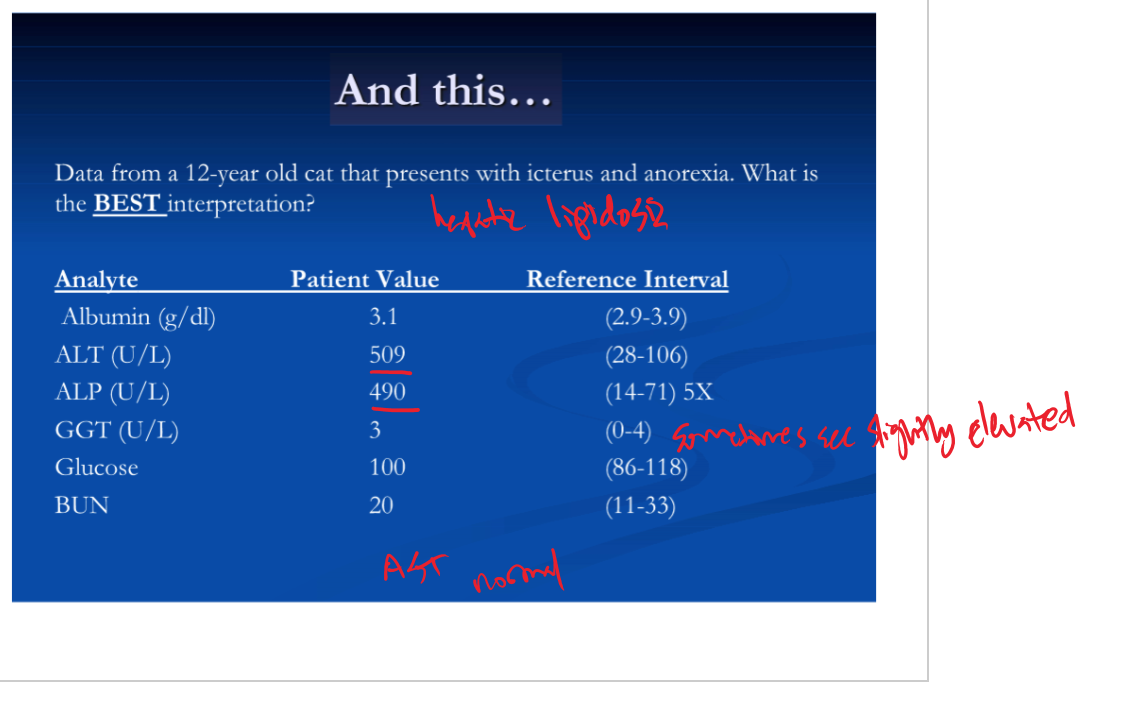
- 45GGTBetter than ALP in large animals. Not usually increased in feline hepatic lipidosis
- 46Icteric cat

- 47Another icteric cat
- 48Name the components of the "lipid" categoryFatty acids, triacylglycerides, phospholipids and glucolipids, and cholesterol