
Fichas
Exam 2 Psych
Fichas del conjunto (86)
- 1Selective Attentionfocusing your awareness on something while ignoring the other things around you.
ex: talking to someone in a crowded, public place - 2Inattentional Blindnessfailure to perceive something outside of the focus of your attention
ex: trying to drive around a traffic accident and not noticing your child unbuckling in the back - 3Change Blindnessform of inattentional blindness
one does not notice a change in a visual stimulus
ex: not noticing a major change in a flickering picture - 4REM Sleep (what is it?)The last stage of sleep characterized by rapid eye movements, brain activity similar to being awake, faster heart/breathing rates, dreams and no moving
where dreaming occurs - 5REM ReboundSpending more time in REM sleep if previous nights you were deprived of it
- 6Sleep Stages Time in EachStage 1- NREM (Falling asleep- Theta)
occurs at beginning and end of night
only lasts a few minutes (5%)
Stage 2- NREM (Light Sleep)
multiple rounds a night (45%)
brain waves slow down but have bursts of activity
Stage 3- NREM (Deep sleep- Delta)
needed to wake up feeling rested
hard to wake up; if woken, they will have sleep inertia (mental fog)
Goes back to 2, then to REM
20-25%
REM Sleep- Dreams
eyes move behind eyelids when sleeping
awake brain activity
25% of time asleep - 7Why do we Sleep?Repair Theory:
-provides ability for body to restore and rejuvenate
-sleep deprivation effects mood, attention, and RT
-helps learning and memory
Adaptive Theory:
-conserve energy
-predator vs. prey
-hibernation
-animals sleep even when not safe to do so - 8Sleep DisordersInsomnia: trouble falling asleep, staying or getting good qual. sleep
Sleep Apnea: serious disorder that makes breathing stop and start while sleeping
Narcolepsy: chronic neuro. disorder that controls sleep/wake cycles- falling asleep often while doing things
Sleep Terrors: intense fear, crying, screaming when not fully awake
Sleepwalking- walking/do things that should only happen when awake
Sleep Eating: Eating when sleeping, could cause eating disorders
Rem Behavior Disorder (RBD): Dream-enactment behaviors including kicking, punching, talking, emotional outbursts, etc. during sleep - 9Circadian Rhythms24-hour cycles that are part of the body’s internal clock, running in the background to carry out essential functions and processes.
- 10Jet Lagtemporary sleep disorder
a combination of fatigue and other symptoms caused by travelling abruptly across different time zones. - 11Content of Dreamsyou can only remember dreams in the middle of the night if you wake up. there are dreams in every stage but higher stages are more detailed (rem)
People usually have more negative than positive dreams
Usually involving people you know, not strangers - 12Theories of DreamingWish Fulfillment (Freud): Dreams provide fulfillment for repressed wishes which meaning is usually masked
-Latent (hidden/true meaning) vs manifest content (what you remember dreaming about)
Activation Synthesis: Dreams are our subjective awareness of our brain signals that are generated during REM sleep
-No new information, just processing
-Random activation
Neurocognitive Model: thinking under conditions of reduced sensory input and absence of voluntary control
-dreams reflect interests, personality and worries (reflection of life)
-random - 13Hypnosis"cooperative social interaction in which hypnotized person responds to suggestions with changes in perception, memory and behavior.
-anyone can be if they want to be - 14Behaviors under HypnosisPosthypnotic Amnesia: Inability to remember events (loss of memory)
Posthypnotic Suggestion: Person will carry out suggested behavior
Hypermnesia: Memory enhancement (helping someone remember something)
Hypnotic Analgesia: Pain reduction - 15Applications for HypnosisMedical and dental uses
Police investigations (can help memory, but not reliably)
Behavioral Change
Can make people believe they are not in pain - 16Psychoactive drugsDrugs that affect a person's psychological state
- 17Drug Terms: Toleranceincreasing amounts of drug are needed for the same effect
- 18Drug Terms: Physical Dependencebody and brain chemistry adapt to the drug, you need it to feel normal
- 19Drug Terms: Psychological DependenceStrong desire to use the drug again, even when not experiencing withdrawal or physical need for the drug
- 20Drug Terms: Withdrawalunpleasant physical reaction to lack of a drug
- 21Drug Terms: Addictioncaused by both physical and psychological dependence, but seems to be affected by both genetics and environmental factors
- 22Types of Drugs 1- Depressantsdepressants: depress or inhibit the nervous system. produces drowsiness, sedation or sleep
-reduces pain and produces euphoria
-physical dependence and withdrawal are common
alcohol, opiates, barbiturates, tranquilizers - 23Types of Drugs 2- Stimulantsstimulants: stimulate nervous system
-increase alertness and reduce fatigue
-mildly addictive
caffeine, nicotine, amphetamines, cocaine - 24Types of Drugs 3- Hallucinogens (psychedelics)hallucinogens: cause perpetual distortions and mood alterations
-can have unpredictable affects
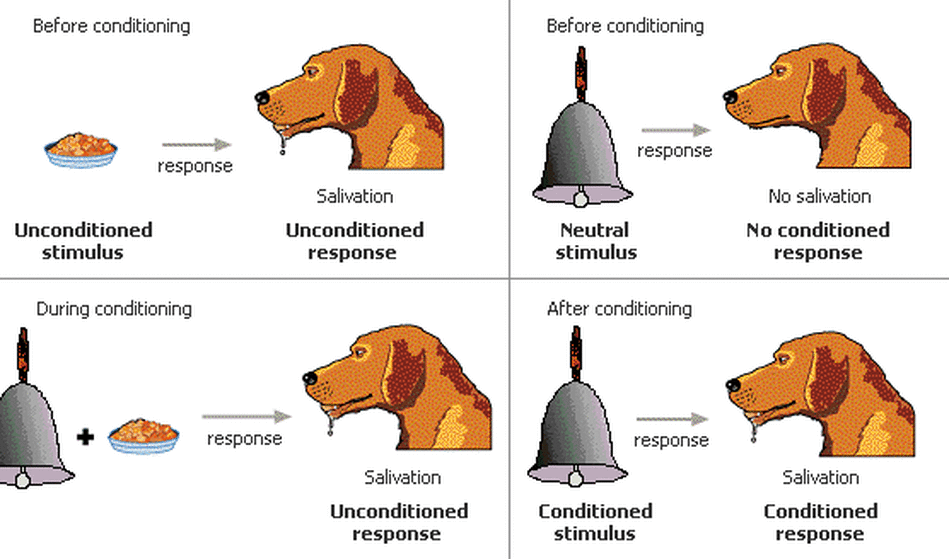
peyote, LSD, PCP, weed, MDMA (ecstasy) stimulant + psychedelic - 25Classical ConditioningINVOLUNTARY
kind of learning in which a neutral stimulus acquires the ability to produce a response that was originally produced by a different stimulus - 26Unconditioned Stimulussomething that happens in the environment that triggers an automatic response
ex. loud noise - 27Unconditioned Responsea response that is not learned but is natural
ex. child crying out of fear - 28Conditioned Stimulusa learned stimulus that can eventually trigger a conditioned response
ex. a rat being put with the loud noise - 29Conditioned Responsea behavior that does not come naturally, but must be learned by the individual by pairing a neutral stimulus with an unconditioned stimulus.
ex. crying at the rat that is now associated with sound - 30The Procedure for Classical Conditioninga person or animal learns to associate a neutral stimulus (conditioned stimulus) with a stimulus (unconditioned stimulus) that naturally produces a behavior (unconditioned response).
- 31Classical Conditioning Concepts: Stimulus Generalizationrespond to a stimulus similar to the conditioned stimulus with response similar to the conditioned response
(have to learn one stimulus to relate it to another)
ex. being scared of a dog because it bit you, and it transfers to fearing other dogs as well - 32Classical Conditioning Concepts: Stimulus Discriminationresponse to particular stimuli but not others
ex. your cat being able to tell the difference between a chip bag opening a treat bag opening - 33Classical Conditioning Concepts: Extinctionif conditioned stimulus is repeatedly presented alone, conditioned stimulus stops eliciting conditioned response
ex: you stop giving the treat to the dog while asking it to do tricks, it will eventually stop doing the trick because there is no longer a treat reward - 34Classical Conditioning Concepts: Spontaneous RecoverySometimes conditioned response with reappear after extinction even though no further conditioning trials have occurred
ex: the dog doing the trick even though no treat is given after a short period of time - 35Taste AversionA classically conditioned response where individuals are more likely to associate nausea with food than with other environmental stimuli.
ex: getting nausea or vomiting after drinking milk and then avoiding it after the incident. - 36Phobiasassociating something we do not fear with something we do fear so they coincide
fearing the bite, not the dog
but the bite makes you scared of dogs and develop a phobia - 37Operant ConditioningVOLUNTARY
kind of learning in which the consequences that follow some behavior increase or decrease the likelihood of that behavior occurring in the future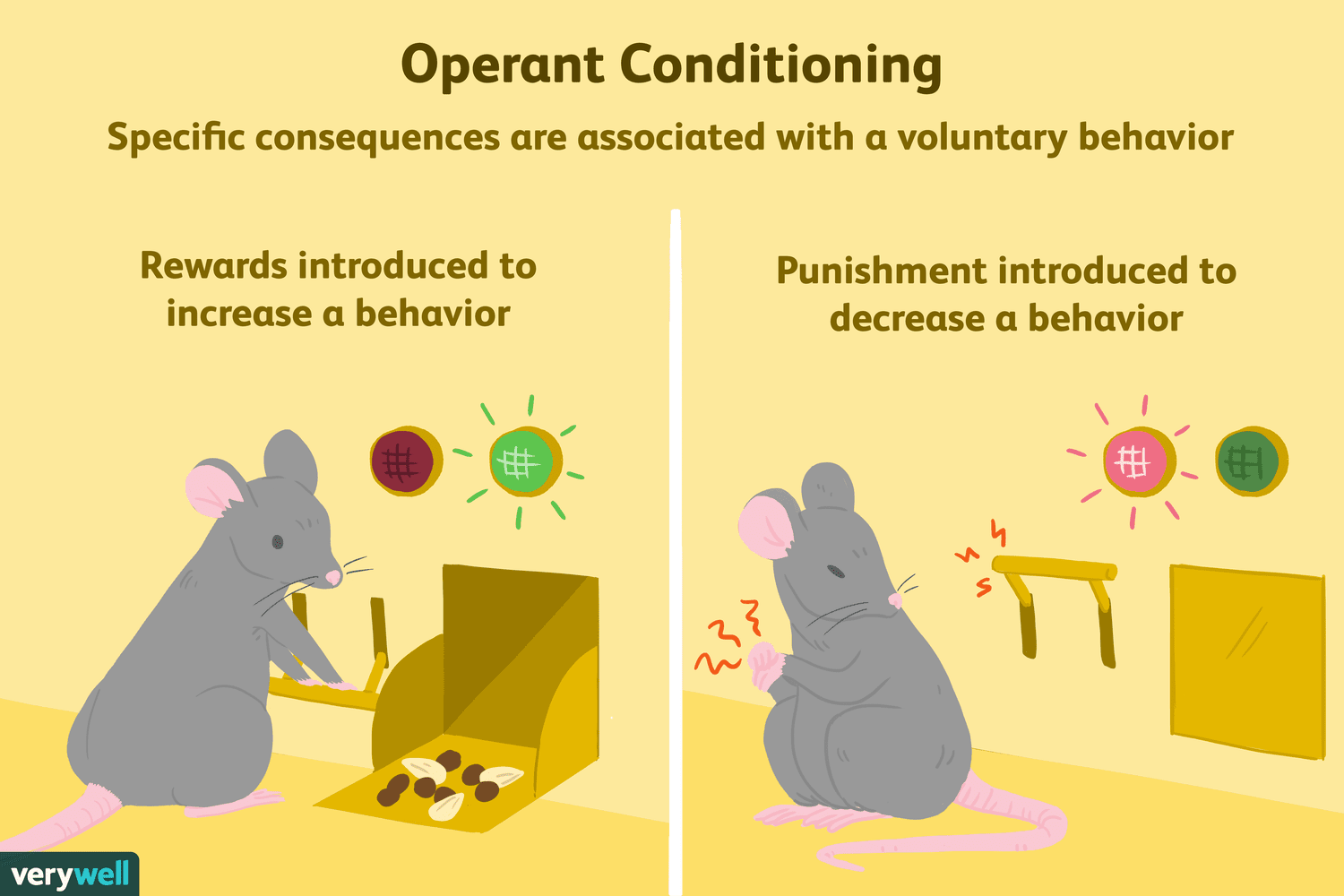
- 38Reinforcement vs. PunishmentReinforcement (pos. vs neg.) increases likelihood of behavior happening
Punishment (pos. vs neg.) decreases likelihood of behavior happening - 39Shapingawarding people as they get closer and closer to desired behavior
ex. giving a treat to a dog doing the steps to complete a full trick - 40Schedules of Reinforcementcontinuous: when first shaping, more treats are given
partial reinforcement: rewarding later/less as behavior is learned more.
ex: giving a treat every couple of tries rather than every try - 41Types of Partial ReinforcementFIXED VS. VARIABLE RATIO, FIXED VS. VARIABLE INTERVAL
interval: how much TIME has passed between reinforcements
ratio: NUMBER of responses between reinforcements
fixed ratio- reinforcement given after a set number of responses
variable ratio- reinforcement is given after a variable number of responses
fixed interval- reinforcement given for a first response after a set amount of time
variable interval- reinforcement is given for the first response after a variable amount of time - 42Positive Reinforcementpresentation of positive stimulus, leading to increase in frequency of a behavior
(giving something to get good behavior)
ex: giving a toy for good behavior - 43Negative Reinforcementremoval of a negative stimulus, leading to an increase in frequency of a behavior
(taking something away to get good behavior)
ex: removing a grounding period because the child worked on their homework - 44Positive Punishmentpresentation of a negative stimulus, leading to a decrease in the frequency of behavior
ex: giving a child a time out for acting out - 45Negative Punishmentremoval of a positive stimulus, leading to a decrease in the frequency of a behavior
ex: not letting a kid go outside to play because their homework was not completed - 46Observational Learninglearning in which a person observes and imitates a behavior from a model
ex: watching an adult put on clothes, the child learns how to put on clothes - 47Reinforcementconsequence that increases the likelihood that a behavior will be repeated
ex: candy to a child participating in class - 48Punishmentconsequence that decreases the likelihood that a behavior will be repeated
ex: making a child do more chores and taking away free time - 49Associative Learningform of learning that involves making connections between stimuli and behavioral responses
ex: Training an animal with treats when they are good or punishments when they are bad - 50Nonassociative Learningform of learning that involves a change in magnitude of an elicited response with repetition of the eliciting stimulus
- 51Habituationreduction in response to a specific stimulus after repeated exposures to it
associated with nonassociative learni
ex: Horns that honk multiple times every hour will become background noise much more quickly than the sound of an ambulance siren that only passes by once each week. - 52DishabituationThe recovery of a response that has undergone habituation, typically as a result of the presentation of a novel stimulus.
ex: hearing the car noises outside your window more than you usually do again, when it used to just be background noise - 53Sensitizationan organism becomes more sensitive, or responsive to a repeated stimulus
form of nonassociative learning
ex: an antidepressant becoming more effective through repeated use - 54Memorythe ability to retain information over time
- 55Encodingprocess of transferring information into a form that can be put into memory
- 56Storageprocess of retaining information for later use
- 57Retrievalrecovering stored information into conscious awareness
(taking things out of memory) - 58Atkinson and Shiffrin's Multistore Model (Sensory, Short Term, Long Term)model proposing that information flows from our senses through three storage levels in memory
sensory, short term, long term - 59Sensory Memorystorage level of memory that holds sensory information on the order of milliseconds to seconds
- 60Short-Term Memorystorage level of memory where information can be held briefly, from seconds to less than a minute
-allows us to think about and process information. if you are thinking about it, it goes here
-small capacity
- 7+/-2 chunks for verbal info
-new info interferes with old - 61Long-Term Memorystorage level of memory where information can be held for hours to many years and potentially a lifetime
-holds facts, rules, events, definitions, and experiences that someone can recall when necessary. - 62Iconic Memoryrapidly decaying store of VISUAL sensory information
- 63Echoic MemoryA rapidly decaying store of AUDITORY sensory information
- 64Chunkingprocess of grouping stimuli together in chunks in working memory to increase the amount of information stored in short-term memory
- 65Working Memorycomponent of memory that allows for both the short-term storage and manipulation of information in real time
- 66Maintenance Rehearsalthe straight repeating of information to memorize it
- 67Elaborative Rehearsala memory and learning technique that involves the formation of associations and connections between new information and knowledge that has already been learned.
- 68Serial Position Curvetend to remember the first piece of information we encounter better than the rest.
because: the earlier information is put into long-term memory, and later items are not - 69Primacy Effecta tendency to better remember stimuli that are presented early in a list.
- 70Recency Effecttendency to remember stimuli more at the end
- 71Episodic MemoryPERSONAL EXPERIENCE
The explicit recollection of personal experience that requires piecing together the elements of that time and place. - 72Semantic MemoryCONCEPTS, FACTS
Explicit memory supporting knowledge about the world, including concepts and facts. - 73Procedural MemoryHOW TO DO THINGS / SKILLS
a type of long-term memory involved in the performance of different actions and skills.
ex: riding a bike - 74Explicit MemoryCONSCIOUS
form of memory that involves intentional and conscious remembering
-recalling previous information consciously
-memory fades in absence of recall - 75Implicit MemoryUNCONSCIOUS
form of memory that occurs without intentional recollection or awareness and can be measured indirectly through the influence of prior learning on behavior.
-procedural memory, priming, conditioning - 76Anterograde AmnesiaCANNOT FORM NEW MEMORIES
inability to transfer information from short-term to long-term memory, preventing new long-term memories from forming. - 77Retrograde AmnesiaCANNOT REMEMBER PAST EVENTS
form of amnesia in which access to memories prior to brain damage is impaired, but the individual can store new experiences in long-term memory. - 78Retroactive InterferenceNEW OVER OLD
new learning interferes with remembering old information
ex: not being able to remember your old password after you changed it to something new - 79Proactive InterferenceOLD OVER NEW
old information interferes with learning new information
ex: not remembering your new password, and instead remembering your old one - 80Created (Reconstructed) Memoriesmemories are actively and consciously rebuilt when we are trying to remember certain things
ex: trying to remember something, sometimes schemas get involved and fill it what it think might've happened, resulting in a memory that didn't really happen. - 81Schemasmental representation of past experiences (general knowledge about how the world works, semantic)
ex: knowing where a light switch is located when it is dark - 82Schemas Scenesinformation about spatial layout (where things are located)
- 83Schemas Scriptsinformation about temporal sequence (sequence of events, order that things happen)
ex: we rely on schemas when we are uncomfortable, telling us how to do things and this gets contested in areas where it is unfamiliar - 84Eyewitness Memoryan individual's recollection of an event, often a crime or accident of some kind, that they personally saw or experienced.
the longer someone waits to say what they saw, the memory fades and some details can change. memories can be effected with certain questions, making answers different. if witness stories are different the second time around, they are discounted. this is why eyewitnesses aren't always reliable witnesses. - 85Misinformation EffectThe decreased accuracy of episodic memories because of information provided after the event.
memories come consistent with information and it is altered
ex: asking someone if they saw a gun can make someone believe a gun was there and say saw it, even if they did not. memories change because of information after - 86Infantile Amnesia Why?The inability of adults to retrieve episodic memories from the first few years of life.
This is due to the underdevelopment of the infant brain, which would preclude memory consolidation or to deficits in memory retrieval.