
Flashcards
1.1 Atomic Structure
Cards in this deck (54)
- 1Why do we need to know the masses of atoms and molecules?To calculate the Ar (relative atomic mass)
- 2What 4 things can we find out using a mass spectrometer?•Isotopic mass
•Relative abundance of isotopes
•Molecular mass
•Ionisation energy - 3How do you calculate the Ar using a mass spectrometer?Abundance of each isotope x mass
------------------------------------------
total abundance - 4What are the 4 stages of a mass spectrometer?•Vaporisation
•ionisation
•deflection
•detection - 5What are the 2 types of ionisation?•Electron bombardment
•Electrospray ionisation - 6What happens in electron bombardment and when is it used?•High energy electrons are fired at the sample from an electron gun, which knocks off one electron from each atom
•Used for isotopes/low Mr compounds - 7What happens in electrospray ionisation and when is it used?•Sample is dissolved in volatile solvent and injected through nozzle and sprayed into vacuum chamber
•Voltage is applied to end of nozzle (which is positively charged) so the particles gain a proton
•Used for high Mr compounds - 8What is the equation for electron bombardment?X(g) + e- -----> x+(g) - 2e-
- 9What is the equation for electrospray ionisation?X(g) + h+(g) -----> XH+(g)
- 10What happens in the acceleration stage?Ions are accelerated using an electric field so that all the ions have the same kinetic energy
- 11What happens in the ion drift stage?Lighter ions travel faster. Different ions have a different time of flight
- 12What happens at the detector?Detector is negatively charged. Current is produced when ions hit it - more ions means a bigger current is created.
- 13What does a mass spectrum show?Abundance against mass/charge ratio (m/z). Charge is usually 1 so m/z value is usually mass.
- 14What does the amount of peaks signify on a mass spectrum?Different isotopes
- 15How can you tell how many shells an element has by looking at the periodic table?Look at period number
- 16How can you tell how many electrons on the outer shell an element has by looking at the periodic table?Look at group number
- 17What is the proper term for "shells"?Principal energy levels
- 18What is the proper term for "electrons on outer shell"?Principal quantum number
- 19What are orbitals?Space where electrons are found
- 20How many electrons do each type of orbitals hold?2 max
- 21What are the 4 types of orbitals?s, p, d and f
- 22What are shells split into?Sub-shells
- 23What can an s sub-shell hold?1 s-orbital
- 24What can a p sub-shell hold?3 p-orbitals
- 25What can a d sub-shell hold?5 d-orbitals
- 26How do electrons fill orbitals? (2)•Lowest energy level first (4s before 3d)
•Singly before pairing - 27Why does 4s fill before 3d?4s has slightly lower energy than 3d before it is filled meaning electrons go into 4s before 3d (Aufbau principle)
- 28What are the 2 exceptions to the Aufbau principle?Chromium and copper because they give one electron from 4s to 3d to make it either half full (Cr) or full (Cu) so it is stable
- 29Why are 4s electrons lost before 3d electrons in transition metals when forming ions?As soon as 4s and 3d sub-shells have electrons in them, their positions swap and 3d becomes lower in energy than 4s, which means 4s is the highest energy level.
- 30What is the first ionisation energy?The energy needed to remove 1 electron from each atom in 1 mole of gaseous atoms to form 1 mole of gaseous 1+ ions.
- 31What is the ionisation energy used for?To break forces of attraction between positive nucleus and negative electron
- 32When is the ionisation energy greater? (3)•Distance from nucleus is smaller
•Less electron shielding
•Nuclear charge is greater - 33What happens to the first ionisation energy down any group? (2)Decreases because:
•More shells causing more shielding on the outer electron
•Distance from nucleus of outer electron gets greater so force of attraction decreases
Both of these factors outweigh the increase in nuclear charge - 34What happens to the first ionisation energy across any period?Generally increases because nuclear charge increases but shielding and distance from nucleus remain the same. Drops between groups 2 & 3 and groups 5 & 6
- 35Why is there a drop between groups 2 & 3 in first ionisation energy?The electron removed from the p orbital is further from the nucleus and has more shielding so first ionisation energy is lower
- 36Why is there a drop between groups 5 & 6 in first ionisation energy?Group 6 elements outer electron is removed from a paired orbital and so the force of repulsion makes it easier to remove. Group 5 elements outer electron removed from singly-occupied orbital.
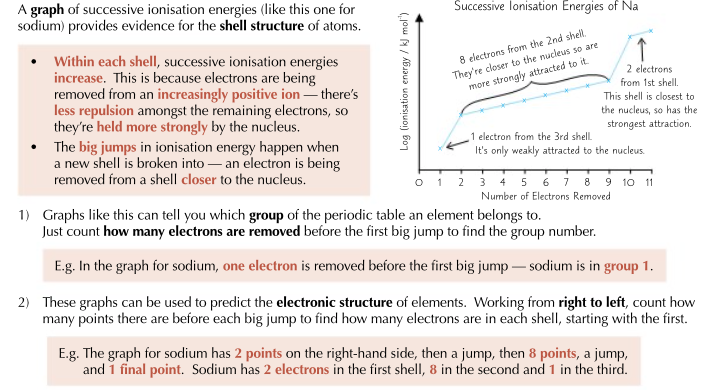
- 37How can you use ionisation energies to identify what element is in the graph?Amount of electrons removed before big jump = group number
Number of shells = period number - 38Atoms are made up of protons, neutrons and electrons electronshave a -1 charge
they whizz around the orbitals. The orbitals take up most of volume of the atom
mass 0.0005 - 39Atoms are made up of protons, neutrons and electrons nucleusMost of the mass is concentrated in the nucleus
The diameter of the nucleus is rather small compared to the whole atom
where protons and neutrons are found - 40mass numbertotal number of protons and neutrons
- 41atomic numberproton number
number of protons in nucleus
all atoms of the same element have the same number of protons - 42isotopesdifferent mass numbers as different proton number
- 43relative atomic massthe ratio of the average mass of one atom of an element to one twelfth of the mass of an atom of carbon-12.
- 44relative isotopic massthe mass of an atom of an isotope compared to the mass of 1/12 of the mass of an atom in carbon-12.
- 45relative molecular massthe ratio of the average mass of one molecule of an element or compound to one twelfth of the mass of an atom of carbon-12.
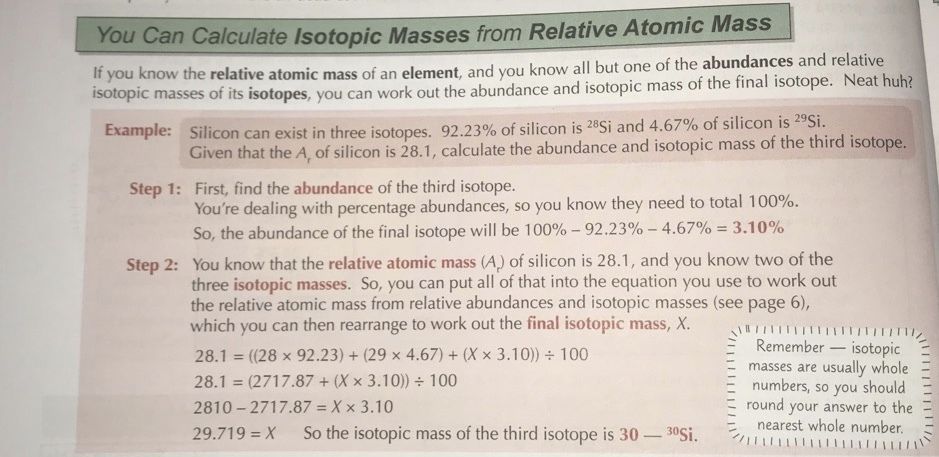
- 46how to calculate isotopic mass from relative atomic mass
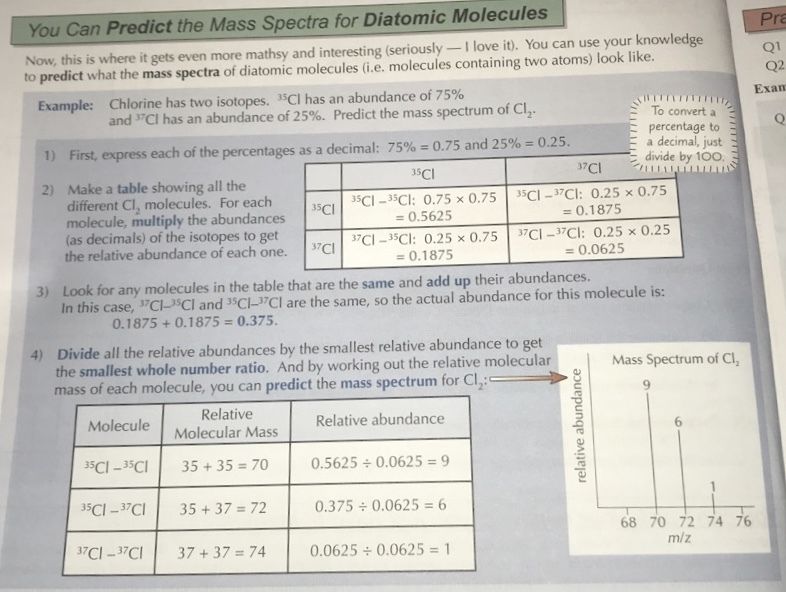
- 47predict the mass spectra for diatomic molecules
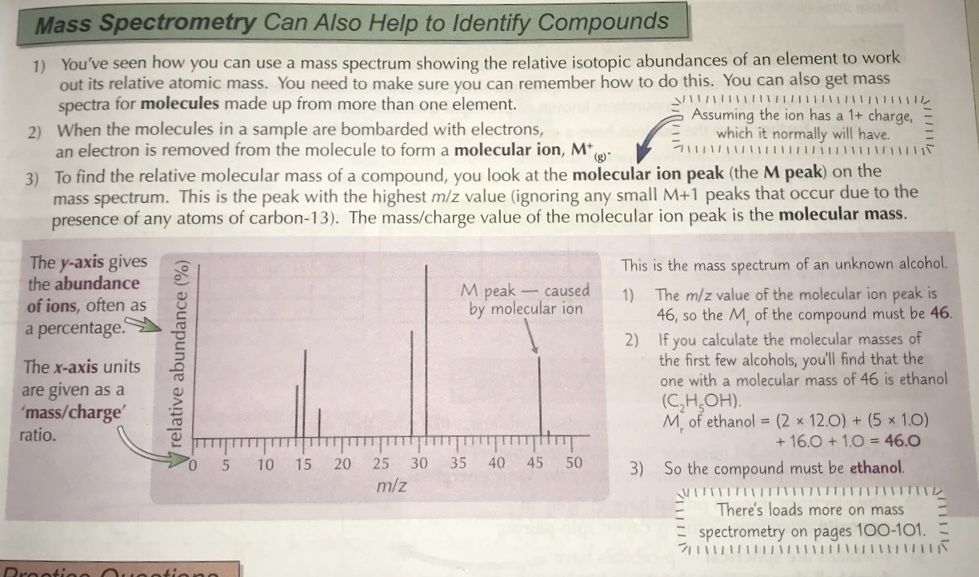
- 48mass spectrometry can help to identify compounds
- 49electrons release energy in fixed amounts
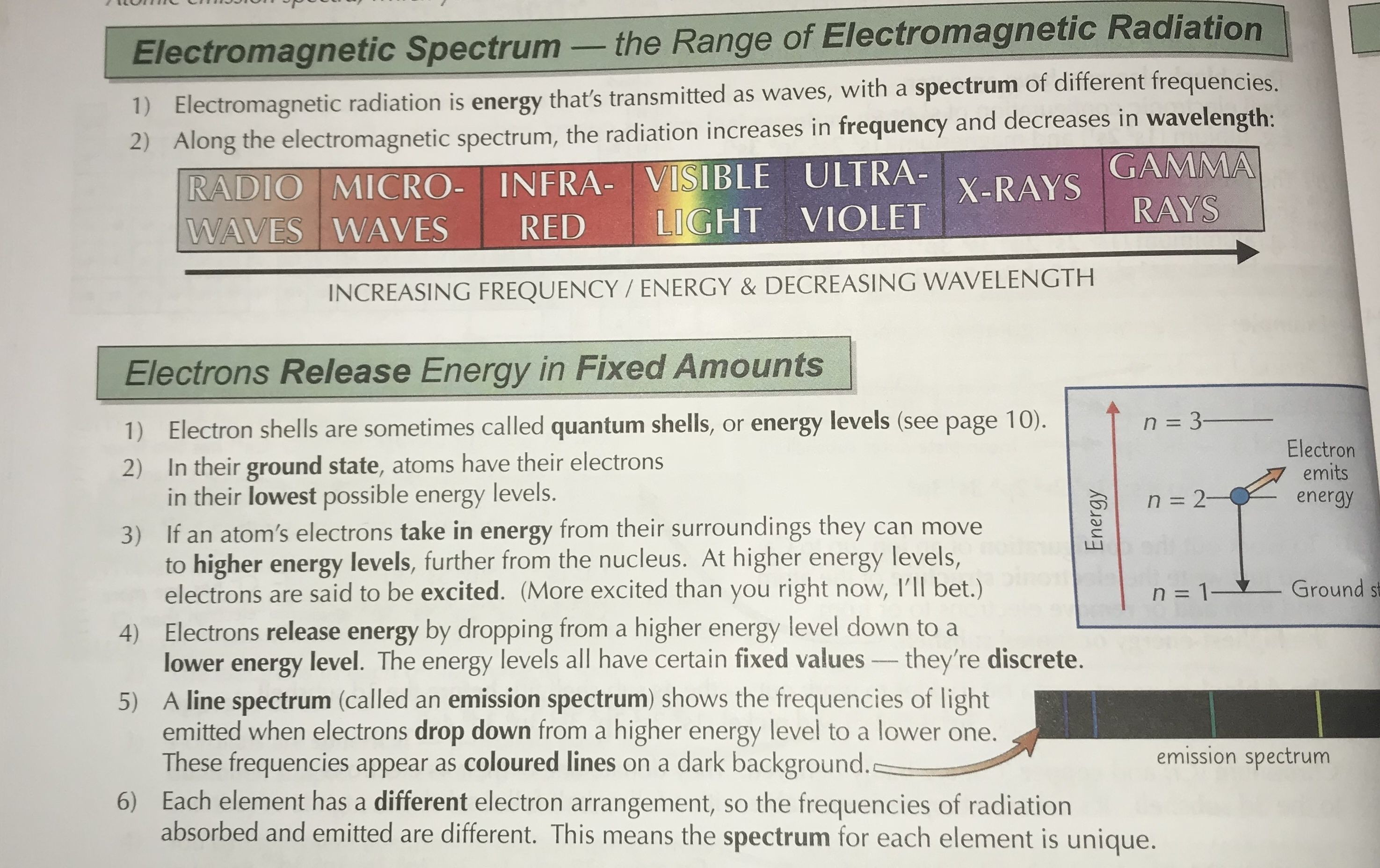
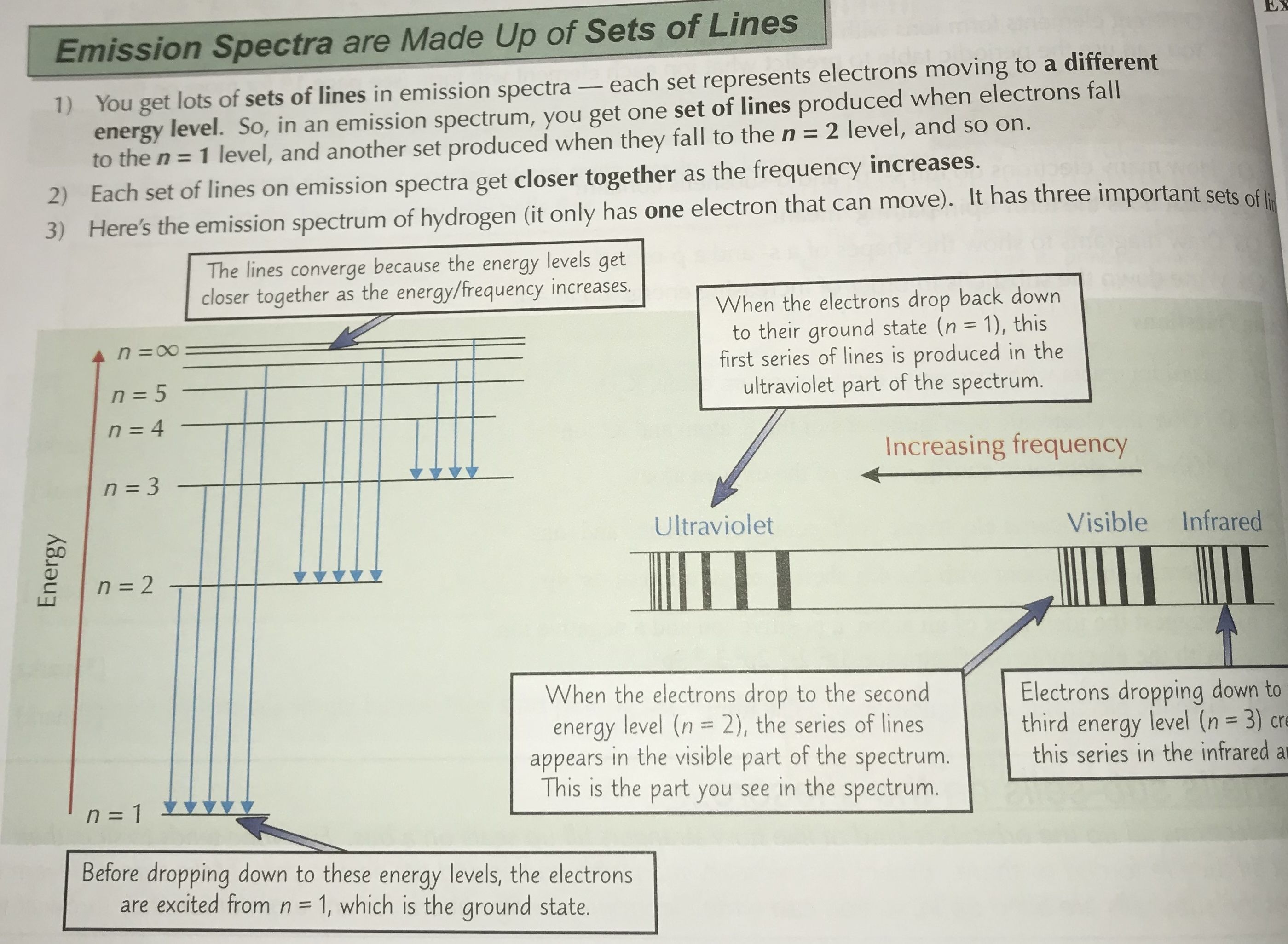
- 50emission spectra are made of sets of lines
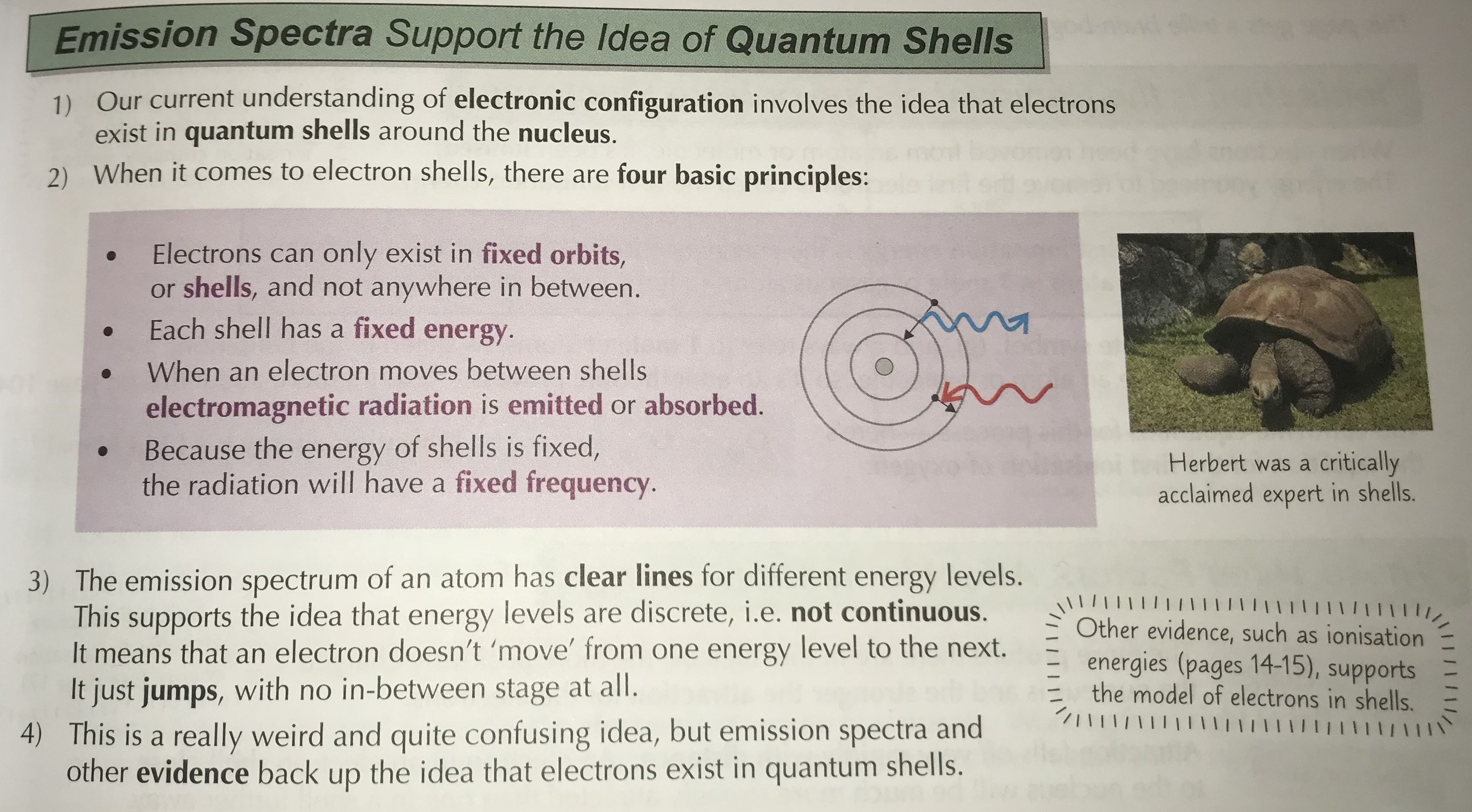
- 51electron spectra support the idea of quantum shells
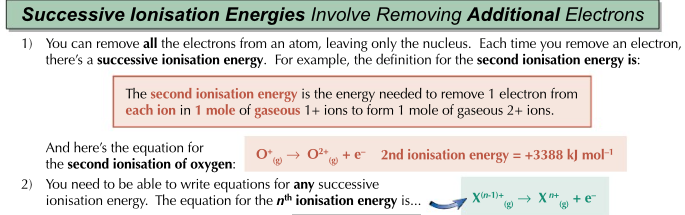
- 52successive ionisation energies involve removing additional electrons
- 53successive ionisation energies show shell structure
- 54—
Information
- Description
- A level Chemistry Flashcards on 1.1 Atomic Structure, created by megan trent on 07/10/2017.
- Created by
- megan trent
- Views
- 0
- History
-
- Created by Tania Parvaiz · Oct 24, 2016
- Copied by megan trent · Oct 7, 2017
- Rating