
Flashcards
Inheritance
Cards in this deck (35)
- 1What is the definiton of: Gene? Locus? Allele?-A gene is a section of DNA which codes for a particular protein
-The position of a gene on the chromosome
-Alleles alternative forms of a gene with different protein coding for the same characteristic (to be an allele they would be found in the same locus on the homologous chromosome), for example blue and brown eyes. - 2What is the definiton of: Homozygous? Heterozygous? Genotype? Phenotype?-Where the alleles from both chromosomes are the same (i.e AA or aa)
-Where the alleles from both chromosomes are different (i.e Aa)
-Is all the alleles that they contain.
-The phenotype is the physical expression of a characteristic (Can be external or internal like blood group or freckles). - 3What is the definiton of a: Dominant characteristic? Recessive characteristic?-An allele that is expressed as long as it is present, it would be shown with a capital letter
-An allele that is not expressed unless it is homozygous, and can be show with a lower case letter - 4What is co-dominance? Give an example of co-dominance. Why is blood group O recessive?-Where two dominant alles are both expressed physically
-Blood groups are an example, I^AI^B blood group are co-dominant, this would mean I^AI^B blood patients contain A and B antigens
-This is because blood I^O has no antigen so it acts as a recessive blood group. - 5What is the definiton of a: F1? F2? Autosome? Sex chromosome?-F1 describes the first generation of fertile offspring from the first cross between 2 parents
-F2 describes the second generation of fertile offspring when 2 of the F1 offspring are crossed
(USUALLY GIVE US MENDELIANS RATIO)
-Autosomes are the 1st to 22nd chromosomes which are not sex chromsomes
-Sex chromosomes are the X and Y chromosome which decide gender - 6What is are Mendilian's ratios for F2 offspring?-Medelians ratios are 3:1 or 9:3:3:1
- 7-In diploid organisms like humans, two chromosomes from either parent are joined together and are homologous.Each of the chromosome has 2 of its own alleles which are in the same location on either chromosome (4 total alleles). 2 of the 4 alleles will code for the phenotype which will be expressed.
- 8What is a genotype? What are alleles? What do alleles do? What are the different phenotypes can you obtain from: Homozygous parents? Heterozygous parents?-It is all the alleles an organism contains.
-They are genes with altered characteristics which occupy the same locus on the homologous chromosome
-2 alleles from the parents join together to make the phenotype
-AA x AA = all AA
-Aa x Aa = AA:2Aa:aa - 9Who is mendel? What did mendel do?-Mendel is known as the farther of genetics
-He conducted many genetic crosses with pea plants to develop the laws of inheritance and law of segregation - 10What is Mendel's laws of inheritance: -law of segregation? -law of independent assortment? -law of dominance?-During the gametes formation, the alleles for each gene segregate from eachother (each parent gene will break down into 2 gametes)
-That alleles of one gene sort into gametes independently of the alleles of another gene (genes can be independatly/randomly assorted)
-That the gene pair can have dominant and recessive alleles, which the dominant allele will be expressed if present (but not all the time in certain circumstances) - 11VIDEO LINKS TO EXPLAIN MENDEL'S LAW OF SEGREGATION AND INDEPENDENCE Also explains the meiosis behind it.https://www.youtube.com/watch?v=OiZEfMe8NJk&list=PLBUg0t2DsO5kvlDT2_vj_XsHcTfQfsm4t
- 12What is monohybrid inheritance? How was it discovered? Why is it important?-Monohybrid inheritance is the inheritance of a single gene (2 alleles one from each parent)
-It was discovered when mendel chose pairs of contrasting characteristics to see what would happen
-It is important because it helps us understand variation and how it occurs - 13What is a genetic cross diagram and what does it show?-It is a diagram used for showing the possible gametes of parent genes. It also tells us the parents pheno and genotypes as well as the F1/F2 possibilities, and the alleles they would have.
- 14How would you draw a genetic cross? (monohybrid and dihybrid)1)Write the parent phenotypes
2)Write the parent genotypes
3)Write the gametes they would make
4) Watch this video on how to draw the cross and find the F1 offspring info
(https://www.youtube.com/watch?v=OiZEfMe8NJk&list=PLBUg0t2DsO5kvlDT2_vj_XsHcTfQfsm4t) - 15In a monohybrid cross with two heterozygous parents what phenotypic ratio will we have?- a 3 dominant to 1 recessive ratio
- 16If a dominant trait is show what are the possible genotypes it could be? If a recessive trait is show what are the possible genotypes it could be?-Hetrozygous dominant (Aa) or Homozygous dominant (AA).
-Homozygous recessive (aa). - 17What is a back cross? How would you figure out the parent genotype from the F1 generation?-A back cross is the way of determining if you have a homo or hetero zygous dominant. You can find out the parent genotype by crossing the F1 generation with a homozygous recessive, if you produce 50% you know that you must have a homozygous domininant parent genotype
- 18What happens when neither allele is dominant over the over? What is incomplete dominance? What would the phenotypic ratio be for incomplete dominance?-When this occurs we get Co-Dominance or incomplete dominance?
-Incomplete dominance is when 2 dominant alleles are expressed in its middle form, E.g red and white would make an incomplete of pink.
-F1 will all be the same. And the F2 would have a 1:2:1 ratio. - 19When dealing with more than 1 dominant allele why do we show genes with a subscript for the allele (For example blood group showing gene I with the subscripts A,B.o?- This is so we can differentiate between the different dominant alleles.
(https://www.youtube.com/watch?v=cJmy6XYhLzQ) - 20What would the back cross for incomplete domininace/ Co-Dominance tell us?-If we have a ratio of 1:2:1 this would tell us that the parent genotype would likely be heterozygous.
- 21What is dihybrid inheritance? How was it discovered? What phenotypic ratio would you expect to see when crossing 2 heterozygous parents, and why might we observe a ratio different to this? How would you do a dihybrid back cross?-It is the simultaneous inheritance of two unlinked genes (Gene on seperate chromosomes).
-It was discovered when Mendel decided to cross over plants with two pairs of contrasting characteristic.
-9:3:3:1, this could be because the genes are linked
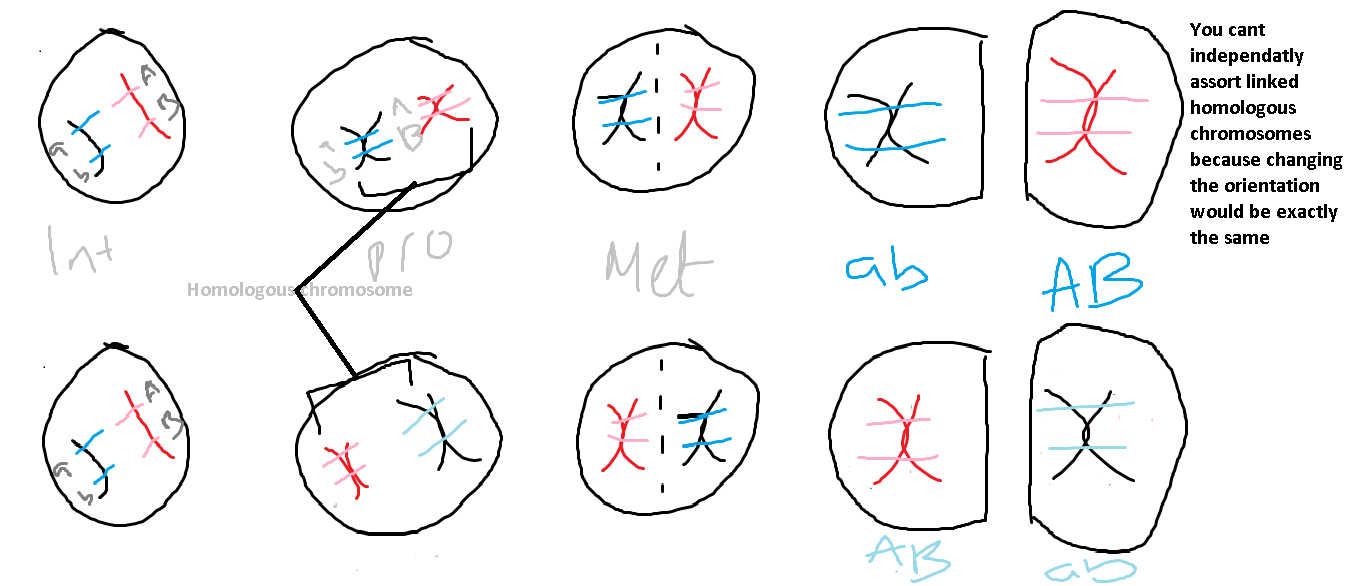
-You would cross a double recessive with the offspring genotype - 22What is independant assortment (random assortment)?-Independent assortment is the different orientation of homologous chromosomes during prophase 1,*BY SWAPPING THE ORIENTATION CHROMOSOMES NOT CHROMATIDS*. There are 2 orientation they can form and there is an equal chance of either happening (If they are unlinked chromosomes). These means alleles will be mixed so there will be 4 possible gametes due to this
- 23What is the meaning of linkage? What is the meaning of linked? Why can linked alleles not segregate independently during meiosis, and why does this stop random assortment?-Linkage is where the alleles of two genes are on the same chromosome prevent them from seperating independantly (So basically because random assortment they are linked and on the same chromosome you cant randomly assort one gene because they linked you would have to swap the chromosome and the 2 genes and if you did that youd still have the same thing
-Linked is where genes that are on the same chromosome do not segregate independatly at meiosis.
-This is because the chromosome are physically the same so they must move together to the poles. - 24Why linked chromosomes cannot independantly assort. (Diagram behind)
- 25What are recombinent genotype? In terms of the linked parental genes DE and de, what will be the recombinant gametes and the phenotype, and explain why?-They are genotypes which can undergo orientation switching. (This can be independent assortment or crossing over, or both)
-The recombinant gametes will be dE and De, and the phenotypes will be the same. This is because there are only 2 possible gametes in linked genes so we would expect the F1 phenotype to be the same. - 26How does linkage explain deviations from mendels ratios?-This is because when cells are linked, you can only produce 2 possible gametes (the same as the genotype), as there is no independant assortment. As a result of this you would expect the offspring to have the same phenotype's as the parents. This means the only way of getting variation in this would be due to crossing over of chromosomes which is very rare, but bcecause crossing over is rare you dont have 50/50 chance of making different gametes, this is why when we see deviation in
- 27What will calculating a COV (cross over value) help us do?-It helps us figure out the distance between the genes on the chromosomes, this information can be used to plot a gene map of the chromosome.
- 28What is the Chi^2 (x^2) test?-It is the method used to determine whether or not the phenotypic ratio is close enough to the 9:3:3:1 ratio, if it is then we can conclude that the deviations to have occured by chance
- 29What is the null hypothesis? Write a suitable null hyopthesis.-It is a statistical test which in terms of genetics means it is a statement suggesting that the phenotypic ratio observed follows mendels ratio meaning any deviations are a result of chance)
There is no significant difference between the observed ([Insert observed ratio]) and the expected ([Insert expected ratio]). - 30How would you carry out a Chi^2 test?1) Divide the number of offspring phenotype's (your testing) by 16 (9+3+3+1), this gives you you expected ratio
2)For each phenotype, you would subtract the (OBSERVED-EXPECTED)
3) Square the values from 2)
4) Divide the value of 3) by the expected value
5) Add all the values from 4) and you have found you x^2 - 31What do we do to Chi^2 (x^2) to prove or disprove the null hypothesis? How would you construct a conclusion?-You would compare it to the degree of freedom and the 0.05 significance level. You would use 1 minus the number of phenotype's for the degree of freedom
-Compare the x^2 value to the critical value from the table, state whether we will accept or reject the null hypothesis at a 5% sig level, if null is accepted then the results follow the ration and devations are due to chancee - 32How in sex inherited?-Sex is inherited from the sex chromosomes in the 2ndary oocyte and the sperm cell, sperms contain XY chromsomes and 2ndary oocytes contain XX. You would get 1 chromsome from each parent , this means you have a XX are female and XY are males if you draw a punnet square you would find you have a 50/50 chance of being either.
- 33Why are male sex chromosomes not homologous and how does this differ to females? Why can male genes not be dominant or recessive?-Because males have XY, these are not homologous because they are different sizes and there loci don't have corresponding genes. Females have XX which are homologous this means there loci have corresponding genes and are the same size.
-This is because they only have 1 X chromosome and 1 Y, and since they are not homologous, this would mean that whatever gene is on the X chromosome is expressed - 34What is sex linkage? What is a carrier in terms of sex linkage?-Sex linkage is where a gene is carried on sex chromosome, this means that its characteristics are seen mainly in a certain gender which is ususally males (E.g haemophillia)
-A carrier is a female who has a dominant and a recessive allele, in which she can pass on the recessive allele which can cause a recessive male to inherit and express the characteristic making her a carrier. (Female can only express the recessive with 2 recessives where as males would only need 1) - 35Pedegree diagrams, how to read them etc page 175P175
Information
- Description
- A level Biology (Components 2) Flashcards on Inheritance, created by BUKDABOSS . on 04/12/2018.
- Created by
- BUKDABOSS .
- Views
- 6
- Rating