
Flashcards
Biology 1 Honors-Quarterly #2 Review
Cards in this deck (34)
- 1What are the 3 main parts to the cell theory?-All known living things are made up of 1 or more cells.
-All living cells are made from preexisting cells by division
-Cells are the basic structure of all life and they function in all living organisms. - 2Describe the Function of MitochondriaProduces the energy for the cell in the form of ATP
- 3Describe the Function of the NucleusStores DNA and contains the instructions for all processes in the cell.
- 4Describe the Function of CholoroplastsConverts light energy to chemical energy
- 5Describe the Function of the Cell membraneLipid Bi-layer that is semi-permeable
- 6Describe the Function of the Cell WallSemi-permeable rigid wall that supports and protects the cell
- 7Describe the Function of RibosomesMakes proteins for the cell
- 8Describe 5 differences between Eukaryotic cells and Prokaryotic cells.-Eukaryotes contain a nucleus and membrane bound organelles while prokaryotes contain neither.
-Prokaryotes contain a capsule layer while Eukaryotes don't.
- Eukaryotes are large, complex and multi-cellular while Prokaryotes are very small and single celled. - 9Describe 3 similarities between Prokaryotic and Eukaryotic CellsBoth Contain:
-Ribosomes
-Cell Membrane
-Cytoplasm - 10Describe 4 Differences between Plant and Animal Cells1.Cell wall is only in plant cells
2.Chloroplasts only in plant cells
3.Central Vacuole only in plant cells while animal cells contain small vacuoles
4. Centrioles only in animal cells - 11Explain the upper and lower limits to cell sizeIf a cell is large it is able to house the parts it needs to survive and reproduce however, it means that the SA:V ratio will be small which means that substances will take a longer time to diffuse throughout the entire cell.
-If a cell is small it may not be able to house all the parts it needs to survive however substances will diffuse easily through the cell due to the SA:V ration being large. - 12Compare and Contrast Passive and Active TransportActive Transport requires ATP energy to move substances across a membrane and it is able to go against or with the concentration gradient..
Passive Transport requires no energy and goes with the concentration gradient - 13Differentiate between simple diffusion and facilitated diffusion-In simple diffusion, ATP is not required because it goes with its concentration gradient. Diffuses small and non polar molecules only.
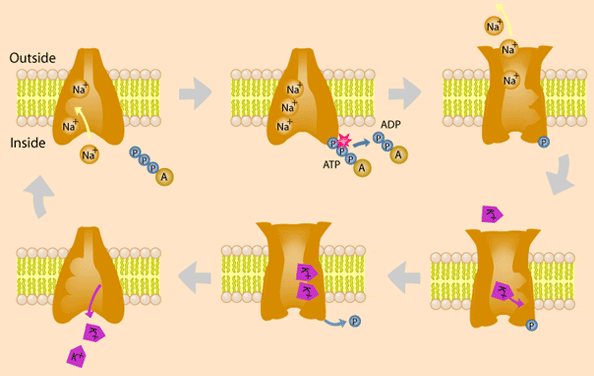
-Facilitated Diffusion may or may not require ATP because it can go with or against its concentration gradient. Is capable of diffusing large and polar molecules. - 14Give two examples of active transport pumps. What do the pumps require?1. Sodium-Potassium Pump
2. Proton Pump
Both pumps require ATP - 15Explain how the Na+/K+ pump works.Na+ enter the pump into fitted sections. An ATP molecule attaches itself to the pump during this process. When the ATP separates from the pump and leaves only 1 phosphate, the pump changes the Na+ shape and from and it releases it to the other side of the membrane. K+ then enter the pump on the side Na+ was released. When the final phosphate detaches itself, the pump once again changes the shape of the ion and moves back to its original state, releasing the K+ on the other side.
- 16Describe in detail the process and all the structures involved in producing a protein hormone to be shipped out of the cell.DNA→RNA→Ribosomes→Smooth ER→Vesicle→Golgi Body→Vesicle→Plasma Membrane(Excocytosis)
- 17What is the ideal osmotic environment for animals cells to be in?The ideal osmotic environment for animal cells would be in an isotonic solution.
- 18Describe what would happen to an animal cell if placed in the other two osmotic environments that don't keep it stable.If an animal cell is placed in a hypertonic solution the cell would shrivel up and if it was placed in a hypotonic solution, it would explode.
- 19What is the ideal osmotic environment for plant cells to be in?The ideal osmotic environment for plant cells would be in a hypotonic solution.
- 20What structures allow them to adapt to osmotic environments?There cell wall protects the cell from exploding or shriveling up completely.
- 21What would happen if the plant cell was placed in the other two osmotic environments that don't keep it stable?If it was placed in an isotonic solution, it would be normal but it wouldn't flourish also know as being flaccid. If it was placed in a hypertonic solution, the plant cell would become wilted eventually dying off.
- 22Describe how ATP functions as an energy molecule?It is the key to energy coupling of endergonic and exergonic reactions. When the bond holding the 3rd phosphate group breaks, the rest of the molecule is broken down in hydrolysis, to supply energy for cellular work.
- 23How much ATP, CO2, NADH, and FADH2 are made in glycolysis and where does it occur?-NET worth of 2 ATP
-No CO2 production
-2 NADH
Occurs in the cytosol. - 24How much ATP, CO2, NADH, and FADH2 are made in The Krebs Cycle and where does it occur?-2 ATP
-6 CO2
-8 NADH
-2 FADH2
Occurs in the mitochondrial matrix - 25How much ATP, CO2, NADH, and FADH2 are made in Oxidative Phosphorylation and where does it occur?-about 34 ATP
-No CO2 production
-NADH and FADH2 are used up
Occurs in the inner mitochondrial membrane - 26List the Pros and Cons of Aerobic RespirationPros: Produces more ATP
Cons: Longer Process
Needs Mitochondria
Needs Oxygen - 27List the Pros and Cons for Anaerobic RespirationPros: Shorter Process
Doesn't need Oxygen
Doesn't need mitochondria
Cons: Produce very few ATP - 28Explain the role of O2 in aerobic respirationO2 receives the low energy electrons from the Electron Transport Chain to combine with H+ ions to form H2O.
- 29Which wavelengths of light are absorbed by the lead and which are reflected. Explain your answer.All colors of wavelength are absorbed except green because the pigments in the chloroplast don't absorb green, mostly red and blue therefore, green just passes through the pigment reflecting off the plant.
- 30What are the reactants and products of the Light Reaction and where does it occur?Reactants of the light reaction are H2O and CO2. The products are ATP and NADPH. The light reaction occurs in thylakoids.
- 31What are the reactants and products of the Calvin Cycle and where does it occur?Reactants of the Calvin Cycle are ATP, NADPH and CO2. The products are G3P. The Calvin Cycle occurs in the stroma of a cell.
- 32List some factors which affect the rate of photosynthesis of a terrestrial producer.-Temperature
-Light
-CO2
-Wavelength
-H2O - 33What is the role of the ETC in Photosynthesis?It releases the energy from electrons gradually forming a proton gradient which helps move H+ ions across the thylakoid membrane into the stroma.
- 34Differentiate between endergonic and exergonic reactions. Which type of reaction is photosynthesis?Endergonic reactions is when you put energy into a chemical reaction. Exergonic is when you break something down for energy. Photosynthesis is endergonic because its making products of sugar that contain stored energy.
Information
- Description
- Topics: Cell Theory Cell Structure Cell Transport Cellular Respiration Photosynthesis
- Created by
- Kimberly Antury
- Views
- 3
- Rating