
Flashcards
Chapter 25: Population Genetics
Cards in this deck (81)
- 1genetic driftchance factors operating in small populations
- 2genetic rescueThe introduction of new genetic variation into an inbred population
- 3population genetics- branch of genetics that studies the genetic makeup of groups of individuals and how a group’s genetic composition changes over time
- also the study of evolution - 4Populationgroup of interbreeding, sexually reproducing individuals that share a
common gene pool - 5Mendelian populationa group of interbreeding, sexually reproducing individuals that have a common set of gene pool
- 6gene pooltotal of all alleles carried in all members of a population
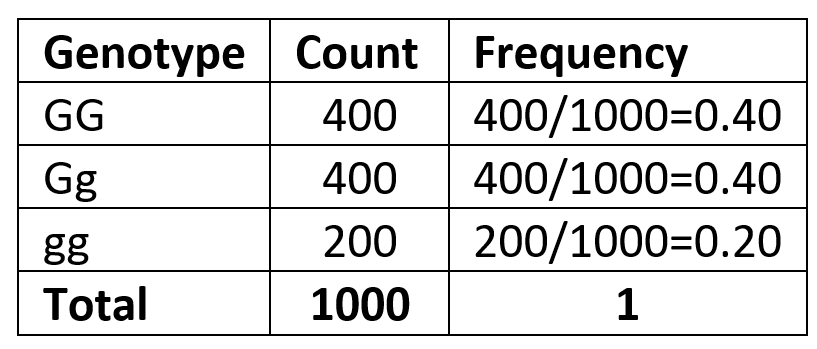
- 7mathematical model- describes a process as an equation
- factors that may influence the process are represented by variables
- equation defines how variables influence the process - 8frequency-a proportion or a percentage expressed as a decimal fraction
- for large populations, a sample of the population is taken & genotypic/allelic frequencies are calculated for this sample - 9genotypic frequencyProportion of a particular genotype within a population.
- 10calculating genotypic frequency- add up # of individuals w/genotype & divide by total # of individuals in the sample (N)
- sum of all genotypic frequencies = 1 - 11Allelic Frequencyproportion of a particular allele in a population
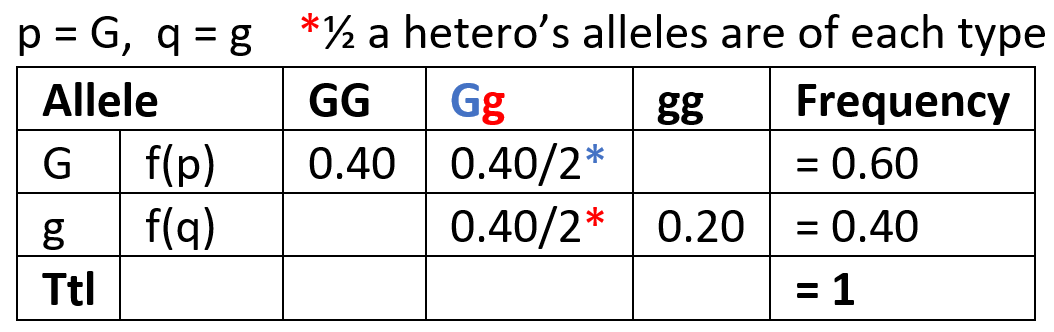
- 12calculating allelic frequencies- p and q alleles
- sum the genotype frequency of an allele by adding:
(homozygote: genotype frequency) +
(heterozygote: genotype frequency / 2) - 13—
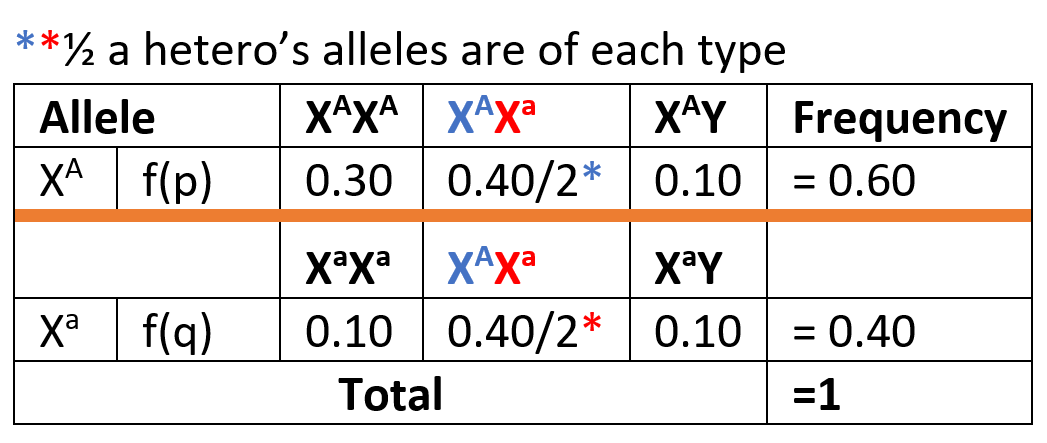
- 14X chromosome allelic frequencies
- 15Hardy–Weinberg lawstates that in a infinitely large population
- w/random mating
- w/no mutation, migration, or natural selection
- allelic frequencies don't change
- genotypic frequencies stabilize after one generation - 16Hardy–Weinberg law allows us to predictgenotype frequencies from allele frequencies
- 17Hardy–Weinberg law applies to a ____ _____ not the ____ ____. A population may be in Hardy–Weinberg equilibrium for one ____ but not for others- single locus
- entire genome
- locus - 18- the purpose of the Hardy–Weinberg law is to examine only the effect of ... - When this effect is known, the effects of other factors (such as _____ & _____ _____) can be examined- reproduction on the gene pool
- migration
- natural selection - 19Hardy–Weinberg law tells us that _____ alone will not bring about evolution. Other processes–such as: _____, _____, _____ _____, and ______ ______ are required for populations to evolve- reproduction
- mutation, migration, natural selection, chance events - 20- can determine the ___ frequencies from the ___ frequencies. determining _____ frequencies from _____ frequencies is possible only when the population is in Hardy–Weinberg equilibrium- allelic
- genotypic
- genotypic
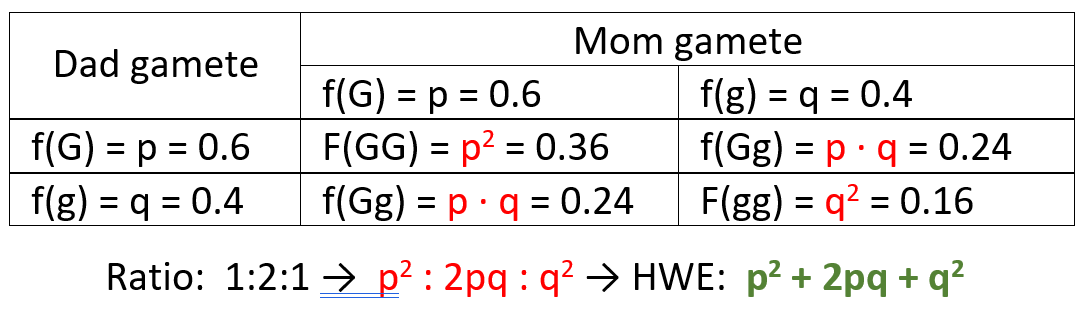
- allelic - 21Hardy–Weinberg law proportionsp² = AA frequency
2pq = Aa frequency
q² = aa frequency - 22Hardy–Weinberg law equation
- 23For an autosomal locus with three alleles, the equilibrium genotypic frequencies are(p + q + r)² =
p² + q² + r² + 2pq + 2pr + 2qr - 24is this population in Hardy-Weinberg equilibrium? step 1- get ttl of population = 190
- get genotypic frequency
R²R² = 135/190 = 0.710
R²R³ = 44/190 = 0.231
R³R³ = 11/190 = 0.058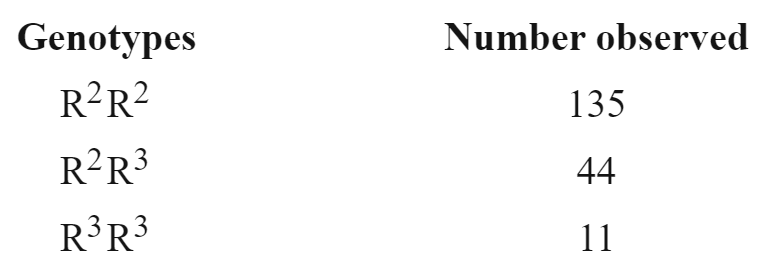
- 25is this population in Hardy-Weinberg equilibrium? step 2- get allelic frequency
R² = 0.710 + (0.231/2) = 0.826
R³ = 0.058 + (0.231/2) = 0.174 - 26is this population in Hardy-Weinberg equilibrium? step 3- get expected genotype frequencies under Hardy–Weinberg equilibrium
R² = p, R³ = q
p² = 0.826² = 0.682
2pq = 2 × 0.826 × 0.174 = 0.287
q² = 0.174² = 0.030 - 27is this population in Hardy-Weinberg equilibrium? step 4- get expected # under Hardy–Weinberg equilibrium using expected frequencies
R²R² = 190 × 0.682 = 129.58
R²R³ = 190 × 0.287 = 54.53
R³R³ = 190 × 0.030 = 5.7 - 28is this population in Hardy-Weinberg equilibrium? step 5
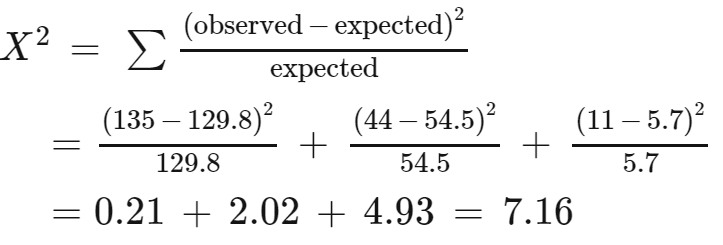
- 29is this population in Hardy-Weinberg equilibrium? step 6- determine degrees of freedom
df = (# of genotypes) - (# of alleles)
df = 3 - 2 = 1 - 30is this population in Hardy-Weinberg equilibrium? step 7- find df=1 & chi val=7.16 in chi square
probability between 0.01 and 0.005
p < 0.05 → hypothesis rejected, not in HWE - 31The frequency of the recessive allele is equal tothe square root of the frequency of the recessive trait
- 32If the frequency of cystic fibrosis in North American Caucasians is approximately 1 in 2000, what is the % of defective alleles1/2000 = 0.0005
q = √ 0.0005 = 0.02236
- 2% of alleles in Caucasian population encode the defective protein that causes cystic fibrosis - 33Positive assortative- mating refers to a tendency for like individuals to mate
- i.e. tall people mate preferentially with other tall - 34Negative assortative- mating refers to a tendency for unlike individuals to mate
- i.e. tall people mating w/short people - 35Assortative matingusually for a particular trait and affects only those genes that encode the trait
- 36positive assortativemating for relatedness
- 37inbreeding- preferential mating between related individuals
- positive assortative
- leads to increase in homozygotes - 38Outcrossingpreferential mating between unrelated individuals
- 39statetwo alleles are alike in structure and function but do not have a common origin
- 40descentcopies descended from a single allele that was present in an ancestor
- 41Individuals may be homozygous by _____ or by _____.- descent
- state - 42Inbreeding is a measure of the probability that two alleles are identical by _____. measured by the _____ _____.- descent
- inbreeding coefficient - 43- inbreeding coefficient, designated, _____ which is a measure of .... - range from ____ to _____ - ____ indicates mating is random in a large population. value of _____ indicates that all alleles are identical by descent- F
- probability that two alleles are identical by descent
- 0
- 1 - 44Inbreeding coefficients can be calculated from .... or they can be determined from ...- analyses of pedigrees
- the reduction in the heterozygosity of a population - 45proportion of heterozygotes decreases by _____ ______, and half of this value is added to the proportion of each _____ each generation- 2 Fpq
- homozygote - 46proportion of heterozygotes decreases by _____ ______, and half of this value is added to the proportion of each _____ each generation visual
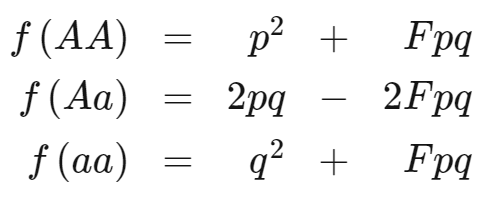
- 47- recessive allele (a) causes disease w/frequency (q) of 0.01 - if population mates randomly (F = 0), what's the frequency of individuals affected by the disease (aa)? - if F = 0.25 (brother/sister mating), what's expected frequency of aa?- q² = 0.01 = 0.0001 → 1 in 10,000 individuals w/disease
- q² + Fpq = (0.01)² + (0.25)(0.99)(0.01) = 0.0026 → disease is 26 times as frequent at this level of inbreeding - 48Asexual reproduction reduces the proportion of _____ in the population by _____ with each generation, until all genotypes in the population are _____- heterozygotes
- 1/2
- homozygous (AA and aa) - 49inbreeding depressionincreased appearance of lethal and deleterious traits with inbreeding
- 50advantageous to inbreeding: reason 1If a species undergoes inbreeding for a number of generations, many deleterious recessive alleles are weeded out by natural or artificial selection so that the population becomes homozygous for beneficial alleles
- 51advantageous to inbreeding: reason 2- helps preserve groups of genes (co-adapted gene complexes) exhibiting gene interaction & work well together in specific environment
- Outcrossing breaks up co-adapted gene complexes leading to recombination of genes that might not work well together - 52What is the effect of outcrossing on a population? a. Allelic frequencies change b. more heterozygotes than HW law c. fewer heterozygotes than HW law d. Genotypic frequencies = HW lawb. more heterozygotes than HW law
- 53gene mutationnecessary for genetic variation that leads to evolution
- 54migration or gene flow- influx of genes from other populations
- prevents populations from becoming genetically different from one another
- increases genetic variation within populations - 55migration counteracts____ _____ and _____ _____ends to keep populations homogeneous in their allelic frequencies- genetic drift
- natural selection - 56The amount of change due to migration depends on both the .... and the....- amount of migration
- difference in allelic frequencies between the source and the recipient populations - 57sampling errorThis kind of deviation from an expected ratio due to limited sample size
- 58Genetic drift- change in allelic frequencies due to chance
- 59amount of change in allelic frequencies due to genetic drift is inversely related to ...the effective population size (the equivalent number of breeding adults in a population).
- 60_____ ______ arises when gametes unite to produce progeny and may lead to _____ _____- Sampling error
- genetic drif - 61Genetic drift is maximal when p and q areequal (each 0.5)
- 62Genetic drift will also be greater whenthe population size is small
- 63causes of genetic drift cause 1a population may be reduced in size for a number of generations because of limitations in space, food, or some other critical resource
- 64causes of genetic drift cause 2- establishment of a population by a small number of individuals
- although population may increase, genes carried by members are derived from the few genes present in the founders (assuming no migration or mutation) - 65causes of genetic drift cause 3genetic bottleneck, which develops when a population undergoes a drastic reduction in size
- 66- three results of genetic drift are ... - they take place _____ - all result from ____ _____ - The first two results take place _____ populations, whereas the third takes place _____ populations.- allelic frequency change, loss of genetic variation within populations and genetic divergence between populations
- simultaneously
- sampling error
- within
- between - 67allele has reached a frequency of 1, we say that it has reached _____. Other alleles are lost (reach a frequency of _____) and can be restored only by .... Fixation, then, leads to- fixation
- 0
- migration from another population or by mutation.
- a loss of genetic variation within a population - 68Given enough time, all small populations will become ... Which allele becomes fixed is _____ but is influenced by the initial ...- fixed for one allele or another
- random
- frequencies of the alleles - 69Natural Selection- eliminates individuals whose fitness is lower
- chooses individuals with higher fitness to survive & parent next generation - 70fitness- relative reproductive success of a genotype compared to reproductive successes of other genotypes in the population
- Fitness values (W) range from 0 to 1 - 71To calculate fitness for each genotype ...take mean number of offspring produced by a genotype and divide it by the mean number of offspring produced by the most prolific genotype
- 72To calculate fitness (W) for each genotype exampleA¹A¹ = 10 offspring
A¹A² = 5 offspring
A²A² = 2 offspring
A¹A¹ = 10 / 10 = 1
A¹A² = 5 / 10 = 0.5
A²A² = 2 / 10 = 0.2 - 73selection coefficient- relative intensity of selection against a genotype
- selection coefficient is equal to 1 − fitness - 74selection coefficient for A¹A¹ = 1 A¹A² = 0.5 A²A² = 0.2A¹A¹ = 1 - 1 = 0
A¹A² = 1 - 0.5 = 0.5
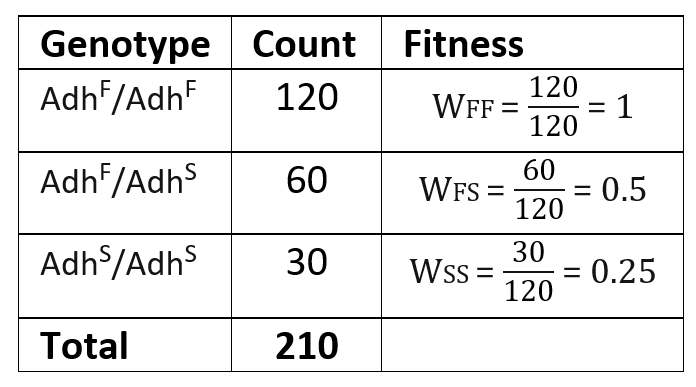
A²A² = 1 - 0.2 = 0.8 - 75a. Calculate the fitnesses of females having these genotypes step 1 - calculate fitness
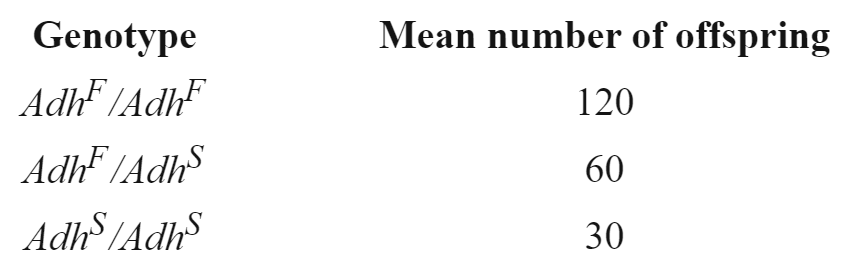
- 76a. Calculate the fitnesses of females having these genotypes step 2 - calculate fitness contribution
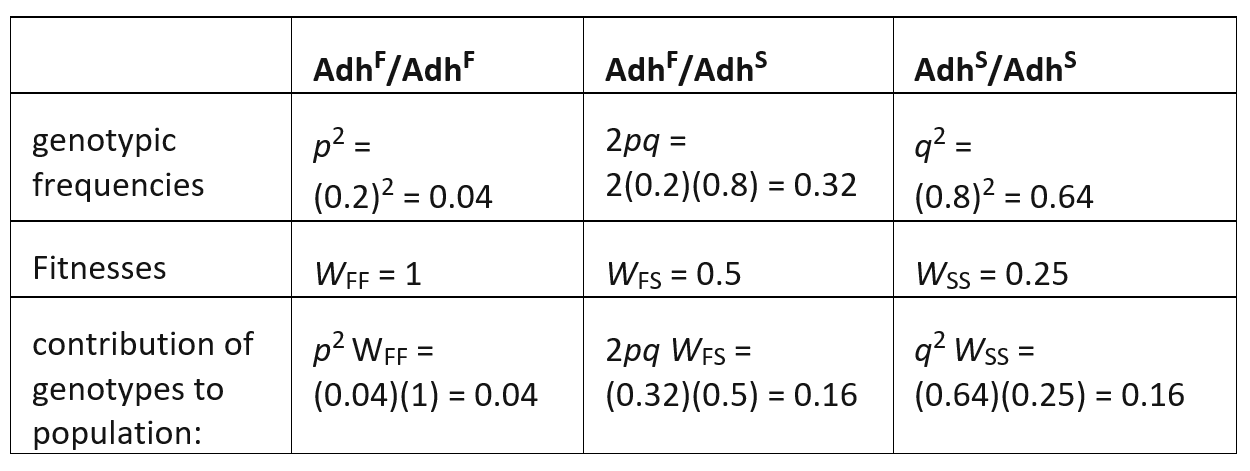
- 77b. calculate frequency of AdhF in the next generation- p′ = f(AdhF) = f(AdhF/AdhF) + f(AdhF/AdhS)/2
- p’ = f(AdhF) = 0.11 + (0.44)/2 = 0.33
- q’ = 1 – 0.33 = 0.67
- frequency of AdhF will increase from 0.2 to 0.33 - 78directional selectionone allele or trait is favored over another
- 79overdominance or heterozygote advantageheterozygote has higher fitness than either homozygote
- 80underdominancewhen heterozygote has lower fitness than either homozygote
- 81- Mutation and natural selection act as opposing forces on detrimental alleles: - eventually producing an _____- mutation tends to increase their frequency
- natural selection tends to decrease their frequency
- equilibrium
Information
- Description
- Genetics (Exam III) Flashcards on Chapter 25: Population Genetics, created by Alexandra Bozan on 01/12/2019.
- Created by
- Alexandra Bozan
- Views
- 0
- Rating