
Flashcards
Lecture Three - Basic Principles of Kinetics & Thermodynamics
Cards in this deck (17)
- 1Concepts to understandRate of reaction, rate constant, order of reaction
Reaction can be reversible
Rate constants for forward and reverse reactions are not the same
Equilibrium constant Keq
Laws of Thermodynamics
• Enthalpy, Entropy, Gibbs free energy (G)
• If ΔG < 0, the forward reaction is favorable
Transition state and activation energy - 2Definition of kinetics 1 a: a branch of science that deals with the effects of forces upon the motions of material bodies or with changes in a physical or chemical system b: the rate of ___ in such a system 2: the mechanism by which a physical or chemical change is effected Chemical kinetics studies reaction ___: -->Mathematical description based on the reaction model -->What affects the rates: T, pH, enzymes, spatial restrictions, ...change
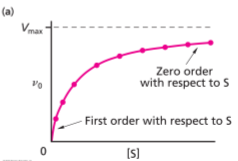
rates - 3Zero Reaction The biochemical reaction may be of zero-order when enzyme-catalyzed max This happens when the enzyme (E) is saturated by the substrate (S). Concentration of S exceeds that of E [S] >> [E}
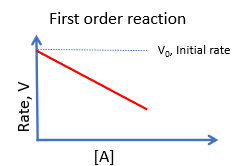
- 4Mon-molecular FIRST ORDER Reaction A --> B (can be reversible) k = rate (depends on multiple factors such as temperature) rate = ___ reaction rate units = ___ 1 st order reaction: Biochemical reaction may be of 1st order when enzyme-catalyzed If this case [S] __ [E].M/s
k[A]
<<
- 5Second-Order bimolecular reaction A + B --> C + D rate or V = ____k[A][B]
- 6Second-Order bimolecular reaction & Equilibrium Concept Equilibrium when: forward rate = ___ rate k1[A][B] = k-1[C][D] The ratio of product to reactant concentrations is constant: Keq = concentration of products / concentration of reactants (k1 / k-1) so it would look like: ____ / ____ when keq >> 1 then rxn strongly favors ___ when keq << 1 then rxn strongly favors ____reverse
Keq = ([C][D]) / ([A][B])
products
reactants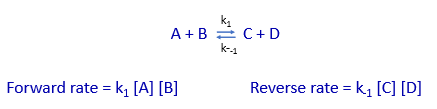
- 7Thermodynamics is the flow of __ 0th Law of thermodynamics = states that if two thermodynamic systems are each in thermal equilibrium with a third one, then they are in thermal equilibrium with ___ ___heat
each other - 8First Law of Thermodynamics = The law of Conversation of Energy The total amount of energy in the Universe remains Energy is neither created nor destroyed, it just ___ its form • Conservation of mass in chemistry is a special case of the law, assuming no nuclear reactions occur.constant
changes - 92nd Law of Thermodynamics Multiple equivalent definitions have been proposed by scientists: -Heat does not transfer from cold systems to hot systems • No work can be done at a ___ temperature • Total amount of entropy (S) of the universe always ____ What is Entropy? defined as a measure of the system ____constant
increases
disorder - 103rd Law of Thermodynamics If an object reaches the absolute zero temperature (0K = -273.15 degrees C = -459.67 degrees F), its atoms will stop moving. T(K) = T(C) + ___273.15
- 11Gibbs free energy G = __ - __ H — enthalpy, a heat function at constant pressure (p=const.) Since most of the biochemical reactions are isobaric, ΔH = ΔHeat S — Entropy T — Temperature (K) ΔH < 0 = rxn is ___ ΔH > 0 = rxn is ___G = H-TS
exothermic
endothermic - 12G = H-TS Reaction will proceed forward if G is reduced ΔG __ 0 If ΔG < 0 then ΔH -TΔS must be __ 0 A non-spontaneous rxn can still proceed if ___ to another reaction providing that overall ΔG < 0 (the reaction can be entropy driven)<
<
coupled - 13Reaction will proceed until it reaches ___ If ΔG = 0 Then ΔH = TΔSequilibrium
- 14If the transition state has higher energy compared to the reactants, additional activation energy, Ea, is required -Need to __ the activation energyovercome
- 15Two ways to speed up a reaction: 1. Increase ___ (may destroy your reactants) 2. Use ___ (bio-catalysts) Equivalent to: 1. Produces more 'hot' molecules 2. ___ activation energy, 3D coordination, longer timetemperature
enzymes
Decreases - 16To find Keq: Given a concentration of either the reactant or productkeq = [C]^2 / [A]^2
- 17To find concentrations given Keq: You can find concentration of [A], [B], [C], [D]1/ ( 1+sqr(keq) ) = [A}
[A] = [B]
1-[A] = [C]
[C] = [D]