
Flashcards
Bloodstain Pattern Analysis
Cards in this deck (66)
- 1Bloodstain Pattern Analysis (BPA) why is it important?A tool used to understand what may have taken place during blood shedding activities:
What, how, when, how many, where
Possible injuries sustained
Possible weapon used
Minimum number of blows, shots or actions
Sequence of events
An understanding of how blood behaves is essential - 2What general info a blood spatter analyst would need to knowAverage person contains 4½ to 5 litres of blood
Blood accounts for ≈ 8% of body weight
Blood is made up of cells and plasma or serum
Plasma or serum is ≈ 55% of blood volume
Cells ≈ 45% of blood volume – comprising red blood cells (99% of cell volume), white blood cells and platelets
Can loose 10% (≈ ½ litre) with no effect
The loss of 35 – 40% (1¾ – 2 litres) typically fatal
Veins ‘leak’ or ‘ooze’
Arteries carry blood with pressure from the heart and are usually deep within the body to prevent damage - 3BPA Phase 1 (Searching and documenting)Searching using white light primarily
Level of search will depend on case circumstances, what is found, and what scenarios need to be considered
Will always include looking up and under
Finding blood may direct search in different ways:
- Follow trails
- Direct attention to bloodstain surfaces, e.g. cupboard doors indicates places searched
-Suggest activities to investigate further, e.g. bloodstained towels, sink taps indicates clean up - 4BPA Phase 2 what is phase 2Once blood is found and documented the analyst will begin to describe the patterns in terms of possible mechanisms that may have created them.
Opinions always documented separately from the blood to allow for an independent second check - 5BPA Phase 2BPA is a scientific method where the observations are evaluated against specific questions or hypothesis
What are the questions you have that you would like to try and answer with BPA?
For example
Witness says it was self defence – does BPA support this?
Witness says there was no weapon used – do the bloodstain patterns support this? - 6ClassificationBPA starts from the shape, size, and distribution of the stains
From this the analyst will eliminate certain mechanisms
All other possible mechanisms will be included until further information rules them out
If there is doubt about an answer more mechanisms will be included.
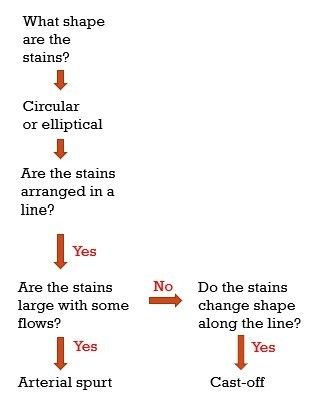
Analysts MUST NOT over state the evidence. - 7Classification questions/flow chart to go through
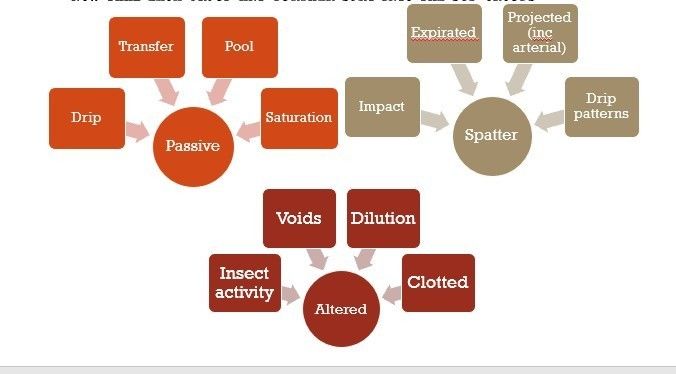
- 8BPA CATEGORIESPASSIVE
SPATTERED
ALTERED - 9BPA CATEGORIESDifferent fields of thought on categories of bloodstain patterns.
Passive stains are sometimes known as non-spatter
Spattered may be sub-sectioned into linear and non-linear
I like the simple separation of active and passive and other! - 10BPA CATEGORIES passiveTransfer
Drips
Flow
Pool/Saturation - 11BPA CATEGORIES spatteredImpact
Projection
Cast off
Secondary - 12BPA CATEGORIES alteredClotting
Dilution
Voids
Insects - 13passiveCreated without force, other than gravity
- 14passive TRANSFER/CONTACTdirect – non moving
wipe – moving lateral force (removing blood)
swipe - moving lateral force (adding blood)
drag marks - 15passive FLOWgravity or inertia
- 16passive LARGE VOLUME/POOLaccumulation of blood – no force
- 17Passive dropsBlood droplets held together by cohesive forces between cells and the surface tension of the blood
Droplets form when the weight of the blood exceeds the cohesive force
Note droplets are SPHERICAL - 18Physical properties of bloodThe predicable physical behaviour of blood is a key factor in bloodstain pattern analysis
Surface tension is important in bloodstain pattern analysis as;
- the gravitational force must overcome the surface tension of blood before a drop of blood can fall,
- and drops of blood remain intact as they move through the air due to surface tension.
The fact that droplets remain spherical as they fall is also important as;
- it allows us to use mathematics to calculate the angle blood droplets hit a surface
- and allows us to use trigonometry to calculate the angle that blood hit a surface - 19Droplet sizeDroplet size depends on the amount of blood and the object from which it falls
Blunt weapons (e.g. bats) form larger blood droplets and therefore larger spots on floors
A knife with the same volume of blood forms smaller droplets and therefore smaller spots because the end of a knife is smaller and holds less blood - 20evil surfacesRough textured surfaces a nightmare for BPA
Size and shape are distorted
Blood is broken up
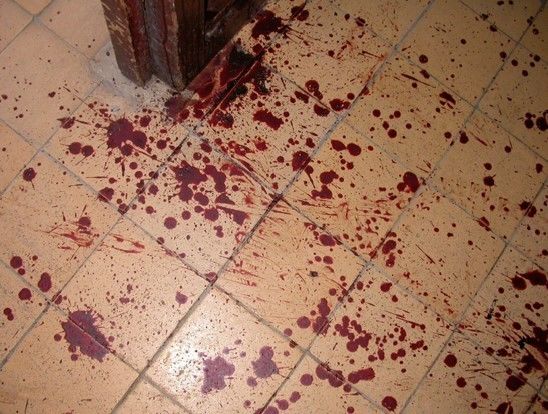
Interpretations are more difficult - 21Drip patternsall you can determine is that blood has been dripping there A bleeding person (usually also say or a person/object wet with blood, but probably too many drips here) has been dripping blood in this location for a period of time
- 22Blood trailCan tell direction of movement.
Need to understand how blood behaves when it hits a surface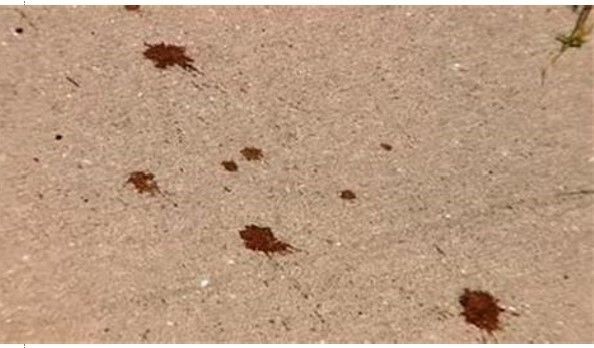
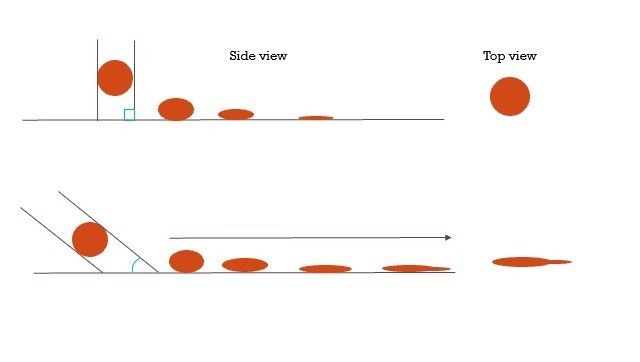
- 23Blood drops landing at different anglesAs blood droplets are spherical they behave in a predictable way when they hit a surface
You can think of the surface being horizontal or vertical - 24Blood drops landing at different angles
- 25Blood drops landing at different angles
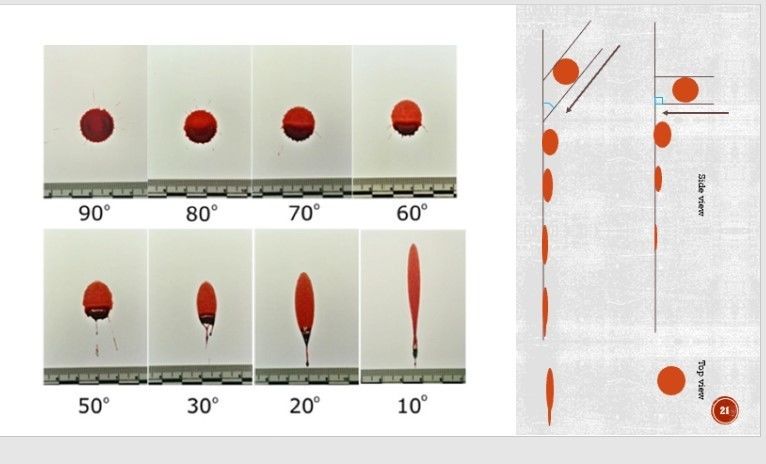
- 26Blood trailBlood dripping straight down from a person or object will hit the surface at roughly 90degrees
As the person begins to move forward the angle the blood hits the surface will change and will generally be greater than 50degrees
In terms of a drip trail the more elliptical the stain the faster the forward motion
The tail or spines of the stain allow us to see the direction of movement - 27blood trail motion
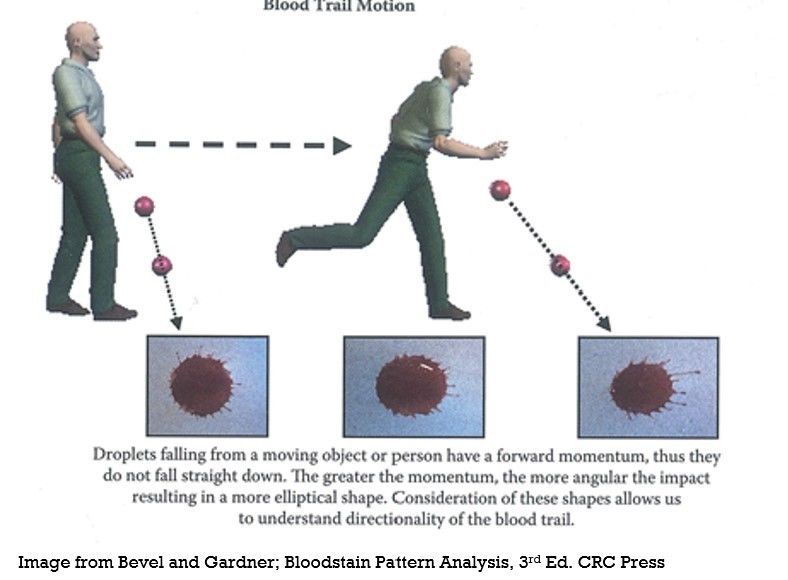
- 28Transfer StainsDirect contact between a bleeding person or an object wet with blood with an unstained surface
Swipe – bloodied object onto clean surface
Wipe – bloodied surface contacted with non-bloodied object
Can be just as significant as spattered blood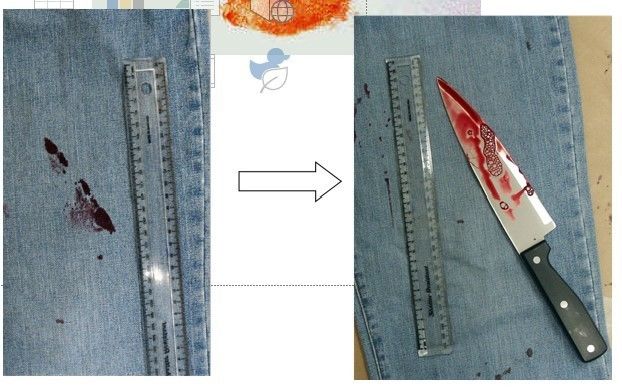
- 29when in a crime sceneFocus attention on areas disturbed
Transfer stains may contain pattern detail such as skin ridge detail, in this case suspect’s finger mark in the victim’s blood
Other useful transfer stains are drag marks, footwear marks, hair swipes…. - 30Drag MarksUse appearance to follow drag marks – generally taper off towards the end
Shoeprints associated with drag marks very significant - 31Saturation Staining and poolingLarge volume of blood from heavily bleeding person
Depending on nature of injury this could occur over a short or prolonged period of time
In this instance, pool created in only a few minutes
Saturation – porous surface
Pool – non porous surface - 32spatteredSpatter patterns are created by a force other than gravity
Spattered bloodstains result from blood drops dispersed through the air due to an external force applied to a source of liquid blood.
Greater volume of blood present – more blood to be spattered on impact
Larger drops of blood travel further – greater mass - 33spattered IMPACTblunt force – striking force
gunshot – striking force
expirated – airflow force
blood into blood – striking force - 34spattered CAST OFFswing – centripetal force vs surface tension
cessation – sudden stopping of moving item - 35spattered ARTERIALgush
spurt - 36impactA bloodstain pattern resulting from an object striking liquid blood.
Generally a greater impact force results in smaller spots of blood. High, medium and low velocity spatter terms are NOT used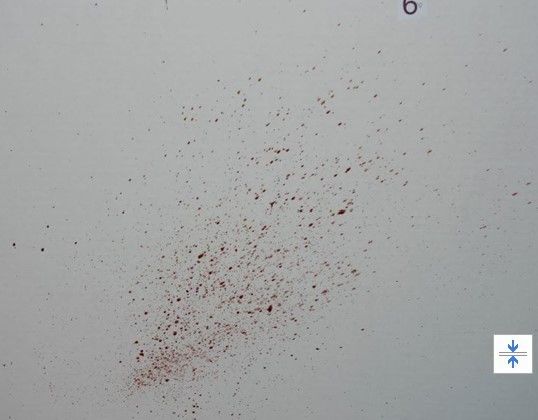
- 37AREA OF ORIGIN DETERMINATION
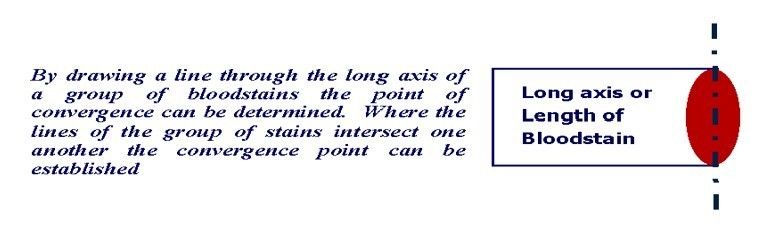
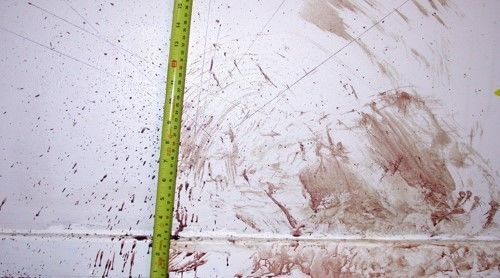
- 38Convergence 2D Area of Origin
- 39Area of Origin CalculationsIn some cases it may be important to establish exactly where an impact occurred
In other word where is the origin of the blood
We can estimate it from the shape and distribution of bloodstains in a pattern
But to calculate it accurately we need to measure bloodstains and use trigonometry - 40TrigonometrySine of unknown angle = length of Opposite side divided by length of Hypotenuse
Cosine of unknown angle = length of Adjacent side divided by length of Hypotenuse
Tangent of unknown angle = length of Opposite side divided by length of Adjacent side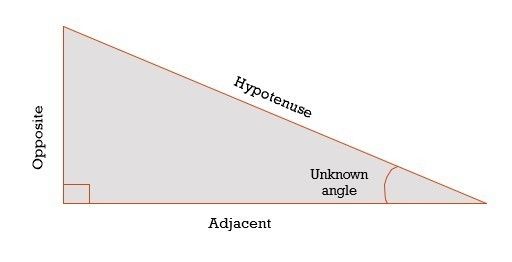
- 41Angle of OriginSine of unknown angle = length of Opposite side divided by length of Hypotenuse
Our bloodstain gives us the opposite (width) and the hypotenuse (length) so we can work out the angle of impact using Sine. - 42Angle of Origin angle of impact =angle of impact = inverse sine ( width / length )
= SIN-1 ( 1.5cm / 3cm )
= SIN-1 0.5
= 30o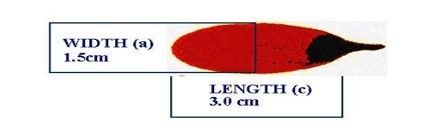
- 43Area of originCombine area of convergence with angle of impact to get area of origin
Attach strings to blood spots and tie off at angle of impact
Strings photographed once in place
Identify area of convergence – where the strings cross
Measure the height and distance from walls, etc.
Then possible to relate spatter pattern to injuries - 443D Determination of area of origin

- 453D Origin3D string analysis – locate area of impact and position the person when struck
Note also blood smearing patterns on wall and floor - 46Link Other Evidence With BPAImpact mark from bottle on wall where victim struck
- 47Secondary (BLOOD INTO BLOOD or drip pattern)Blood dripping forms a pool
Subsequent drops create satellite spatter
Often observed as multi-directional blood spots around a pool of blood
Result of blood impacting into blood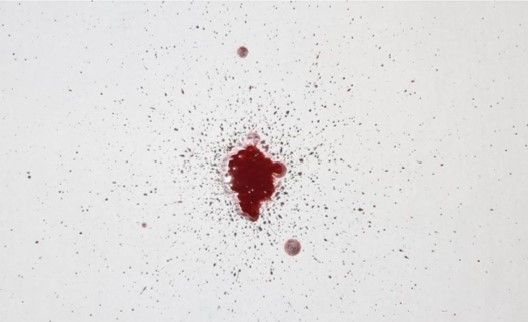
- 48expiratedOccurs when people sustain facial injuries, or injuries to lungs, heart and/or respiratory tracts
Must have blood in mouth, nose or airways
Often difficult to differentiate from impact spatter
May be an issue if the suspect places themselves with victim conducting first aid
May have air bubbles in spots of blood - 49projectedBlood projected at force creates satellite spatter spines of blood from parent bloodstain
A bloodstain pattern resulting from the ejection of a volume of blood under pressure.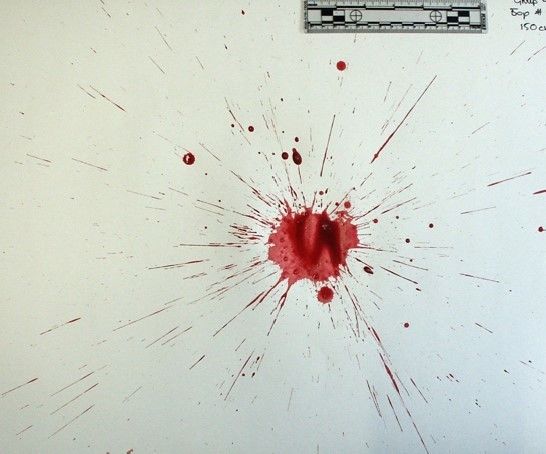
- 50arterialProjected patterns
Large volume stains
Often with flows of blood
Heart beat apparent, in a wave like pattern
Can be projected considerable distances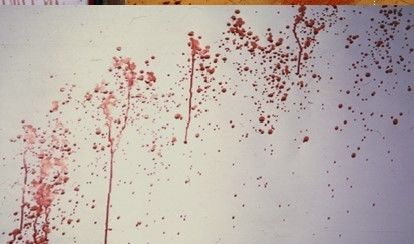
- 51cast offLinear Pattern
Blood spots all roughly the same size
Geometry of spot will vary according to the angle that the blood leaves the weapon (individual spots can show subtle angle changes)
It may be possible to indicate weapon that was used and rough size of weapon (i.e. small or long), and how many actions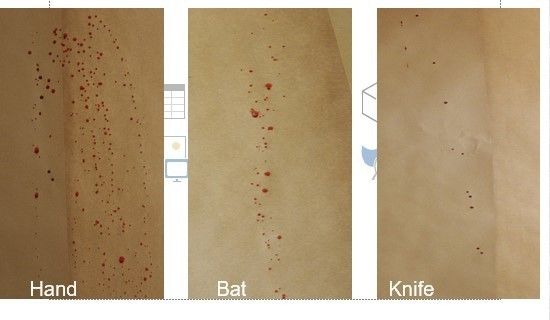
- 52Cast Off On AssailantOften very small
Located on shoulder, back,
swinging arm
Ideal evidence on suspect clothing - 53Gun shot spatterHigh velocity of bullet results in blood misting (‘atomisation’)
Two blood patterns can be created if an exit wounds is present
Forward spatter – out from the exit wound
Back spatter – back towards shooter
Also Draw back – blood sucked back into barrel of the weapon
Results from difference in pressure and expanding gases exiting the wound (close contact shots)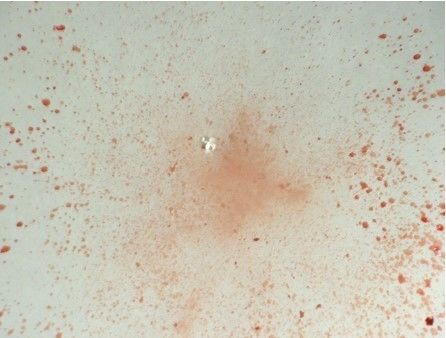
- 54Forward spatterMoves with bullet
Generally larger in area than back spatter
Requires exit wound
- 55alteredCharacteristics not dependent on a force at all
Changed in some way after deposition - 56altered CLOTTINGAltered appearance of blood
Also serum separation - 57altered DILUTIONBlood diluted as a result of cleaning
From landing on a wet surface
Mixed with another substance - 58altered VOIDSAreas where bloodstain pattern is discontinuous
- 59altered INSECT ACTIVITYFlies, maggots
- 60Insect activityFlies feed on blood in the scene and regurgitate the blood elsewhere in the scene
Appear diluted and like mini volcanos!
Position is often a clue, near lights or windows
Something to consider if spatter just doesn’t fit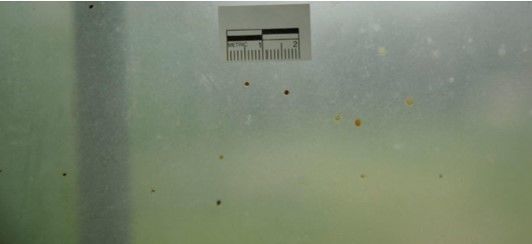
- 61voidAn absence of blood in an otherwise continuous bloodstain or bloodstain pattern.
May indicate something has been moved - sequencing
May suggest an assailant would be bloodstained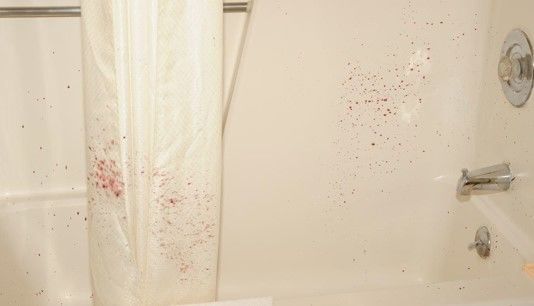
- 62dilutionSink areas should always be searched for dilute bloodstaining and sink taps and plug holes KM screened
Dilute bloodstaining on the taps and towel in this murder case
Luminol used to visualise any further bloodstaining - 63LuminolA useful tool in bloodstain pattern analysis
Challenging on non-porous surfaces as stains will run, therefore photographed as carried out
Excellent for footwear marks, drag marks and clean up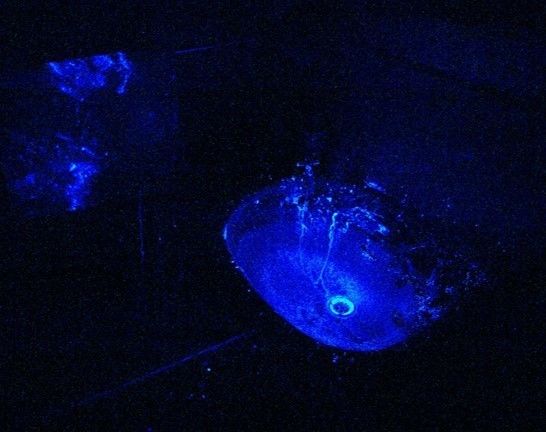
- 64Blood clottingClotting in a healthy person generally takes between three to 15 minutes
Medication can greatly affect clotting time – half an aspirin tablet can increase time by up to half an hour
Temperature can increase clotting time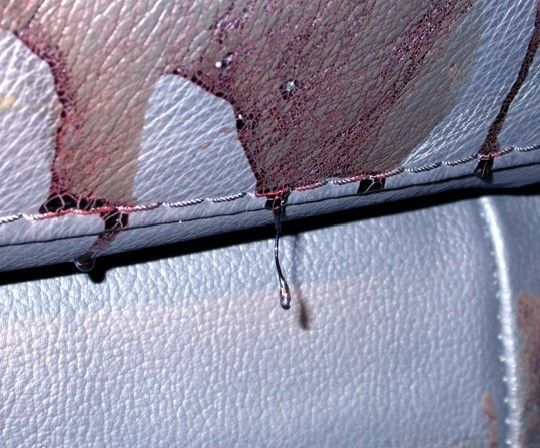
- 65Blood clotsClots in blood are significant – especially if related to the body or in spattered blood
Clots on body that don’t match body position or location indicate body was moved
Clots in spatter indicate prolonged assault – time for injury to clot and stop bleeding before being struck again - 66each group further sorted into the sub groups
Information
- Description
- - Forensics Flashcards on Bloodstain Pattern Analysis, created by megan trent on 02/03/2020.
- Created by
- megan trent
- Views
- 1
- Rating