
Flashcards
Chapter 22 AQA BS2

Cards in this deck (21)
- 1MotivationThe causes of people's actions - why people behave as they do.
- 2Motivation theoryThe study of factors that influence the behaviour of people in the workplace
- 3Scientific ManagementBusiness decision making based on data that are researched and tested quantitatively in order to improve the efficiency of an organisation.
- 4Taylor• People are motivated by money
• Workers don't naturally enjoy work
• Workers should constantly be supervised
• Workers should be trained to work efficiently
• Workers paid 'Piece-rate' or per product
• Boosts productivity but could affect quality. - 5Mayo• Hawthorn Experiments
• Changed working conditions - Working hours, temperature, lighting, humidity, rest breaks.
NO CHANGE
• Concluded that people are best motivated by better communication, greater management involvement and working in groups.
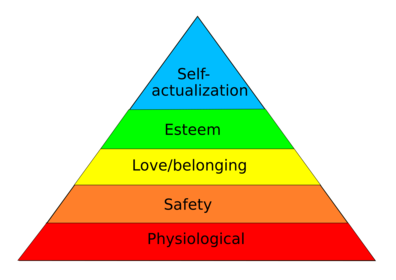
- 6MaslowHierarchy of human needs
• People are motivated by different key levels
• To reach the highest level you have to fulfill the lower sections.
- 7Herzberg• Two main motivational factors
-Hygiene Factors and Motivators
HYGIENE FACTORS - things that do not give positive satisfaction, but without them, dissatisfaction will occur.
- Achievement
- Recognition
- Work itself
- Extra Responsibility
- Giving a Presentation
MOTIVATIONS - things that give positive satisfaction arising from job conditions.
- 8MASLOW Physiological needsRequirement for food, clothes and shelter.
In relation to work, need to earn an income in order to acquire these things, have reasonable work conditions. - 9Time RatesSalary and wage payment systems are time-based payment systems
Wages - paid weekly, based on hourly rate
Salaries - paid monthly, based on annual rate
Salaries used when it is difficult/ impossible to measure work output and where tasks are complex and involved.
Means that effort is not guaranteed - staff could waste time
However, appraisal and supervision procedures and the need to meet targets can act as a sufficient check.
Security provided motivates workers according to Maslow's hierarchy of needs. - 10PieceworkPayment based on the number of items each worker produces.
• Gives employees an incentive to work hard.
• Reduces amount of supervision needed
• Can cause problems
- encourages workers to concentrate on quantity but quality suffers.
- Can increase levels of scrap
- Reduces focus on quality - adds to costs - 11Performance related pay• A bonus or increase in salary usually awarded for above-average employee performance
• Usually used where piece-rate system wouldn't work- hard to measure in a precise way. - 12Advantages of Performance related pay• Direct links between pay and effort
• May lead to reduction in costs - lower levels of supervision, increase in productivity & quality
• Reduction in labour turnover and absenteeism.
• Improvements in motivation
• Useful for getting staff to work towards company objectives - individual targets. - 13Disadvantages of Performance Related Pay• May be source of conflict between staff who are receiving different bonuses for what they perceive as the same effort
• effect of motivation is debatable - PRP represents a small proportion of salary.
• How can performance be measured?
• Can reduce the influence of trade unions and of collective bargaining - 14Profit Sharing• A financial incentive in which a proportion of a firm's profit is divided among its employees in the form of a bonus paid in addition to an employees salary
- 15Advantages of profit sharing• Reduce problems related to a feeling of 'them and us' between employees
• Lessen resistance to change - focus is on profit
• if profit share is large enough, can provide staff with personal incentive - keeps costs down and productivity up - 16Problems with profit sharing• Employees are unlikely to consider it a significant incentive - little or no motivation boost
• May encourage 'free-rider problem' - certain workers put less effort in knowing that all employees receive same rewards
• Rewards fluctuate with success of company - can cause uncertainty in financial planning if staff depend on them - 17Share OwnershipFinancial incentive whereby companies give shares to their employees or sell them at favourable rates below the market price.
Share options - financial incentive in which chief executives and senior management are given the choice of buying a fixed number of shares at a fixed price by a given date.
• Offered extensively to senior management - 18Benefits of share options• Believed to provide senior management with the incentive to perform at their best.
- 19Problems with share options• Can lead to short-termism
• Can lead to excessive financial rewards in boardroom when workforce deserve just as much credit as directors. - 20Fringe benefitsBenefits received by employees in addition to their wages or salary
• Way of rewarding employees without increasing their wage/salary
• Add to cost of employing labour but are expected to pay for themselves - encourages loyalty and commitment, reduces labour turnover
• More common at senior management level - leads to conflict between workers and management - 21Money as a MotivatorMost evidence suggests it doesn't motivate people in long-term
Information
- Description
- A level Business Studies Flashcards on Chapter 22 AQA BS2, created by rachelwilson00 on 23/03/2015.
- Created by
- rachelwilson00
- Views
- 1
- Rating