
Flashcards
Organic Chemistry

Cards in this deck (108)
- 1Structure and Formulae: What are Structural formulae?Structural formulas identify the location of chemical bonds between the atoms of a molecule.
- 2Structure and Formulae: Why are there so many different Structures and formulae in organic chemistry?tetravalent carbon atom.
- 3Structure and Formulae: What makes Carbon able to form so many different compounds?>sp3 hybridization
>Can form three types of bonds due to hybridization (-,=,≡)
>Catenation (able to form cyclic, Branched, or straight-chain molecules)
>Large bond energy - 4Structure and Formulae: What is a molecular formula?A molecular formula consists of the chemical symbols for the constituent elements followed by numeric subscripts describing the number of atoms of each element present in the molecule.
- 5Structure and Formulae: What is the empirical formula?The empirical formula represents the simplest whole-integer ratio of atoms in a compound. The molecular formula for a compound can be the same as or a multiple of the compound’s empirical formula.
- 6Structure and Formulae: What is the disadvantage of a molecular formula? (as opposed to a structural formula)Molecular formulas are compact and easy to communicate; however, they lack the information about bonding and atomic arrangement that is provided in a structural formula.
- 7Structure and Formulae: What is the difference between the molecular formula, structural formula, and empirical formula?The structural formula indicates not only the number of atoms but also their arrangement in space. While the empirical formula indicates the simplest whole-number ratio of all the atoms in a molecule, and the molecular formula describes the exact number and type of atoms in a single molecule of a compound.
- 8Structure and Formulae: Show the difference between the molecular formula, structural formula, and empirical formula using glucose.The molecular formula for glucose is C6H12O6.
The empirical formula of glucose is CH2O.
The structural formula then is: - 9Structure and Formulae: What are the three main categories of bonding configurations of carbon?>Tetrahedral; which has 4 bonding pairs, and a 109.5º bonding angle.
>Trigonal; which has 3 bonding pairs and a 120º bonding angle.
>Linear; which has 2 bonding pairs and a 180º bonding angle. - 10Structure and Formulae: What are Isomers?Different compounds having the same molecular formula are called isomers. That is a different arrangement of atoms in the molecule thus different properties.
- 11Structure and Formulae: What are the 2 categories of isomers?Isomers can be split into two broad groups – structural (or constitutional) isomers, and stereoisomers
- 12Structure and Formulae: What are structural isomers?Structural isomers are those isomers in which the atoms are completely arranged in a different order with the same molecular formulas.
- 13Structure and Formulae: What are the 3 types of structural isomers?Structural isomers can be split again into three main subgroups: chain isomers, position isomers, and functional group isomers.
- 14Structure and Formulae: What are stereoisomers?Stereoisomers are isomers that have the same composition (that is, the same parts) but that differ in the orientation of those parts in space.
- 15Structure and Formulae: What are the 2 types of stereoisomers?Stereoisomers can be split into two main subgroups: optical isomers and geometric isomers.
- 16Functional group analysis of organic compounds: What are Functional groups?Functional groups are often used to “functionalize” a compound, affording it different physical and chemical properties than it would have in its original form.
- 17Functional group analysis of organic compounds: What are Functional groups' main purpose?Functional groups are often used to “functionalize” a compound, affording it different physical and chemical properties than it would have in its original form.
- 18Functional group analysis of organic compounds: What is Functionalization?Functionalization refers to the addition of specific functional groups to a compound by chemical synthesis to afford the compound new, desirable properties.
- 19Functional group analysis of organic compounds: What are the 9 major functional groups? (apart from alkane/ene/yne and phenyl)Hydroxyl/Alcohols (OH), Carboxyl/Carboxylic acids (COOH), Amino/Amines (NH2), Ethers (ROR), Esters (COOR), Aldehydes (CHO), Ketones (RCOR), Carbonyl Chloride (Cl-C=O), and Nitrile (C≡N)
- 20Functional group analysis of organic compounds: What is the order of reactivity in functional groups?COOH-->COOR-->Cl-C=O-->C≡N-->CHO-->RCOR-->OH-->NH2-->ROR
- 21Functional group analysis of organic compounds: Why do Alcohols have higher boiling points than alkanes?Due to the presence of an -OH group, alcohols can hydrogen bond. This leads to higher boiling points compared to their parent alkanes.
- 22Functional group analysis of organic compounds: Are Alcohols polar? If yes, why?Alcohols are polar in nature. This is attributed to the difference in electronegativity between the carbon and the oxygen atoms.
- 23Functional group analysis of organic compounds: What are the real-life purposes of Alcohols?They are used in beverages, antifreeze, antiseptics, fuels, and preservatives for specimens in science, and they can be used in industry as reagents and solvents because they display an ability to dissolve both polar and non-polar substances.
- 24Functional group analysis of organic compounds: What are Ethers boiling point?Ethers have relatively low boiling points due to their inability to form hydrogen bonds with each other.
- 25Functional group analysis of organic compounds: Are Ethers polar?Yes, due to the electronegativity difference between the oxygen and carbon atoms of an ether, the molecule is slightly polar.
- 26Functional group analysis of organic compounds: Are Ethers reactive?Although they have low reactivity overall, the two lone pairs of electrons on the oxygen atom do afford the ether molecule some reactivity; the ether molecule is subject to reacting with strong acids and serves as a Lewis base.
- 27Functional group analysis of organic compounds: What is the difference between an Aldehyde and a ketone?The carbonyl functional group is a carbon double bonded to an oxygen. Depending on the location of the carbonyl group, it is termed differently; ketones contain the carbonyl inside the compound and aldehydes contain the carbonyl at the end of the organic compound.
- 28Functional group analysis of organic compounds: What is the difference between an Aldehyde and a ketone (in terms of boiling point)?Ketones have a higher boiling point than aldehydes. The reason for this is because the carbonyl group of a ketone is more polarized than that of an aldehyde. Put differently, the oxygen of the ketone carbonyl has a greater partial negative than the oxygen of the aldehyde carbonyl.
- 29Functional group analysis of organic compounds: Can Aldehydes and ketones be oxidized?Ketones cannot be oxidized (easily) while aldehydes can be oxidized to carboxylic acids.
- 30Functional group analysis of organic compounds: What are carboxylic acids typically used to form?Carboxylic acids are used as precursors to form other compounds such as esters, aldehydes, and ketones.
- 31Functional group analysis of organic compounds: Why are carboxylic acids boiling points relatively high?Carboxylic acids can exhibit hydrogen bonding with themselves, especially in non-polar solvents; this leads to increased stabilization of the compounds and elevates their boiling points.
- 32Functional group analysis of organic compounds: Are carboxylic acids hydrogen donors or acceptors?Carboxylic acids act as both hydrogen-bond acceptors, due to the carbonyl group, and hydrogen-bond donors, due to the hydroxyl group. Thus, they often participate in hydrogen bonding.
- 33Functional group analysis of organic compounds: Are carboxylic acids soluble in water? If yes, why?Carboxylic acids tend to be soluble in water because they are polar molecules; but as the alkyl chain gets longer, their solubility decreases due to the increasing hydrophobic nature of the carbon chain.
- 34Functional group analysis of organic compounds: What is the IUPAC suffix for Esters?Ester names are derived from the parent alcohol and the parent, thus using the systematic IUPAC name, based on the name for the acid followed by the suffix “-oate.”
- 35Functional group analysis of organic compounds: What are some common uses for Esters?Most naturally occurring fats and oils are the fatty acid esters of glycerol. Typically fragrant, and those with low enough molecular weights/volatile are commonly used as perfumes and essential oils, and pheromones. Polymerized esters, or polyesters, are important plastics.
- 36Functional group analysis of organic compounds: Describe Esters polarity.Esters are more polar than ethers but less so than alcohols.
- 37Functional group analysis of organic compounds: Can Esters participate in hydrogen bonding?They participate in hydrogen bonding as hydrogen-bond acceptors, but cannot act as hydrogen bond donors, unlike their parent alcohols and carboxylic acids.
- 38Functional group analysis of organic compounds: Are Amines basic or acidic?Due to the lone pair of electrons, amines are basic compounds.
- 39Functional group analysis of organic compounds: Why do Amines have relatively high boiling points and are soluble in water?Amine compounds can hydrogen bond, which affords them solubility in water and elevated boiling points.
- 40Functional group analysis of organic compounds: What are alkANES physical properties?>Exist as gases and liquids
>Low boiling point which increases with carbon number
>Insoluble in water
>Low densities
>Most alkanes exists as fossil fuels found in the soil as crude oil - 41Functional group analysis of organic compounds: Why are alkANES relatively unreactive?They only single bonds involved in SP3 hybridization. This produces sigma bonds which are found in the same vicinity of the carbon nuclei and hydrogen nuclei. Thus, have short bond lengths and the bonded electrons are held strongly by the two positively charged nuclei on either side, these bonds experience a strong intra-molecular force and hence are stable. As a result, it takes a lot of energy to break them.
- 42Functional group analysis of organic compounds: Since alkANES are relatively unreactive, what are the only two reactions they can undergo?COMBUSTION AND SUBSTITUTION
- 43Functional group analysis of organic compounds: Combustion is...?>Chemical change.
>Oxidation by burning in oxygen.
>Products are carbon dioxide and water vapour.
>Energy is applied in the form of heat to overcome activation energy.
>Overall heat change is EXOTHERMIC. - 44Functional group analysis of organic compounds: What are the advantages of Combustion of alkANES?1) The sigma bonds that form the single bond is strong so it has strong bond energies hence it releases a high heat of combustion which is useful in industry.
2) It burns to give safe products which are not pollutants. These products can be recycled to reform safe products, that is carbon dioxide used by plants in the process of photosynthesis to form glucose. While water vapour is recycled in the water cycle as rain (condensation)
3) Very few toxic gases (low air pollution)
4) Readily available as fossil fuels (non-renewable) and also biofuels (renewable) Example of biofuels is biogas which is made by decomposing
garbage or plant material. - 45Functional group analysis of organic compounds: What are the disadvantages of Combustion of alkANES?1) Large alkanes burn to give a sooty flame than smaller alkanes making them not so clean and create pollutants.
- 46Functional group analysis of organic compounds: Why do manufacturers crack large hydrocarbons to make smaller ones?>Less soot
>Higher heat of energy released - 47Functional group analysis of organic compounds: What is Cracking and what are the Possible products?Cracking is the process by which heat is used to break large hydrocarbons into smaller hydrocarbons.
Possible products:
Alkenes, alkanes, hydrogen and carbon (soot) - 48Functional group analysis of organic compounds: What are the Advantages of cracking?1) Fuel has smaller more efficient molecules with high heat
2) Fuel burns with less soot hence less pollution, since lower carbon numbers are oxidized completely.
3) Lower carbon dioxide emission…less chance of global warming
4) The alkenes produced as bi-products can be used to make other useful organic molecules. The following flow diagrams should explain this. - 49Functional group analysis of organic compounds: MECHANISM OF FREE RADICAL SUBSTITUTIONThe three main stages are:
-Initiation
-Propagation
-Termination - 50Functional group analysis of organic compounds: USES OF ALKANES1) Used as fuels (fossil fuels) e.g. gasoline, kerosene, and diesel
2) Used as fuels (Biogas) as methane
Formed by the anaerobic respiration of bacteria in the biogas generator
[C6 H11 O5 ]n ====> CH4 + CO2 + N2 + H2
Plant material
3) Heavy oils are used as lubricants
4) Candle wax and kerosene used for lighting
5) Asphalt used to pave roads
6) Cracked alkanes to form alkenes which are used to make plastics and textiles (polymerization of alkenes) - 51Functional group analysis of organic compounds: What is the general formula for alkENES?The General formula is CnH2n.
- 52Functional group analysis of organic compounds: alkENES Compounds contains at least one double bond, describe the features of this..
>They have SP2 hybridization for the carbons in the double bonds.
>These carbons are unsaturated.
>The double bond creates an electron cloud so it attracts positive species or electrophiles.
The pi-bond is long and easy to break, making alkenes very reactive thus Alkenes can undergo addition reactions. - 53Functional group analysis of organic compounds: Why are alkENES not good fuels?They burn with a sooty flame, so are not good fuels.
- 54Functional group analysis of organic compounds: What are the six reactions alkENES typically undergo?hydrogenation, hydration, hydrohalogenation, oxidation, combustion, and halogenation.
- 55Functional group analysis of organic compounds: Out of the six reactions alkENES undergo which are addition reactions and why?hydrogenation, hydration, hydrohalogenation, and halogenation because 2 reactants only form one product.
- 56Functional group analysis of organic compounds: What are the condition and/or reagents for hydration and hydrogenation reaction?>concentrated sulphuric acid and 170 degrees Celsius (hydration)
>Nickel catalyst and 140 degrees Celsius (hydrogenation) - 57Functional group analysis of organic compounds: Describe each addition reaction.1) HALOGENATION: Addition of a halogen molecule
2) HYDROHALOGENATION- addition of a hydrogen halide
3) HYDRATION- addition of water
4) HYDROGENATION- addition of hydrogen gas - 58Uncertainty in measurements: Certainty vs UncertaintyCertainty;
-Precise measurements
-Equipment shows low deviation from accuracy
-Repeatable
Uncertainty;
-Equipment shows high deviation from accuracy
-Not precise
-Not always repeatable - 59Uncertainty in measurements: What is the Definition of Uncertainty?The measurement which has a high level of errors in the measurement or data.
- 60Uncertainty in measurements: Accuracy vs precision.Accuracy: Readings are close to the true value
Precision: Readings are close to each other
- 61Uncertainty in measurements: Define standard deviation:
Standard deviation is a measurement of how close a set of values vary from the mean or average. - 62Uncertainty in measurements: Standard deviation formula.When the standard deviation is very small (≤ 0.1 value) then the readings are precise.
MEAN = X = ∑ Xi /N = (in words)
STANDARD DEVIATION:
- 63Uncertainty in measurements: How is the "true value" of what is being measured (or calculated), generally assumed to exists?Scientists reporting their results usually specify a range of values that they expect this "true value" to fall within. The most common way to show the range of values is:
measurement = best estimate ± uncertainty
Example: a measurement of 5.07 g ± 0.02 g means the actual value for the quantity being measured lies between 5.05 g and 5.09 g. - 64Uncertainty in measurements: What is the relative uncertainty? (formula)Relative Uncertainty =
uncertainty
____________
measured quantity - 65Uncertainty in measurements: What is the relative error? (formula)Relative Error =
measured value − expected value
_______________________
expected value - 66Titrimetric Methods of Analysis: What are the principles of titration?It is a quantitative analysis, which is used to find unknown concentrations. It is also used to standardize known solutions.
- 67Titrimetric Methods of Analysis: Describe the endpoint.The endpoint is when the concentration of the known reacts completely with the unknown. The endpoint can either be detected by a visual colour change of redox solutions or colour changes of an indicator.
- 68Titrimetric Methods of Analysis: Titrant vs AnalyteThe unknown solution is called the analyte while the known is called the titrant. The titrant goes in the burette while the analyte goes in the conical flask.
- 69Titrimetric Methods of Analysis: Describe the equivalence point.The equivalence point of a Titration: is the volume/quantity of the titrant which is of equal proportion/concentration to the analyte.
- 70Titrimetric Methods of Analysis: What is the titration error?The difference between the endpoint and the equivalence point is the titration error. This closeness is dependent on the appropriateness of the indicator.
- 71Titrimetric Methods of Analysis: What are the manipulation techniques for the pipette?-Wash pipette with the analyte
-Read pipette at eye level
-Use index finger
-Remove hanging drop
-Keep the tip of pipette below liquid while filling
-Transfer contents smoothly - 72Titrimetric Methods of Analysis: What are the manipulation techniques for the burette?-Rinse burette with the standard solution
-Clamp burette straight
-Remove funnel before zeroing at eye level.
-Remove air from the tip of the burette
-Use the left hand to manipulate.
-Use white tile to view endpoint.
-Use white paper to view the meniscus clearly. - 73Titrimetric Methods of Analysis: What are the manipulation techniques for mass readings?-Zero or calibrate the instrument.
-Clean surface of the scale to remove debris
-Use the same balance for all readings.
-Cover analytical balance from wind currents - 74Titrimetric Methods of Analysis: What are the manipulation techniques for the thermometer?-Bulb of thermometer below the liquid.
-Read thermometer at eye level
-Thermometer does not touch the sides of the container.
-Stir gently to distribute heat. - 75Titrimetric Methods of Analysis: Primary standards vs Secondary standardsPrimary Standard:
>Substance of high purity used to prepare standard solutions
>Known as the titrant.
>This substance is placed in the burette
Secondary Standard:
>Substance of initially unknown concentration which is standardized by a primary standard.
>Known as the analyte initially but becomes the titrant eventually.
>Placed in the conical flask
>This solution becomes standardized once the concentration is determined
>This solution is later used as a standardized molar solution which now becomes the titrant and is used to determine other unknowns. - 76Titrimetric Methods of Analysis: What are examples of Primary standards and Secondary standards?PS-Examples: Sodium carbonate
SS-Example: Sulphuric or hydrochloric acids - 77Titrimetric Methods of Analysis: What are the Properties of a Primary standard?1) A solid of high purity
2) A solid that is stable to air i.e. not easily oxidized, deliquescent or hygroscopic.
3) Must be stable to heat
4) Has no water of crystallization i.e. must be anhydrous
5) Must be highly soluble in water.
6) Has a large formula mass (Molar mass) - 78Titrimetric Methods of Analysis: Types of solution with their corresponding Primary standard.~Base-->Oxalic acid, potassium hydrogen phthalate KC8 H5 O4
~Oxidizing agents-->Oxalic acid
~Acids-->Na2CO3 or NaHCO3
~Reducing agents-->Potassium ~Dichromate K2 Cr2 O7
AgNO3-->NaCl
~Sodium Thiosulphate Na2S2O3
-->Potassium Iodate KIO3 - 79Titrimetric Methods of Analysis: Types of titration?TYPES OF TITRATIONS
1) Acid/base titrations
2) Redox titrations
3) Precipitation titrations
4) Back titrations - 80Titrimetric Methods of Analysis: Describe Redox titrations.involves reacting oxidizing and reducing agents which is accompanied by colour changes e.g.
FeSO4 and KMnO4, KI and H2O2. - 81Titrimetric Methods of Analysis: Describe Precipitation titrations.This involves the production of a precipitate by the reaction of the analyte and the titrant. The endpoint will be determined by using an indicator that will signal the point at which no more precipitate is produced because all the analyte is used up. The titrant will now be in excess and this will react with the indicator to bring about a colour change.
- 82Titrimetric Methods of Analysis: Describe Back Titrations.If a reaction is incomplete because incomplete dissociation of the reactant or its products affects the function of the indicator or one of the products is a gas, then direct titration becomes impossible. These may be conducted using back titration. This involves reacting one of the products with a known quantity of another substance that is in excess; then titrating the excess of the reagent leftover with a standard solution, Then calculate backwards to get the concentration of the product.
- 83Titrimetric Methods of Analysis: Example of Back Titration.For E.g. Ammonium salts will react with alkali to release ammonia gas. It is difficult to measure the mass of the ammonia gas expelled experimentally. Ammonium salts may be determined by reacting the salt with excess sodium hydroxide of a known concentration, then titrate the un-reacted sodium hydroxide with a standard acid solution.
The un-reacted NaOH can then be calculated from the titration. This can then be subtracted from the original sample of excess NaOH to obtain the number of moles of the NaOH that reacted with the ammonia. - 84Titrimetric Methods of Analysis: Key points of Back Titrations.>The reactant that does not vapourize, whose concentration is known is used in excess.
>The unreacted excess solution is then titrated against a standardized solution to obtain the quantity that did not react.
>This unreacted quantity is subtracted from the overall quantity that was used in excess in order to get the number of moles of the quantity that reacted.
>This reacted value is used to calculate the quantity of the unknown(usually the unstable reagent).
>Calculation is in the reverse order…that is why it's called back titration. - 85Titrimetric Methods of Analysis: What are the reasons for using Back Titrations?1) The endpoint is too difficult to observe.
2) There are no indicators available.
3) The reaction is reversible and considered incomplete.
4) The product affects the function of the indicator
5) One product is gaseous.
6) Reaction is too slow.
7) The concentration is too minute for a titration. - 86Titrimetric Methods of Analysis: List examples of reactions that may need to use back titrations.1) Reaction with ammonium salt and a base.
2) Carbonates and acids
3) Reaction is too cloudy and turbid, hence the indicator cannot be seen.
4) The reaction produces precipitates. - 87Titrimetric Methods of Analysis: Describe the Non-indicator endpoints Thermometric TitrationsEnd-points indicated by changes in temperatures either increase or decrease.
- 88Titrimetric Methods of Analysis: Graphically represent the Thermometric Titrations end-points

- 89Titrimetric Methods of Analysis: Describe the Non-indicator endpoints Potentiometric TitrationsThis involves the measurement of the potential difference between two electrodes for the products formed during the titration.
- 90Titrimetric Methods of Analysis: Describe the Non-indicator endpoints Conductometric TitrationsThe electrical conductance or resistance of the solution being titrated is measured and used to determine the end-point.
- 91Titrimetric Methods of Analysis: Why does the experimenter measure the electrical conduction through aqueous solutions?>the presence of the ionic specie increases conduction
>the nature of the electrolyte will determine conductance values e.g. weak/strong electrolytes (degree of ionization) - 92Titrimetric Methods of Analysis: Graphically represent a Strong acid and strong base e.g. NaOH and HCl [ complete ionization]
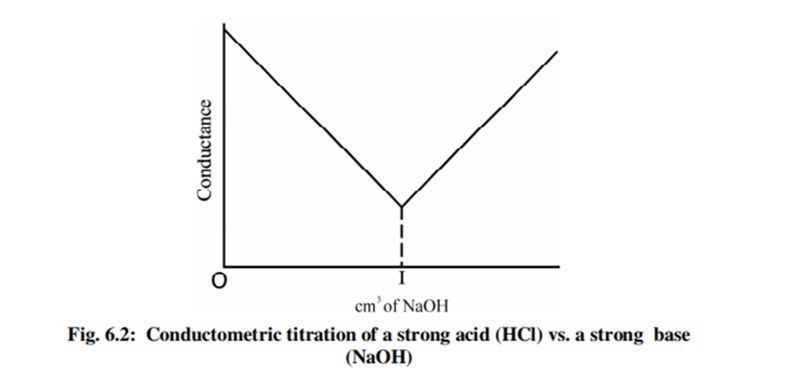
- 93Titrimetric Methods of Analysis: Explain using NaOH- Titrant and HCl- analyte for the strong acid and strong base Conductometric TitrationsIons in solution are H+ Cl- as NaOH is added the OH- combines with H+ and hence the hydrogen ion is removed and replaced by Na+. The sodium ion is larger and moves much slower so the conductance will decrease until all the hydrogen ions are removed [end point] addition of NaOH will increase the number of ions and the conductance start rising.
- 94Titrimetric Methods of Analysis: Graphically represent for weak acid and strong base e.g. CH3 COOH and NaOH [partial ionization]

- 95Titrimetric Methods of Analysis: Explain for the strong acid and weak base Conductometric TitrationsCH3 COOH does not ionize completely CH3 COOH ⇌ CH3 COO- + H+ conduction will be low as NaOH is added the undissociated acid will ionize more so conduction will increase gradually.
CH3 COOH + NaOH CH3 COO- Na+ + H2O
When the endpoint is reached then the NaOH added will cause a sharp increase in conductivity as the NaOH will be completely ionized. - 96Titrimetric Methods of Analysis: Explain Potentiometric TitrationsThe most common type is one using pH readings. As the titrant is added the concentration of the analyte will decrease, this can be detected by the change in the potential of the electrode. An ion-sensitive electrode has to be used e.g. Hydrogen electrode or pH sensitive glass electrode.
As the H+ ion decreases the pH or electrode potential will vary slightly. However, when H+ concentration is at zero at the neutralization point the pH or potential difference will rise sharply. Hence the endpoint is detected by the steepest change in the readings. - 97Titrimetric Methods of Analysis: Graphically represent the steep change in Potentiometric Titrations

- 98Titrimetric Methods of Analysis: What are the Advantages of Conductometric/Potentiometric Titrations-can be used in turbid/coloured reactions
-used in very dilute solutions which are not sensitive to indicators
-sharp end-points makes it easy to identify end-points - 99Gravimetric Methods of Analysis: Gravimetric vs TitrimetricGravimetric-
>Change in mass
>Uses solids or precipitates
>Uses analytical balance
>Endpoints depend on mass readings
Titrimetric-
>Change in concentration
>Use solutions
>Use burettes and pipettes
>Endpoints need a visible change - 100Gravimetric Methods of Analysis: Define Gravimetric AnalysisThe process by which analytes are identified by using a change in mass.
- 101Gravimetric Methods of Analysis: Gravimetric Analysis Apparatus

- 102Gravimetric Methods of Analysis: TYPES OF GRAVIMETRIC ANALYSISprecipitation and volatilization methods
- 103Gravimetric Methods of Analysis: Explain VOLATILIZATIONPbCO3 (s) --> PbO (s) + CO2 (g) ↑
(heat)
List: silica crucible, bunsen burner, desiccator, analytical balance, tongs,
Procedure:
-Weigh mass of Lead carbonate
In a crucible
-Heat it in the crucible until constant mass.
-Subtract the mass of the end product from the original mass to obtain the mass of carbon dioxide that was given off.
-Calculate the Empirical formula.
The sample is thermally decomposed
One product must be a gas; while the other product must be solid.
Examples: Hydrocarbons, metal carbonates, metal nitrates, salts with water of crystallization. - 104Gravimetric Methods of Analysis: Diagram of VOLATILIZATION Apparatus

- 105Gravimetric Methods of Analysis: Explain PRECIPITATIONPb(NO3)2 (aq) + 2 NaOH (aq) --> Pb(OH)2 (s) ↓ + 2NaNO3 (aq)
List: Buchner funnel or sintered glass crucible, filter paper, vacuum flask, beaker, analytical balance, desiccator,
Procedure:
-Weigh mass of lead Nitrate. Dissolve in water.
-Add NaOH in excess.
-Filter to remove the precipitate.
-Test the filtrate with more NaOH to ensure all the lead was removed.
-Collect residue and dry it in a desiccator.
-Weigh residue and Calculate the empirical formula.
The analyte is isolated by making it a precipitate.
The original reagents must be soluble.
One product must be insoluble and stable to air.
Precipitate must be granular i.e. must not pass through the filter paper.
Examples: used for soluble silver salts, lead salts, Barium salts, and all salts that form precipitates. - 106Gravimetric Methods of Analysis: Diagram of PRECIPITATION apparatus

- 107Locating and Operating Industrial Plants: List the factors that affect the location of a plant>Tranport
>Telecommunication
>Reliable power source
>Labour supply (workers with the right skills)
>Raw product
>Grants and financial incentives from the government
>Flat land is easier accessible, easier to expand the plant, thus cheaper
>Water supply
>Climate - 108Locating and Operating Industrial Plants: Ways to keep safe>label clearly
>train employees on the specifics of the chemicals
>regularly access the location of the chemical
>hygenie
>no eating around work area
>chain of command for in the event of emergencies
>practice safety procedures
>safelty gear
Information
- Description
- Structure and Formulae, Locating and Operating Industrial Plants, Gravimetric Methods Analysis, Titriatric methods of Analysis, Uncertainty in measurements and Functional Group analysis in Organic Compounds
- Created by
- Aaliyah Forbes · Jul 2021
- Updated
- Jul 5, 2021
- Views
- 12
- Rating