
Flashcards
Eye muscle anatomy

Cards in this deck (75)
- 1Why type of muscle are the EOM?Skeletal
- 2How is eye skeletal muscle fibre different from non-cranial skeletal muscle fibre (9)?- Structure: smaller and more variable in size (makes them faster)
- More innervation allows for finer movements
- Quick contraction time for faster movements: ,SIF MIF and PIF fibres (non-cranial only have SIF)
- increased fatigue resistance (due to metabolic characteristics)
- can remodel during life (diff regeneration pattern from non-cranial)
- Spared from certain muscular diseases
- Susceptible to different diseases than non-cranial
-fibers do not run from origin to insertion like other skeletal muscle
- more longitudinal and transverse elastic fibers than skeletal fibres - 3Define skeletal muscleOne of three types of muscle tissue (skeletal, smooth, cardiac) which represents the majority of the muscular tissue in the body. Skeletal muscle is the type of muscle which powers movement of the skeleton as in walking and lifting. Skeletal muscle is striated muscle in that it is formed by parallel muscle fibers
- 4How is eye skeletal muscle fibre similar to non-cranial skeletal muscle fibre?Muscle spindles and pallisade endings offer sensory feedback about eye position (just like other skeletal muscle) --- proprioception
- 5Each muscle fibre is composed of many units called what??sarcomeres
- 6What are the two distinct layers of muscle fibre?Orbital layer: adjacent to the periorbita and orbital bone
Global layer: Adjacent to the optic nerve and the eye - 7What is the pattern of muscle fibre layers in the recti muscles? What about the oblique muscles?At the orgin of the rectus muscles, the muscle fibres are arranged concentrically, but change to be distinct layers at the insertion.
The fibres in the obliques are concentric throughout - 8What were the original two different muscle types?Feldenstrukter (slow, multiple terminal nerve endings, drives slow eye movement -- pursuits)
Fibrillenstruktur (fast, single nerve endings, drive fast eye movements - saccades) - 9What are the five types of muscle fibres?-Orbital SIF (high mitochondria and smalll myofibrils thus fast twitch and fatigue resistant)
-Orbital MIF (several nerve terminals along the length of a single fibre, both fast twitch and slow contracting fibres)
-Global Red SIF (high myoglobulin, fast twitch and fatigue resistant)
-Global pale SIF (less myoglobulin, fast twitch an more easily fatiguable)
-Global MIF (palisade endings; large myofibrils thus slow and tonic) - 10What type of activity do the MIFs in each layer supply?Tonic
- 11What type of activity do the SIFs in each layer majorly supply?Saccades (fast eye movements)
- 12What are the three types of nerve endings in eye muscles?Ordinary single motor endplates (en plaque)
Multiple grapelike nerve endings around tendons (en grappe)
Very fine, nonmedulated fibres ending in thinner muscle fibres - 13What is the basic functional unit of a skeletomotor system? What is the size of this unit in EOM?A motor unit: One motor neuron plus the musce fibres that it innervates
In EOM, the motor unit size is small (1:1 or 1:10 at most) - 14Why do EOMs have quick conduction time and fine-tuned responses?a combination of small motor unit size (number of muscle fibres per motor neuron) and different types of nervous conduction
- 15How to EOM muscles contract? What does this depend on?because of the abundance of nerve fibers, eye muscle fibers respond with a maximal contraction every time they are stimulated, rather than a graded force (all or nothing law).
The amount of total contraction of the whole muscle depends on how many fibers and which fiber types are recruited during the movement. The distance the eye moves is related to how long the maximal contraction is sustained, rather than the number of fibers that are recruited. - 16In relation to muscle fibre recruitment, what are small, precise EOM movements associated with? What about large, quick movements?small movements: a small number of motor units stimulated for a short time
Large movements: A lot of fibres stimulated for a relatively long time - 17What determines the fineness with which muscle force can be increased or decreased?Motor unit size
- 18Which CNs run inside the AOZ? Outside?CN III and VI run inside the muscle cone. CN IV runs superiorly
- 19In which area of the muschoe does the motor nerve reach the EOM?In the region of the muscle's middle and posterior thirds
- 20Why is little to no sharp or temperature sensation felt by the eye muscles?Because there is little sensory innervation
- 21What % of muscle fibres never stop firing?18%
- 22Explain the concept of tonus. What % of muscle fibres are firing at this time?All muscles have a resting tonus when the eye is in primary position, with up to 70% of the fibers firing. The amount of tonus differs between rectii and obliques but serves to keep the eye in primary position
- 23What are 4 categories of disorders that specifically affect eye muscle?Strabismus - some studies show muscles make adaptive changes to their length (less or more sarcomeres)
Nystagmus – may be genetic, or have a sensory or motor origin. Pts may have altered muscle structure
Congenital cranial dysinnervation disorders (CCDD) – inherited. Congenital fibrosis of the EOM fibers dues to nerve development defects
Diseases where EOM are preferentially involved – TED, CPEO, Kearn-Sayre, Ocular MG - 24What are the three translational movements a sphere can make? What 3 rotations can it make?side to side, up and down and front to back
(ie the object physically moves from one spot in space to another)
Rotational: think x, y, z axis - 25What is the first step to describing rotational motion of the eye?To define specific axes with regards to the globe -- Axes of Fick
- 26What are Fick's Axes?Rotation around the x axis which runs left to right, creates up and down rotation of the globe. (vertical)
Rotation around the z axis which runs superior to inferior, creates rotation to the right and left. (horizontal)
Rotation around the y axis which runs anterior to posterior, creates clockwise or counter clockwise rotation. (torsional, cyclo rotation) - 27What is Donder's Law?states that every position of the eye has a specific coordinate point.
When the head is in a fixed position, to travel from primary position to this point, the eye can make many combinations of movements with HORIZONTAL and then VERTICAL vectors or vice versa, and still reach the same coordinate. This is called commutivity. - 28Explain Listings LawListing described a plane through which movements that are made up of horizontal, vertical or oblique vectors from primary position are free from cyclorotation of the globe.
Listing’s Law predicts a specific amount of torsion which is achieved by movement in the horizontal and vertical vectors for each eye position represented by Listing’s Plane. The net amount of movement around the y axis (torsional vector) is ZERO.
When the eyes move but the head and body are still, the movement is PURELY horizontal/vertical. Only when the head and body move from upright to “tilted” do the eyes MAKE a cyclo rotational movement around the y axis - 29Describe ocular counter roll, and on which axis this happens aroundWhen we tilt our heads to the side, the globes rotate around the y axis in the opposite direction to try to bring the vertical meridian into line with earth vertical. This movement is stimulated by the inner ear and is called the ocular counter roll.
- 30What is the degree difference between the muscle/orbital axis and the visual axis when the eye is in primary position?23 degrees
- 31What factors determine the direction of eye movement created when the muscle contracts?The position and angulation of the muscle insertion and the muscle pathway with respect to the visual and orbital axes
- 32What are muscle actions dictated by?Their pathway, the angle between the visual axis and muscle plane, and the angle of insertion of the muscle
(strongest muscle action is from the muscle in its muscle plane) - 33Each of the 6 EOMS and their respective functions (primary, secondary, tertiary)
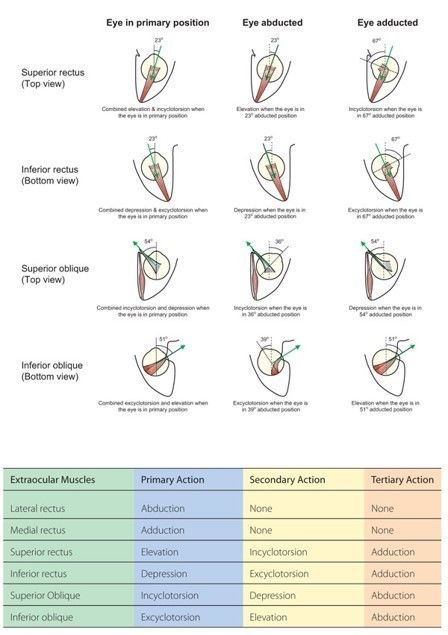
- 34Which EOMs originate at the AOZ?The rectus muscles
- 35Where do the oblique EOMs originate?SO: superior to AOZ
IO: medial orbital floor (near lacrimal fossa) - 36Define muscle planeThe direction that the muscle lies in its pathway to the globe
- 37How does the strength and thickness of the recti vs oblique muscle differ?Rectii muscles are on average thicker and stronger than the obliques
- 38When a rectus muscle contracts, the majority of the muscle effect is in the direction of the _______muscle plane (The direction that the muscle lies in its pathway to the globe)
- 39Generally, where do the recti muscles insert on the globe? the obliques?R: Anterior to the equator
O: Posterior to the equator - 40What is the spiral of Tillaux and why is it signifncant?The distance of the muscular insertions from the limbus can be illustrated as a spiral with a gradually increasing radius, called the Spiral of Tillaux.
important during strabismus surgery, for locating musles and determining where to move the muscles to during resection/recession procedures - 41Discuss which extraocular muscle is the longest, which is the strongest, which has the least tendon and which is longest of the recti.MR is the strongest (probably due to the frequency of convergence) and has the smallest tendon out of the recti muscles.
IO has the smallest tendon of all EOMs.
Longest tendon of recti muscles is the LR, overall EOMs is SO - 42Discuss the characteristics of the individual extraocular muscles: a. Origin b. Insertion c. Length d. Tendon length e. Width of insertion f. Innervation g. Blood supplyfix snipping tool and paste here
- 43An angled insertion with respect to the visual and orbital axes will cause a rotation around the ____ axisY (torsional)

- 44Describe the insertion points of the SR and IR and how this positioning contributes to their secondary muscle actionsThe SR insertion is slightly closer to the limbus in it’s nasal portion than the lateral, and is slightly to the lateral side of the globe. This means that when the globe is in primary position and the muscle contracts, it has the secondary action of INTORSION
The IR is placed in a similar position on the inferior globe. As it is inferior on the globe, it’s contraction causes a slight amount of EXTORSION as it’s secondary action. Note that the insertions are only slightly angled, so the torsional ability of these rectii is limited. - 45Why do the LR and MR not have any secondary/tertiary muscle actions?The insertions of the MR and LR are placed vertically, parallel to the limbus, limiting their pull to purely horizontal or vectors.
- 46The oblique muscles differ from the recti muscles by which two factors?Their origin and muscle plane
The SO originates from the superior orbit on the lesser wing of the sphenoid ABOVE the origins of the rectii, travelling along the medial wall to the trochlea (cartilage). The SO functions as if its origin is at the trochlea
IR is the only muscle to originate in the anterior orbit. Arises from the maxillary bone, lateral to lacrimal fossa
The muscle plane of both of these muscles is directed to the medial orbital wall, rather than the apex of the orbit. This should make them Adductors but they aren’t - 47What is the action of the oblique muscles determined by?The posterior position of their angeled insertions. The extremely oblique angle of insertions of the oblquie muscles makes them most effective at creating torsion (Primary action).
SO intorts, IO extorts.
By virtue of their insertions superiorly and inferiorly, the secondary actions of the IO and SO are elevation and depression. These muscles are much smaller than the rectii, and their insertions are much more oblique to the visual axis, making them very weak in their vertical actions.
The tertiary action of the oblique muscles is ABduction, due to their insertions in the posterior pole. - 48The common muscle tree (6 cardinal positions) is used to indicate where the muscle has its greatest ____ actionVertical

- 49The 9 diagnostic positions of gaze are used to compare muscle function to confirm or dispute ______muscle weakness.

- 50What are musce pulleys?Thickened bands of tissue surrounding the muscles in the anterior orbit
- 51the global layer of muscle inserts on the ______, and the orbital layer inserts directly on the ______globe, muscle pulley

- 52How do muscle pulleys aid in eye movement?The muscle pulleys are not stationary – instead the force of the orbital layer of muscle causes the pulleys to move with muscle movement, ensuring a full range of motion.

- 53The connective tissues of the orbit are thickened to form _____ for the four rectus muscles and inferior oblique. Interconnections between the pulleys (and anterior and posterior to the pulleys) are the _____pulleys. Pully sling.
- 54Which syndrome can result if the muscle pulleys are displaced?Eye movements can be compromised and sagging eye syndrome can result.
- 55Why is the action of the SR/IR more complex than that of the MR and LR?Because it lies at an angle to each of the axes (the X , Y and Z axes)
Line of insertion on the sclera is oblique, with the nasal side closer to the limbus than the temporal side (both SR and IR) - 56What is important about the anterior extension from the IR muscle sheath and suspensatory ligament in eye movement?This extension (the capsulopalpebral fascia) inserts into the inferior edge of the tarsal plate, allowing for coordination of movements with eyelid positioning, and ensuring lowering of the lid on downard gaze.
- 57In which direction does the SO muscle change to after running through the trochlea?After running through the trochlea, the tendon runs posteriorly (the tendon begins 1 cm posterior to the trochlea)
- 58What other structure can the trochlea be compared to, in terms of function?A muscle pulley, because it changes the direction of muscle pull
- 59What is unique about the IO from the other EOMs?Its insertion point is in the anterior orbit
- 60The fibres of the EOMs have a _____ structurelayered
- 61Compare the global and orbital layers of the EOM in terms of location, fibre size, vascularization, and insertion points to induce muscle movementsG: adjacent to the globe, fibres extend the length of the muscle and inserts onto sclera via tendon causing movements of the globe. Variable size in muscle fibres
O: Adjacent to the orbital bone, consists of small diameter fibres, more vascularized than the GL. Fibres end before the muscle tendon and have insertions into the muscle sheath. Theses fibres ultimately insert into the muscle pulleys to influence the rotational axis of the muscle - 62What % of fibres does the OL make up in EOM?40-60%
- 63Fibers may be distinct based on _____ not which type of eye movement they contribute to or whether they are “fast” or “slow”.the amount of work they do. For example, each muscle layer has some singly innervated fibers that have their largest role in saccades, but also aid in pursuits and fixation.
- 64The _____ fibers in each layer supply “tonic” activity.multiply innervated
- 65What is the function of muscle pulleys? What can happen if a muscle pulley is displaced? The pulley of which muscle is most full developed?To reduce sideslip of the EOM during globe rotation and help determine the effective direction of the pull.
Muscle pulley displacement can clinically mimic muscle dysfunction
The pulley of the MR is most fully developed - 66In primary, how many degrees does the SR/IR axis shift from the orbital axis? The SO/IO?SR/IR - 23 degrees
IO - 51
SO - 55 - 67Name the antagnoist pairs for the current agonists: MR, SR, SOLR, IR, IO
- 68In primary position, muscle contraction causes movement in _____ vectors particular to that muscle.All
- 69Muscle actions are dictated by which three factors?Their pathway, the angle between the visual axis and the muscle plane, and the angle of insertion of the muscle.
- 70All four rectii muscles originate in the ____ of the orbit, from the common tendonous ring, formerly called the _____. The direction that the muscle lies in its pathway to the globe is called the ________.apex ; Annulus of Zinn; muscle plane
- 71Which EOM is the longest? Shortest?Longest - SR (42mm)
Shortest - SO (33.2mm) - 72Which EOM has the longest tendon? Shortest?Longest tendon: SO (27mm)
Shortest: IO (1-2mm) - 73Which EOM has the thickest tendon? Thinnest?Thickest tendon: SR (10.8mm)
Thinnest tendon: LR (9.2mm) - 74Which EOM is the thickest? Skinniest?Thickest: MR
Skinniest: SO - 75—
Information
- Description
- 1º ano Orthoptics review - Year 1 (Module 2) Flashcards on Eye muscle anatomy, created by Suh Dude on 06/11/2021.
- Created by
- Suh Dude
- Views
- 10
- Rating
More on Orbit and Accessory Structures of the Eye