
Flashcards
Electron Arrangement
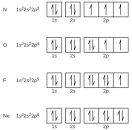
Cards in this deck (76)
- 1What is emission line spectrum?It is a line spectrum of specific colours produced when we pass light through a discharge tube filled with a gas
- 2What is the main principle of emission line spectrums?Different elements produce different line spectrum
- 3What did Bohr propose?an electron in an atom can only have a fixed amount of energy- a quantum of energy
- 4What is an energy level?It is defined as the fixed energy value that an electron in an atom may have
- 5What is the ground state of an atom?it is one in which the electrons occupy the lowest available energy levels
- 6How is an atom provided with energy?Heating them or passing electricity through theme
- 7What happens when we provide atoms with energy?They become excited and jump from lower energy level to higher energy levels
- 8What is the excited state of an atom?it is one in which the electrons occupy higher energy levels than those available in the ground state
- 9What happens to the electrons when they are in excited state?Unstable
- 10What happens when they start to lose that energy?they fall back down to the lower level and as they fall back down they release energy in the form of a photon of light
- 11How are these lights different from each other?Since the electron is falling back down to a fixed energy level, only fixed amounts of light can be given off --> light of a definite frequency
- 12Summary of what happens to electrons when energy is supplied?-> Atom in ground state
-> Energy supplied to atom (heat/electricity)
-> Electron jumps to higher energy levels
-> Now in excited state
-> Electron is unstable
-> Electron fall back to lower levels
->Emit photons of light
->The frequency of light emitted is proportional to the difference in energy between the two energy levels
-> (E2-E1 = hf) - 13What happens when an electron falls to n=1 level?it gives UV Range
- 14What happens when an electron falls to n=2 level?it gives Visible Range
- 15What is the Balmer series?It contains all of the lines in the visible region of the hydrogen spectrum
- 16What happens when an electron falls to n=3,4,5 level?It gives IR range
- 17What is the Lyman series?It contains the lines in the UV region of the hydrogen spectrum
- 18What is the Paschen series?It contains the lines in the infrared region of the hydrogen spectrum
- 19What colour does an electron falling from 3 to 2 in a hydrogen spectrum give?red
- 20What colour does an electron falling from 4 to 2 in a hydrogen spectrum give?Blue/Green
- 21What colour does an electron falling from 5 to 2 in a hydrogen spectrum give?Purple
- 22What colour does an electron falling from 6 to 2 in a hydrogen spectrum give?Violet
- 23What did one line on the spectrum actually appear as when they looked at it closely?There was actually a number of lines very close together. These lines were sublevels
- 24What does AAS stand for?Atomic Absorption Spectrometry
- 25How does the AAS work?Atoms in the ground state absorb the same radiations as they emit in the excited state
- 26What is the AAS used for?To see what elements are present in a substance and to detect the presence of heavy metals in water
- 27What are the limitations of Bohr's theory?-> It did not take into account the presence of sublevels
->It didn't take into account the fact that the electron had a wave motion
-> Heisenberg's Uncertainty principle was in conflict with Bohr's theory - we can only refer to the probability of finding an electron - 28What way do electron move?Electrons have a wave-particle duality. They travel in a wave motion
- 29What is Heisenberg's Uncertainty Principle?It states that it is impossible to measure both the velocity and the position of an electron at the same time
- 30What is electronic configuration?It shows the arrangement of electrons in an atom of an element
- 31How many sublevels does energy level one have?1 sublevel called 1s
- 32How many sublevels does energy level two have?2 sublevels called 2s 2p
- 33How many sublevels does energy level three have?3 sublevels called 3s 3p 3d
- 34How many sublevels does energy level four have?4 sublevels called 4s 4p 4d 4f
- 35What does the Big number mean?Energy level
- 36What does the letter mean?Sublevel
- 37What does the small number mean?number of electrons in sublevel
- 38How many electrons can s sublevel hold?2
- 39How many electrons can p sublevel hold?6
- 40How many electrons can d sublevel hold?10
- 41What is the order in which sublevel are filled by electrons?1s 2s 2p 3s 3p 4s 3d 4p 4d 4f
- 42What is an energy level?It is an orbit/shell which electrons of equal energy can occupy
- 43What is a sublevel?It is a subdivision of an energy level containing one of more atomic orbitals, all of which have the same energy
- 44What is an orbital?It is a region of space within which there is a high probability of finding an electron
- 45What is the number of orbitals in sublevel s?1 called s
- 46What is the number of orbitals in sublevel p?3 called px, py, pz
- 47What is the number of orbitals in sublevel d?5
- 48How many electrons does each orbital hold?2
- 49Diagram of filled orbitals
- 50What is the Aufbau principle?when building up the electron configuration of an atom in the ground state, the e- occupy the lowest available energy levels i.e. electrons go into 1s before 2s
- 51What is Hund's Rule of Maximum Multiplicity?When two or more orbitals of equal energy are available the electrons occupy them singly before filling in pairs
- 52What is Pauli Exclusion Principle?It states that no more than 2 electrons may occupy an orbital and they must have opposite spin
- 53What shape does the P orbital have?Dumb-bell shaped
- 54What shape does the s orbital have?Spherical
- 55Who was the scientists that devised mathematical equations to work out the probability of finding an electron in particular sublevels?Erwin Schrodinger
- 56What are the exceptions?Chromium and Copper
- 57What is the actual electron configuration of chromium?1s2 2s2 2p6 3s2 3p6 4s1 3d5
- 58What is the actual electron configuration of copper?1s2 2s2 2p6 3s2 3p6 4s1 3d10
- 59What is a positive ion?Lost electrons
- 60What is a negative ion?Gains electrons
- 61What is the electron configuration of Na+?[ 1s2 2s2 2p6]+2
- 62What is a sigma bond?It is formed by the head-on overlap of 2 orbitals
- 63What is a pi bond?It is formed by the sideways overlap of p orbitals
- 64What does every single bond contain?1 sigma bond
- 65What does every double bond contain?1 sigma and 1 pi bond
- 66What does every triple bond contain?1 sigma, 2 pi bonds
- 67Which are stronger bonds?Sigma are stronger than pi as there is more overlapping of orbitals in sigma bonds
- 68What does delocalised mean?It means electrons shared between more than 2 atoms
- 69How many sigma bonds are there is a benzene?12
- 70How many pi bonds does benzene have?it has 1 pi-bonding system
- 71Graph of the exceptions to the general trend across a period
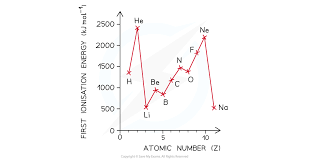
- 72Explain why Be, N, Mg and P are exceptions to this general trend?As we know atoms with sublevels that are fully filled/exactly half-filled are extra stable therefore they have higher ionisation energies than expected (more stable means more energy required to lose an electron)
- 73Graph looking at ionisation energies for one particular atoms (potassium)
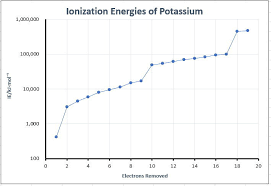
- 74What is the second ionisation energy?It is the energy required to remove a second electron from that same atom
- 75What is the evidence for sublevels?-> Ionisation Energies as you remove electrons from one atom
-> Emission line spectrum - 76Why does it take more energy to remove the second electron than the first (second ionisation energy is higher than the first)?1. For each electron that is removed the size of the positive charge on the ion that is left behind increases by one. This means there is a greater attraction between positive nucleus and remaining electrons
2. A positive ion of an element is smaller than the neutral atom. Therefore electrons are closer to nucleus= more attracted to nucleus
Information
- Description
- Leaving Certificate Chemistry (Electron Arrangment ) Flashcards on Electron Arrangement, created by Adrianna Bialecka on 27/04/2023.
- Created by
- Adrianna Bialecka
- Views
- 0
- Rating