
Flashcards
O level Biology Syllabus
Cards in this deck (46)
- 1What are cellsCells are the simplest unit which makes up living organisms
- 2What is a light microscope and what organelles can be seen through the light microscope?Light microscope uses light to produce a coloured image and can be used to view larger organelles such as Large central vacuole, cytoplasm, nucleus, cell wall, chloroplast and cell membrane.
- 3What is an electron microscope and what organelles can be seen through the electron microscope?The electron microscope uses electrons to produce a black and white image and very small organelles such as golgi apparatus, endoplasmic reticulum ,ribosomes and mitochondria
- 4What are micrographs?Micrographs are photographs taken by cameras on microscopes.
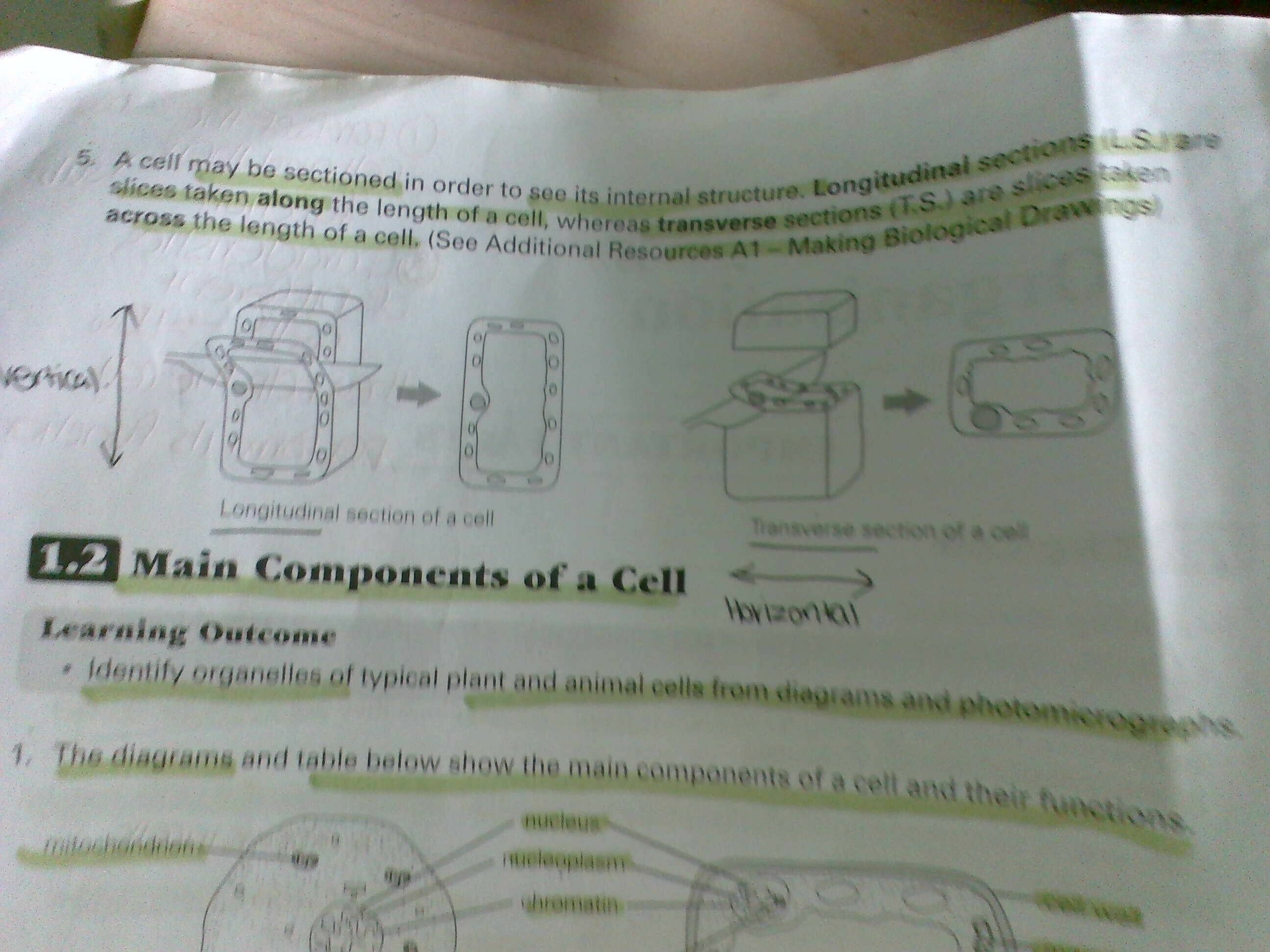
- 5Two ways to cut a cell to observe its internal structure?
- 6What is the cell wall? (Structure)Structure- The outermost part of the plant cell and is made up of cellulose(Carbohydrate).
It is freely permeable to small molecules(acts as a barrier for larger molecules).And Is not part of the living protoplasm - 7What is the cell wall's Function?Protects the plant cell from injury and gives it a fixed shape.
- 8What is the Cell surface membrane?Is partially permeable and part of the living protoplasm and controls the movement of substances and in and out of the cell.
- 9What is the function of the cytoplasm?It is the part of the cell where most cellular functions, processes and reactions take place.
- 10The function and structure of the nucleus?Function - Controls cell activities such as cell growth and repair and it also has a essential role in cell division.
Structure - Is made up of nucleoplasm and is seperated from cytoplasm by nuclear envelope(double membrane).Contains one or more nucleoli(singular: nucleolus) - 11What is the Rough Endoplasmic Reticulum?A network of membranes with ribosomes attached to its surface. Transports proteins synthesised by the ribosomes to Golgi apparatus so that these proteins can be secreted out of the cell( Note: Only ribosomes on the RER synthesise proteins that leave the cell there are also free ribosomes in the cytoplasm which synthesis proteins that is used in the cell.
- 12What is the smooth ER? (function and Structure)A network of membranes without ribosomes and synthesises fats and steroids and helps detoxify the cells by converting harmful substances into harmless material
- 13What is the Golgi apparatus? (Structure and Function)It is a stack of flattened disc which comprise of thin spaces surrounded by membranes. It chemically modifies and repackages substances from the ER into vesicles for secretion out of the cell
- 14What are secretory vesicles?They pinch of from the ends of the disc move towards the cell membrane fuse with it and release their contents out of the cell
- 15What is the mitochondria? (Function and Structure)A sausage shaped organelle with highly intricate internal folds and aerobic respiration takes place here to release energy for cellular activities and processes.
- 16What is a plant vacuole?It is a fluid-filled space in the plant cell which is large and central and is enclosed by a membrane known as the tonoplast. It contains the cell sap which contains dissolved sugars, minerals salts, amino acids and waste
- 17What is an animal cell vacuole?Animal cell vacuoles are also fluid-filled spaces which are small and numerous and they hold water and food substances temporaraily
- 18What is a chloroplast?It is a oval structure which contains a green pigment known as chlorophyll which is essential for photosynthesis.
- 19What are centrioles? (Structure and Function)Structure: They are small hollow cylinders which are only found in animal cells and they are usually found in pairs near the nucleus
Function: Play a very important role in cell division - 20Red blood cells; How is it specialised?1)RBCs contain haemoglobin(S) which binds with oxygen(P) hence this way RBCs can transport oxygen to all parts of the body(F)
2)RBCs have no nucleus(S)hence there is more space(P) to carry more haemoglobin and hence more oxygen to all parts of the body(F)
3)RBCs have a circular and biconcave shape(S) 1.hence they have a higher surface area to volume ratio(P)allowing oxygen to diffuse in and out of the cell at a higher rate.(F)2.It makes them to be more elastic(P) hence allowing them to easily squeeze through capillary walls. - 21Xylem vessel elements; How is it specialised?1)Lumen with no cross walls and protoplasm(S) that obstructs the flow of water(P) hence this facilities the flow of water and mineral salts up the xylem(F)
2)There is Lignin deposited in the walls of the xylem vessel (S)which strengthens the walls(F) and provides mechanical support for the cell and for the plant - 22Root hair cell1)Thin cell wall - Short Diffusion distance
2)Selectively permeable Cell membrane - keeps the content of cell sap retained in the cell so as to maintain the low WP
3)More concentrated cytoplasm and cell sap-Decreases the WP of the root hair cell.
4)Large no. of mitochondria - provides more energy so that cells can absorb a lot of mineral salts against the concentration gradient
5) Tube-like protrusion - increases the surface area to volume ratio of the cells so that RHC can absorb more water and mineral salts - 23CellBasic unit of a living organism
- 24TissueA group of cell - same type,
found near each other, carry out the same function
form a tissue - 25Organdifferent tissues working together to perform a specific function or a group of functions forms an organ
- 26organ systema group of functionally-related organs for an organ system
- 27Why is food important?The chemical substances present in food provide energy and raw material for cell growth and division, metabolism, repair and Maintenance of health
- 28Carbohydrates?Carbs consist of carbon,hydrogen and oxygen where the ratio of hydrogen and oxygen is 2:1.They are the main source of energy. There are three types of crabs monosaccharides, disaccharides and polysaccharides.
- 29Functions of carbohydrates1)Substrate for synthesis of other organic compounds such as amino acids and fats
2)Substrate for respiration which provides energy for cellular activities and processes
3)Needed for the synthesis of nucleic acids
4)Main component in nectar of flowers(sugars in it)
5) Key component in supporting structures such as cell wall(composed of cellulose) - 30Monosaccharides and Disaccharides and Polysaccharides1)Glucose
2)Fructose
3)Galactose
1)Maltose -->Gluc+Gluc
2)Lactose-->Gluc+Galac
3)Sucrose-->Gluc+Fruc
1)Starch - Long straight chains of glucose(only in produced and stored in plants),Made up of glucose
2)Glycogen(Only produced and stored in animals)-made up of glucose
3)Cellulose- made up of glucose - 31Why is starch and glycogen good storage materials?1)Insoluble hence they do not affect the WP of cells.
2)Easily digested by enzymes into glucose
3)Large molecules hence they are easily retained in the cells as they cannot pass through the cell surface membrane
4)Compact molecules hence they take up less space as compared to if they existed as separate glucose units.
Starch-Stored in leaves and storage
Glycogen-Stored in liver muscles - 32Benedict's Test1)Add 2cm3 of benedict's solution to a test tube of 2cm3 of solution being tested and shake well.
2)Place the test tube in boiling water for 3 to 5 min
3)Observe the colour change.The blue solution changing to form a brick-red ppt indicates the presence of reducing sugars
Blue to green-->Tracial amounts of RS
Blue to yellow/orange-->Moderate amount Blue to orange-red/Brick-red-->Large amt of RS - 33Iodine test1)Add 2 to 3 drops of dilute iodine solution to the food substance in a white tile
2)If the Iodine changes colour from yellow-brown to blue-black this indicates the presence of starch in the food substance. - 34Fats?Fats are composed of carbon, hydrogen and oxygen
Our body is able to synthesise fats(Excess Glucose->Fats)but we can also obtain fats through or diet
There are two types of fats unsaturated and saturated fats - 35Saturated and Unsaturated fatsSaturated fats- usually comes together with cholesterol hence if it is taken in excess can cause coronary heart disease and gallstones.
Unsaturated fats - reduces cholestrol level in blood - 36Functions of Fat1)Acts as an insulating layer that reduces heat loss
2)An key component in cell surface membranes
3)Help to reduce water loss from skin by forming a hydrophobic layer that prevents the evaporation of water
4)A solvent for fat-soluble vitamins and vital substances - 37Ethanol emulsion test(Liquid fat)1)Add 2cm3 of ethanol to a drop of liquid fat(oil) in a test tube and shake the test tube well.
2)Let the liquid fat completely dissolve in the ethanol until a clear solution is formed
3)Add 2cm3 of water to the mixture and shake the test tube well.
4)If a cloudy white emulsion is formed at the bottom of the test tube this indicates the presence of fats - 38Ethanol emulsion test(Solid fat)1)Cut the solid into smaller pieces and add it to test tube containing 2cm3 of ethanol and shake well.
2) Let the solid particles settle to the bottom of the test tube
3)Decant the ethanol into another test tube containing 2cm3 of water and shake that test tube well
4)If a cloud white emulsion is formed at the bottom of the test tube this indicates the presence of fats.
Why do we need to Cut the solid into smaller pieces?
- So that the surface area of the solid can increases so that the nutrients(fats)in the solid can properly mi - 39Proteins?Proteins compose of carbon, hydrogen, oxygen, nitrogen and sometimes sulfur. They are made up of amino acids. These amino acids are linked up together by peptide bonds to form polypeptides(2D). The polypetides further link to form longer chains of amino acids. One or more of these polypeptides fold together to form a protein(3D)Examples of proteins include eggs, milk, meat and soybeans
- 40Functions of proteins1)Used in the synthesis of antibodies to combat diseases
2)Is a key component in enzymes and some hormones
3)Used in the overall growth and repair of body cells and tissues
4)Used in the synthesis of haemogobin a protein in RBCs that binds with O2 and transports it to the rest of the body. - 41Biuret Test1)Add 1cm3 of NaOH to a test-tube containing 2cm3 of solution being tested. Shake well.
2)Add copper(II) sulfate solution drop and drop mixing the test tube after each drop.
3)If the solution gradually changes colour from blue to violet this indicates the presence of proteins. - 42Functions of water (in animals)1)Main component in protoplasm and body fluids such as blood, digestive juices
2)Used in the hydrolysis/digestion of carbs,fats and proteins
3) Is a main component in blood plasma hence transports digested products, metabolic waste and harmones within the body
4)Helps to regulate body temperature through sweating
5)Acts as a solvent or medium for metabolic and chemical processes in the body - 43Functions of water (In plants)1)Keeps plant cells turgid and plants upright
2)Is a Raw material used for photosynthesis
3)Transports Mineral salts from roots to leaves through the xylem
4)Transports food substances from the leaves to all parts of the plant through the phloem. - 44What are enzymes?Definition: Enzymes are biological catalyst that speed up chemical reactions by lowering the activation energy without being chemically altered during the reaction.
- 45What are the 4 characteristics of enzymes1)Enzymes are highly efficiently and are only required in minute amounts to catalyst a reaction as they can be reused again and again
2)Enzymes are specific in action
3)Enzymes are temperature sensitive
4)Enzymes are pH sensitive - 46The process/concept of lock and key hypothesis?1)The substrate is the key whereas the enzyme is the lock.
2)Only the substrate that is complimentary in shape to the active site of the enzyme is bale to fit in the active site.
3)The substrate binds to active site to form an enzyme-substrate complex
4)Upon the formation of the enzyme-substrate complex the activation energy is lowered hence the reaction is able to take place to convert substrate molecules into products
5)The products leave the active site leaving the enzyme free to bind with more substrate molecules.