
Flashcards
GI
Cards in this deck (200)
- 1What is the floor of the mouth formed by?Mylohyoid muscle
- 2What is the correct term for 'tooth sockets', and how are the teeth anchored to these?Alveoli. Periodontal ligament
- 3Where does all lymph from the tongue eventually drain?Deep cervical lymph nodes
- 4Describe the first stage of deglutitionFirst stage (voluntary): 1)Bolus of food moves to base of tongue.
2) Mylohyoid muscle contracts to move food into the oropharynx.
3) Palatolossi and styloglossi raise the posterior part of the tongue. - 5Describe the second stage of deglutitionsSecond stage (involuntary - from afferents from CNIX and efferents from CNX) 1) Soft palate elevates sealing off nasopharynx.
2) Long pharyngeal muscles pull larynx upwards
3) Laryngeal orifice closed (ariepiglottic and oblique arytenoids)
4) Pharyngeal constrictors contract in sequence
5) cricopharyngeus relaxes - 6What makes up the hard palate?Palatal processes of the maxilla and horizontal plates palatine bones
- 7Name the 5 muscles of the soft palateTensor veli palatine, levator veli palatine, palatoglossus, palatopharyngeus, uvular
- 8What is the blood supply of the palate?Branches of the maxillary artery
- 9Describe the nerve supply over the palateSensation - Maxillary division of CNV
Motor - Most supplied by pharyngeal plexus - 10What is the nerve supply of tensor veli palatine?Mandibular division of CNV
- 11Which muscles make up the external layer of the pharynx?Constrictors
- 12Which muscles make up the internal layer of the pharynx?Palatopharyngeus, salpingopharyngeus, stylopharyngeus
- 13Name the suprahyoid muscles. What do they do?Mylohyoid, geniohyoid, stylohyoid, digastrics. They elevate the larynx
- 14Name the infrahyoid muscles. What do they do?Sternohyoid, omohyoid, sternothyroid, thyrohyoid. They depress the larynx.
- 15What is the nerve supply to the pharynx?Derived from the pharyngeal plexus.
- 16Which nerves pass through the parotid gland?Facial nerve, branches of great auricular nerve
- 17Which arteries pass through the parotid gland?Maxillary artery, external carotid artery, superficial temporal artery
- 18Which veins pass through the parotid gland?Retromandibular vein
- 19At what level does the oesophagus start?C6, level of the cricoid cartilage
- 20At what level does the oesophagus enter the abdomen and with what other structure?T10, with vagi
- 21List the four main constrictions of the oesophagus1) where the pharynx joins the oesophagus, behind cricoid cartilage
2) Where the arch of the aorta passes in front of it
3) where the left main bronchus passes in front of it
4) where it enters the abdomen - 22What is the blood supply of the oesophagus?Upper third: inferior thyroid artery
Middle third: off the thoracic aorta
Lower third: left gastric artery - 23What is the lymph drainage of the oesphagus?Posterior mediastinal nodes, left gastric nodes
- 24What is the root of the tongue anchored to?Hyoid bone and mandible
- 25What is the motor supply to the tongue?Hypoglossal nerve (apart from palatoglossi - vagus)
- 26What is the sensory supply to the tongue?Posterior third - CNIX
Anterior two thirds - Lingual division of CNV3 - 27What is the taste supply to the tongue?Posterior third - CNIX
Anterior two thirds - CNVII - 28Give the position, duct opening and innervation of the Parotid gland.-Wrapped around the mandibular ramus
-Next to the upper second molar tooth at the parotid ampulla
- Glossopharyngeal nerve via the otic ganglion - 29Give the position, duct opening and innervation of the submandibular gland.-Beneath the floor of the mouth
- Adjacent to the lingual frenulum
- Chorda tympani via the submandibular ganglion - 30Give the position, duct opening and innervation of the sublingual gland.- Floor of the mouth underneath tongue
- Numerous small ducts along lingual folds on floor of mouth
- Chorda tympani via the submandibular ganglion - 31In which portion of the mediastinum is the oesophagus?Posterior
- 32What are the foldings in the stomach mucosa called?Rugae
- 33What type of epithelia are present in the stomach?Columnar
- 34Which structures lie anteriorly to the stomach?Part of left lobe of the liver, left costal margin, abdominal wall
- 35Which structures lie posterior to the stomach?Pancreas
- 36Which structures lie superior to the stomach?Diaphragm
- 37What effect do parasympathetic efferents have on the stomach and where do they fibres derive from?Increase stomach motility and secretion. Derived from posterior vagal trunks.
- 38Where do sympathetic efferents travelling to the stomach derive from?Sympathetic trunks via the coeliac plexus
- 39Where do gastric veins drain to?Portal vein travelling to the liver
- 40Where does lymph from the stomach drain?Coeliac nodes (think foregut)
- 41What is the lesser omentum?Two layers of peritoneum passing between the lesser curvature of the stomach and the liver
- 42What is the greater omentum?2 layers of peritoneum folded on itself to form four layers that hang down over intestines 'like an apron'. Attaches the greater curvature of the stomach to the transverse colon and contains variable amounts of adipose tissue.
- 43What is the lesser sac?Subsection of peritoneal cavity, posterior to the lesser omentum and anterior to the retroperiteoneal organs of posterior abdominal wall
- 44What is the communication between the greater and lesser sacOmental foramen (epiploic foramen)
- 45If the supraclavicular nodes are swollen, what malignancy may this be indicative of? What is this sign known as?Gastric malignancy. Troisier's sign.
- 46What are the two main risk factors for peptic ulcer formation? If untreated, what can ulceration lead to?NSAIDS, H. Pylori. Peptic ulcers can lead to perforation and possible malignancy.
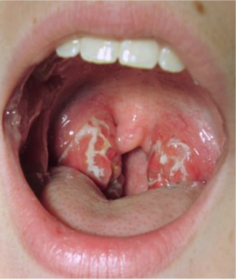
- 47What is the diagnosis?Acute bacterial tonsilitis
- 48What is the diagnosis?Peritsonsilar abscess (quincys). Notice unilateral
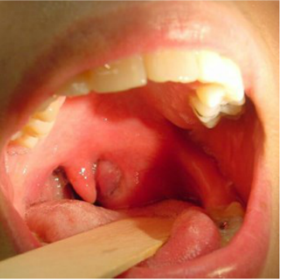
- 49Which lymph nodes are palpable in the head and neck?Submental, submandibular, Pre auricular, anterior cervical chain, psoterior cervical chain, supraclavicular, occipital
- 50What investigations may be performed in order to confirm a diagnosis of a peptic ulcer?-Endoscopy
-Test for H. pylori
- Full blood count (check they aren't anaemic) - 51What is the epithelial change in a patient with longstanding chronic GORD that has developed Barrett's?Squamous to columnar
- 52Describe the location of the myenteric plexusBetween the circular and longitudinal smooth muscle
- 53Describe the role of vasoactive intestinal peptideInhibitory intrinsic regulation of GI smooth muscle
- 54What are the three phases of gastrointestinal control?Cephalic phase - sight smell taste and chewing
Gastric phase - distension, acidity
Intestinal phase - distension, acidity, osmolarity - 55What is 'segmentation'?Most frequent type of movement within the small intestine. Caused by rhythmic contraction and relaxation of the circular muscle layer. Effectively mixes chyme and brings fresh chyme into contact with the mucosal surfaces.
- 56What is peristalsis?Progressive contraction of successive sections of circular muscle layer. Propels chyme for a short distance, allowing tune for digestion and absoption.
- 57Describe the regulation of smooth muscle by calcium (revision)Calcium binds to calmodulin. Calmodulin then binds with ad activates myosin light chain kinase, which can then phosphorylate the myosin light chain. This activates the myosin and allows cross bridges to form.
- 58What are gap junctions?Small gaps between smooth muscle fibres. Allows communication between one an other and permits coordinated contraction.
- 59What is a slow wave and how can it be modulated?A slow wave is the low amplitude oscillations seen in the membrane potential of GI smooth muscle. The frequency of smooth muscle contractions is dictated by the frequency of the slow waves. It can be modulated by hormones, intrinsic and extrinsic nerves, body temp and metabolic activity.
- 60Describe the motor activity in the proximal jejunum during a fasting stateA migrating motor complex is seen. There are periods of spikes (muscle contraction), followed by low muscle activity. This is thought to be a means of 'keeping the gut clean'.
- 61Which sphincters in the body are comprised of skeletal muscle?Upper oesophageal sphincter. External anal sphincter
- 62What is the difference between the secretions produced from the parotid, submandibular and sublingual glands?Parotid - serous secretion rich in alpha amylase.
Submandibular and sublingual - seromucous secretion - 63What are the three main functions of saliva?1) lubricate food to make swallowing easier
2) Clean and protect the cavity of the mouth
3) reduce starch to oligosaccharide molecules - 64Describe the process of isotonic NaCl secretion by salivary acinar cells (6 points)1) The Na+/K+ pump actively pumps Na+ out of the acinar cell across the basolateral membrane. This creates an inwardly directed Na+ concentration gradient.
2) NKCC1 cotransporter accumulates Cl- inside the acinar cell, driven by the Na+ gradient.
3) Ca2+ activated K+ channels i) recycle K+ ions across the basolateral membrane ii) Maintain the driving force for Cl- ion exit across the apical membrane.
4) Ca2+ activated Cl- channels in the apical membrane provide pathway for Cl- exit into the duct lumen.
5) Movement of Cl- into the duct lumen draws Na+ and water through the paracellular pathway. NaCl secretion is complete.
6) ACh is a potent stimulator of NaCl secretion by acinar cells - 65What are the ions channels found in the basolateral membrane of a salivary duct cell?Cl- channel, Na+/K+ pump, K+ channel
- 66What are the ion channels found in the apical membrane of a salivary duct cell?CFTR Cl- channel, HCO3-/Cl- anion exchanger, K+ channel, Na+ chanel ENaC
- 67How is Na+ absorption achieved in a salivary duct cell?Through the combined action of the Na+/K+ pump on the basolateral membrane, and a Na+ channel ENaC located on the apical membrane
- 68How is Cl- absorption achieved in a salivary duct cell?Through the combined action of the CFTR Cl- channel located on the apical membrane, and a distinct Cl- channel located on the basolateral membrane.
- 69How is HCO3- secretion achieved in a salivary duct cell?Through the combined action of the HCO3- anion exchanger located on the apical membrane and the CFTR Cl- channel also located on the apical membrane.
- 70How is K+ secretion achieved in a salivary duct cell?Through the combined action of the Na+/K+ pump located on the basolateral membrane and the K+ channel located on the apical membrane.
- 71How does salivary secretion differ between parasympathetic and sympathetic innervation?Both parasympathetic and sympathetic efferents stimulate secretion. Parasympathetic - more long lasting, stimulate synthesis and secretion of salivary amylase.
Sympathetic - Transient effect - 72How does acetylcholine increase salivary secretion?Decreases NaCl reabsorption
- 73How does noradrenaline increase salivary secretion?Stimulates HCO3- secretion
- 74What effect does noradrenaline have on ion transport in a salivary duct?Increases NaCl reabsorption and K+ secretion
- 75Describe the three phases of swallowing1) Oral phase - Tongue presses the food against the hard palate, the bolus is forced into the pharynx and stimulates the touch receptor.
2) Pharyngeal phase - Soft palate elevates to close of the nasopharynx. Epiglottis closes the trachea off, upper oesophageal sphincter relaxes.
3) Oesophageal phase. Upper oesophageal sphincter closed, peristalsis begins. - 76What are the orad and caudad regions of the stomach? What happens to them whilst swallowing?Two regions of stomach distinguished by their motility.
Orad - Accommodation of food
Orad and caudad - Gastric emptying
Whilst swallowing, the orad relaxes - receptive relaxation. - 77Describe the sequence of vomitingA stimulus of some sort (various) activates receptors in the chemical trigger zone of the brain and activates the vomiting centre. Causes LES relaxation, respiration stop, stomach contraction and antiperistalsis. Increase in abdominal pressure and relaxation of the UES cause a cascade of vomit.
- 78Distinguish between anti-emetics and pro kineticsAnti emetics - act centrally to inhibit or prevent emesis
Pro kinetics - act to promote gastric emptying - 79ChlorpromazineD2 dopamine receptor antagonist anti-emetic. Also antagonises H1 and MAChR.
- 80AcepromazineD2 dopamine receptor antagonist anti-emetic. Also antagonises H1 and MAChR
- 81MetoclopramideD2 dopamine receptor antagonist anti-emetic. Also has pro kinetic effect.
- 82Where are D2 dopamine receptors found in relation to vomiting?CTZ
- 83Which patients would you not prescribe chlorpromazine or acepromazine to?Pregnant patients or nursing mothers
- 84Cisapride5-HT4 receptor agonist anti emetic. Acts peripherally to increase gastro-oesophageal sphincter and GI motility.
- 85Ondansetron5-HT receptor antagonist anti-emetic. Acting on the CTZ. Particularly useful in chemo/radiotherapy induced vomiting.
- 86Nabilone5-HT receptor antagonist anti-emetic. Synthetic cannabinoid. Used in cytotoxic induced vomiting. Side effects of euphoria and drowsiness.
- 87DexamethasoneCorticosteroid anti-emetic often used in conjunction with 5-HT3 receptor antagonist eg ondensatron. Mechanism unclear.
- 88DiphenhydramineHistamine H1 receptor antagonist anti-emetic. Centrally acting. Highly effective in motion sickness and against stimuli acting locally in the stomach.
- 89Where are H1 histamine receptors found?NTS
- 90CyclizineHistamine H1 receptor antagonist anti-emetic. Centrally acting. Highly effective in motion sickness and against stimuli acting locally in the stomach.
- 91PromethazineHistamine H1 receptor antagonist anti-emetic. Centrally acting. Highly effective in motion sickness and against stimuli acting locally in the stomach.
- 92HyoscineMuscarinic ACh receptor antagonist anti-emetic. Effective in motion sickness. Ineffective against substances directly stimulating the CTZ.
- 93ErythromycinPro-kinetic motilin activator.
- 94DomperidoneDopamine D2 receptor pro kinetic acting on the CTZ.
- 95BethanecolM3 agonist pro kinetic
- 96IpecacuanhaEmetic. Contains active constituents emetine and cephaline which are irritant to the stomach lining.
- 97ApomorphineD2 dopamine receptor agonist, acting on the CTZ
- 98How can extreme diarrhoea lead to acidosis?Diarrhoea is due to hypersecretion or reduced absorption due to toxins. Diarrhoea may lead to loss of HCO3- ions needed to buffer the blood. This will lead to a rise in H+ and hence acidosis.
- 99Describe how the cholera toxin leads to diarrhoea.The cholera toxin is endocytosed into the host cell. It then binds to a receptor and activates the G alpha s subunit, which causes activation of adenylate cyclase. This causes a rise in intracellular cAMP which causes the activation of protein kinase A. PKA can then phosphorylate the CFTR channel, causing an over secretion of chloride ions.
- 100Which drugs can be used to treat diarrhoea?Antimuscurinics - reduce peristalsis and segmental contractions
Opioids - reduce peristalsis but increase segmental contractions by having a direct effect on GI smooth muscle. Some increase fluid and water absorption. - 101SulphasalazineAnti-inflammatory agent that can be used to treat IBS and severe ulcerative colitis.
- 102Liquid paraffinUsed as a lubricant laxative to treat constipation.
- 103SterculiaBulk forming drug laxative used to treat constipation. Increase the volume of non-absorbable food material in the colon.
- 104Why should special care be taken when prescribing lubricant laxatives?Lubricant laxatives line the mucosal surface thus they might prevent the absorption of fat soluble vitamins and other nutrients.
- 105BranBulk forming drug laxative used to treat constipation. Increase the volume of non-absorbable food material in the colon.
- 106Why should special care be taken when prescribing a bulk forming laxative?Adequate fluid intake should be provided to avoid dehydration and consequent worsening of constipation.
- 107BisacodylIntestinal stimulant laxative used to treat constipation. Stimulate contraction of intestine to aid faecal expulsion.
- 108DantronIntestinal stimulant laxative used to treat constipation. Stimulate contraction of intestine to aid faecal expulsion.
- 109PhenolphthaleinIntestinal stimulant laxative used to treat constipation. Stimulate contraction of intestine to aid faecal expulsion.
- 110Why should special care be taken when prescribing intestinal stimulants?Might cause abdominal cramps. Don't use when there might be an abdominal obstruction.
- 111MgSO4Osmotic laxative. Poorly absorbed solute which remain in the GI tract and so promote the movement of water from the tissues into the lumen.
- 112LactuloseOsmotic laxative. Poorly absorbed solute which remain in the GI tract and so promote the movement of water from the tissues into the lumen.
- 113What is the role of intrinsic factor?Essential for the absorption of vitamin b12
- 114What is secreted in the cardiac glandular region of mucosa?Mucus
- 115What is secreted in the oxynic glandular region of mucosa?HCl, intrinsic factor, pepsinogens, mucus, histamine
- 116What is secreted in the pyloric glandular region of mucosa?Mucus, gastrin, somatostatin
- 117What type of cell is gastrin secreted by? What is it's effect? Where are these cells found?G cell. Increases gastric secretion. Antrum
- 118What does a surface epithelial cell secrete?HCO3-, mucus
- 119What does a parietal cell secrete?HCL, intrinsic factor
- 120What type of cell secretes histamine? What is it's effect?ECL cell. Increase in gastric secretion
- 121What type of cell secretes somatostatin? What is it's effect?D cell. Decrease in gastric secretion
- 122What does a chief cell secrete?Pepsinogens
- 123What are pepsinogens and how are they activated? What is the role of an active pepsin?Pepsinogens are the pre cursor of pepsins. They are activated by HCl. Pepsins break down proteins to peptides.
- 124Give the four functions of HCl in the stomach1) provides optimal environment for the action of pepsins
2) kills or inhibits microorganisms
3) stimulates secretions in the small intestine
4) Helps iron and calcium absorption in the small intestine - 125Describe the ion transporters and channel of parietal cells and how HCl secretion is achieved?1) The H+/K+ ATPase proton pump uses the energy of ATP hydrolysis to pump H+ ions out of the cell across apical membrane and move K+ ions in.
2) Apical membrane K+ recycle K+ ions out across the apical membrane.
3) secretion of H+ causes a rise in intracellular pH. This rise triggers passive uptake of CO2 and H20. This produces H+ and HCO3-, catalysed by carbonic anhydrase.
4) HCO3- ions are removed from the cell across basolateral membrane by Cl-/HCO3- anion exchanger. Cl- are taken into the cell.
5) HCO3- ions that exit the cell across the basolateral membrane causes alkalisation of the local blood vessels = alkaline tide.
6) Cl- ions that enter across basolateral membrane via anion exchanger exit passively across apical membrane to complete process of HCl secretion.
7) Na+/K+ ATPase creates an inwardly directed Na+ concentration gradient (used for other transporters)
8) Basolateral K+ channels maintain the driving force for Cl- exit across apical membrane (pump K+ out of cell across basolateral) - 126Describe the morphological changes that occur when a resting parietal cell becomes an active parietal cellCanaliculus form which provides a larger secretory membrane with more H+ pumps and Cl- channels
- 127From the enteric neuron through to HCl secretion, describe how histamine stimulates HCl secretion.An AP travels through the axon of the enteric neuron to a G cell, there is a release of acetylcholine which binds to nACh receptors,which causes Gastrin release. Gastrin then binds to CCK-B receptors on the surface of the ECL cell. Enteric neurons also travel directly to the ECL cell and cause acetlycholine release and binding. Both of these things cause secretion of histamine by the ECL cell. Histamine can then bind to H2 receptors on the basolateral surface of the parietal cell and cause an increase in intracullular cAMP. cAMP causes increased action of the apical Cl- channel.
- 128What are the three physiological agonists that cause HCl secretion?Gastrin, histamine, ACh
- 129Describe the role of gastrin in the secretion of HClAn enteric neuron travels to the G cell, causes release of gastrin. Gastrin binds to CCK-B receptors on ECL cells which stimulates histamine release. It also binds to CCK-B receptors on the basolateral membrane of the parietal cell. This causes an increase in intracellular Ca2+, which causes tubulovesicles to fuse with the apical membrane and insert H+/K+ proton pumps to pump H+ out of the cell into the lumen.
- 130What two things does an increase in calcium within the parietal cell cause?1) Tubulovesicles fuse with membrane and insert proton pumps.
2) activates basolateral K+ channels to pump K+ out of the cell and maintain driving force for Cl- movement across the apical membrane. - 131How is HCl secretion inhibited?1) Direct inhibition: Somatostatin released by D cells in the antrum of the stomach travels via the blood to the corpus of the stomach (endocrine mechanism). Inhibits the cAMP signalling pathway within the parietal cell.
2) Indirect inhibition via paracrine pathways. Somatostatin released via D cells in the antrum of the stomach inhibit G cells in the antrum, and ECl cells in the corpus of the stomach to prevent release of gastrin and histamine respectively. - 132What two things is intrinsic factor important for?1) Combines with vitamin B12 to resist digestion by pancreatic proteases
2) Facilitates absorption of vitamin b12 in the ileum - 133What is the optimal pH for pepsins?< or = 3
- 134How does HCO3- enter the surface epithelial cell in the stomach? What is the importance of HCO3-?Enters across basolateral membrane via an Na+/HCO3- cotransporter. HCO3- then exits across the apical membrane and neutralises the high H+ levels within the gastric lumen.
- 135What effect does aspirin have on the stomach?Can cause gastric ulcers. Causes a decrease in HCO3- secretion by the surface epithelial cell into the gastric lumen. This means H+ and peptins can irritate the surface epithelial cell.
- 136Increased gastric secretions is entirely dependant on which nerve during the cephalic phase of GI control?Vagus nerve
- 137How does distension of the stomach lead to increased gastric secretion?Stimulates gastric secretion. Mechanoreceptors send signals via vagovagal reflexes to G cells and directly to parietal cells
- 138How do digested proteins and amino acids lead to increased gastric secretion?Chemoreceptors detect. Sends signals to G cell to produce gastrin
- 139How is feedback inhibition of gastric secretion achieved in the gastric phase?HCl causes activation of somatostatin producing D cells. Somatostatin directly inhibits the parietal cell via an ednocrine mechanism, and indirectly inhibits G cells and ECL cells via paracrine pathways.
- 140What happens in the intestinal phase of gastric secretion?First stimulates then inhibits. Early in gastric emptying the gastric chyme has pH >3, STIMULATION PRE DOMINATES. Later in gastric emptying gastric chyme has pH <3, inhibition pre dominates.
- 141Which cells produce secretin?S cells
- 142Which cells secrete CCK?I cells
- 143Which cells produce GIP?K cells
- 144Describe how HCl in the duodenum inhibits gastric secretion (intestinal phase)?Causes secretion of secretin by duodenal S cells. Secretin then activates somatostatin producing D cells. Somatostatin inhibits G cell, ECL cell and parietal cell. Secretin inhibits G cells in the antrum and parietal cells.
- 145Describe how products of digestion in the duodenum decrease gastric secretion (intestinal). What is the most important product?Causes secretion of CCK by duondeal I cells, and GIP by duodenal K cells. CCK inhibits parietal cells. GIP inhibits parietal cells of G cells in the antrum. Fats are the most important digestion product
- 146What happens to the peristaltic contractions as they approach the gastroduodenal junction?They increase in force and velocity
- 147What is the driving force of gastric emptying into the duodenum?Pressure difference between lumen of the stomach
- 148Where does most of the mixing of food happen in the stomach?Antrum
- 149Describe how gastric emptying is achieved in the stomach?Gastric contents activate receptors on the stomach wall and gastrin producing G cells. This leads to increased gastric motility and decreased contraction of the pyloric sphincter.
- 150What happens to gastric emptying once food is delivered into the small intestine?Gastric emptying slows. It is slowed by hypertonic solutions, HCl pH< 3.5, fatty acids and monoglycerides, amino acids and peptides. Duodenal contents activate receptors on the intestine wall, as well as I, K and S cells that secrete CCK, GIP and secretin respectively. The combination of these things decreases gastric motility and increases the contraction of the pyloric sphincter.
- 151Describe the relation of the duodenum to the peritoneumParts 1 and 4 - intraperitoneal
Parts 2 and 3 - retroperitoneal - 152Which epithelium are present in the duodenum?Columnar
- 153What are the circular folds present in the duodenum known as?Plicae circulares
- 154What are the main functions of the duodenum?Digestion, absorption of food, production of GI hormones
- 155Describe the blood supply of the duodenumProximal to 2nd part - gastroduodenal artery (from coeliac axis)
Distal to 2nd part - SMA
Think about foregut/midgut embryology - 156Where does the pancreatic duct open?Joins the common bile duct at the ampulla of Vater
- 157Which sphincter controls the release of secretion into the duodenum at the major duodenal papilla?Sphincter of Oddi
- 158Which three arteries supply the pancreas?Splenic, superior and inferior pancreaticoduodenal
- 159What is the position of the spleen?Sits under 9th,10th and 11th ribs. Left hypochondrium
- 160What are the anterior, posterior, lateral and medial relations of the spleen?A - stomach
P - Left kidney
L - Diaphragm
M - Tail of pancreas - 161What is the blood supply to the spleen? Where does the vein run?Splenic artery and vein. Splenic vein runs along posterior aspect of the pancreas
- 162Which organ is very vulnerable to injury? Where would pain be felt?Spleen. Left flank pain
- 163Which ribs does the liver lie deep to?5-11 on RHS
- 164Which regions of the abdomen does the liver lie in?Right hypochondrium, epigastric and extends into left hypochondrium
- 165Where does the gall bladder sit?Behind the tip of the 9th costal margin
- 166Where does the neck of the pancreas sit?Overlying L1-L2
- 167When can the spleen be palpated and what is the name for this?When it is three times larger than normal. Splenomegaly
- 168What questions would be asked in your history if you suspected liver disease?Drinking? IV drug user? Been abroad?
- 169Which ligament attaches the liver to the abdominal wall?Falciform ligament
- 170Describe the contents of the porta hepatis from posterior to anteriorportal vein (most posterior), hepatic artery, common hepatic duct (most anterior)
- 171Where do the hepatic veins drain?IVC
- 172What is the lymph drainage of the liver?Drains to coeliac nodes. Mediastinal nodes drain bare area
- 173What is the bare area of the liver?Portion of the liver that is not covered in peritoneum
- 174What is the ligamentum teres a remnant of?umbilical vein
- 175What is the ligamentum venosum (falciform) a remnant of?ductus venosus
- 176When the ligamentum venosum opens in portal obstruction, what is formed?A para-umbilical portosystemic anastomosis (bypassing liver)
- 177What are the three potential spaces around the liver where pus may collect and form an abscess?Subphrenic space - in between liver and diaphragm
Right extraperitoneal space - between bare area of liver and diaphragm
Subhepatic space - below the liver - 178What is the blood supply of the gall bladder?Cystic artery, branch of the right hepatic artery
- 179What is the main function of the gall bladder and how is it stimulated?Storage of bile. Stimulated by CCK when food is in the stomach
- 180How can gallstones lead to jaundice? What type of jaundice is this?Gallstones can migrate and become stuck in the distal part of the common bile duct. This leads to prevention of bile secretion into the duodenum. Leads to bilirubinaemia
- 181What is bilirubin?The yellow breakdown product of normal heme catabolism
- 1825 risk factors for gallstones?Fat, fair, forty, fertility, female
- 183What other condition may arise due a blockage in the common bile duct?If in distal part, pancreatic duct may become obstructed and cause a back up of pancreatic enzymes. Can lead to pancreatitis.
- 184What structures form the hepatic portal vein?SMV and splenic vein, also received blood from IVM, gastric and cystic veins
- 185Cimetidine/ranitidineH2 receptor antagonists found on basolateral membrane of parietal cells, used in the treatment of peptic ulcers. Side effects of cytochrome p450 inhibition and decreased male sexual function
- 186PirenzipineMuscurinic receptor antagonist used in treatment of peptic ulcers. Side effects: dry mouth
- 187OmeprazoleProton pump inhibitor used in the treatment of peptic ulcers. React with a cysteine group on the proton pump and thus inhibit it.
- 188Why should special care be taken when prescribing omeprazole?Irreversible, highly potent and long acting.
- 189Despite having a short plasma half life, why is omeprazole still effective over 2-3 days?Omeprazole is inactivated at neutral pH. However it accumulates in areas of low pH, which are the areas most of interest, therefore is able to last 2-3 days.
- 190Sodium bicarbonateAntacid used in the treatment of peptic ulcers.
NaHCO3 + HCl = NaCl + H2CO3
H2CO3 = H20 + CO2.
CO2 produced which is not good. - 191What are the side effects associated with a magnesium salt antacid?MgCl2 formed can lead to diarrhoea.
- 192What are the side effects associated with an aluminium salt antacid?AlCl2 formed can lead to constipation
- 193SucralfateTreatment of peptic ulcers. A complex of sulphated sucrose and aluminium hydroxide. Forms complex gel with mucus to coat the mucosa. Side effects - constipation
- 194Bismuth chelateDrug used in treatment of peptic ulcers. Coats the ulcer base, absorbs pepsin, enhances prostaglandin synthesis, stimulates bicarbonate secretion.
- 195Use of bismuth chelate is particularly useful in treating peptic ulcers due to which cause?H. Pylori
- 196MisoprostolDrug used in the treatment of peptic ulcers. Synthetic analogue of prostaglandin E1. Acts directly on parietal cells to reduce acid secretion. Increase mucus and bicarbonate secretion.
- 197Distinguish between the duct lining epithelial cells of the salivary gland and the pancreasPancreas - 'leaky epithelia'
Salivary gland - 'tight epithelia' - 198Which proteases are secreted by the pancreas? Why are they stored as zymogens?Trypsin, chymotrypsin, carboxypeptidases. Released as zymogens to keep them inactive - prevents damage.
- 199What are the 2 key stimulators of pancreatic enzyme secretion?CCK and secretin. CCK activates IP3 DAG pathway, secretin activates cAMP pathway.
- 200What is the serology used in the diagnosis of coeliac disease?-Anti-gliadin
-Anti-endomysial
-Anti tissue transglutaminase
-HLADQ2/8
Information
- Description
- Flashcards on GI, created by Harry Robertson on 02/11/2015.
- Created by
- Harry Robertson
- Views
- 22
- Rating