
Flashcards
Chemistry
Cards in this deck (44)
- 1What is an atom?The smallest part of an element
- 2What is a molecule?A cluster of non-metal atoms that are chemically bonded together by covalent bonds
- 3What is an element?A pure substance that is listed on the periodic table and only has one type of atom in it
- 4What is a compound?A pure substance made from more than one type of element chemically bonded together
- 5What is a mixture?An impure substance made from different elements or compounds, which can usually be separated by filtering or distillation
- 6What is a solution?A solute that has been dissolved into a liquid called a solvent, usually water
- 7What is a solvent?The liquid in which the solute dissolves to form a solution
- 8What is a solute?The dissolved substance in a solution
- 9If a white solute is put into a solvent, what colour would the solution be?If the solute is white (eg sodium chloride) then the solution is colourless. This is because the individual particles (in this case, ions) in the sodium chloride crystals break apart and spread out through the water
- 10If a coloured solute is put into a solvent, what colour would the solution be?If the solute is coloured (eg blue copper sulfate) then the solution will have a colour. The particles are now too small to see, and evenly spread out, but keep their colour
- 11What is diffussion in a gas?When chemicals, are let loose in a room, the particles mix with the air particles. The particles of smelly gas are free to move quickly in all directions. They eventually spread throughout the whole room. This is called diffusion
- 12What are the differences in diffusion in liquids and gasses?Diffusion in liquids is slower than in gases because the particles in a liquid move more slowly.
- 13What is simple distillation and what is it used for?Distillation separates a liquid from a solution. e.g water can be separated from salty water by simple distillation. This works because the water evaporates from the solution, but is then cooled and condensed into a separate container. The salt does not evaporate and so it stays behind
- 14What are the steps for simple distillation in salty water?1) The salty water is heated
2) The water vapour cools drips into a beaker
3) The water has condensed and is now in the beaker, the salt stays behind - 15What is fractional distillation and what is it used for?Fractional distillation can be used to separate two or more liquids. For example, ethanol (alcohol) can be separated from a mixture of ethanol and water because the two liquids have different boiling points.
- 16What are the steps for fractional distillation with ethanol and water?1) Water and ethanol solution is heated
2) The ethanol evaporates first (because of the lower boiling point), cools, then condenses
3) The water is left behind and the ethanol is seperated - 17What is Paper chromatography?Chromatography can be used to separate mixtures of coloured compounds. Mixtures that are suitable for separation by chromatography include inks, dyes and colouring agents in food.
- 18What are the steps for paper chromatography?1) Spots of ink or plant dye are placed on a pencil line
2) As the paper is lowered into the solvent the dye spreads up the paper
3) The paper has absorbed the solvent, and the dye has spread further up the paper - 19What is filtration?The technique used to separate an insoluble solid from a liquid. It can be used to obtain a product that is free from unreacted chemicals, by-products or solvent.
- 20What are the steps for filtration?1) One beaker contains a mixture of solid and liquid, the other contains a funnel with filter paper
2) The solid and liquid mixture is poured into the filter funnel
3) The liquid drips through the filter paper but the solid particles are caught in the filter paper - 21What is crystallisation?When a product is made as a solution, one way to separate it from the solvent is to make crystals. This involves evaporating the solution to a much smaller volume and then leaving it to cool. As the solution cools, crystals form, and these can be obtained by filtration.
- 22What is relative atomic mass (Ar)The relative atomic mass of an element shows its mass compared with the mass of atoms of other elements. The relative atomic mass of carbon is 12, while the relative atomic mass of magnesium is 24. This means that each magnesium atom is twice the mass of a carbon atom
- 23What is relative formula mass (Mr)To find the relative formula mass (Mr) of a compound, you add together the relative atomic mass values (Ar values) for all the atoms in its formula.
- 24What is a mole?Chemists measure the amount of a substance in a unit called ‘the mole’. This is a convenient way of counting atoms. It allows chemists to make predictions about the masses of different substances that are involved in reactions
- 25What is Avogadros number?One mole of atoms contains 6 x 10(23) atoms, no matter what element it is. It is known as the Avogadro number.
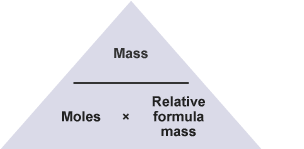
This number is used in chemistry because you can find out how many atoms of an element you have if you know the element and weight. - 26What is the equation linking relative formula mass, number of moles and mass?number of moles = mass ÷ relative formula mass
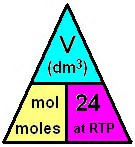
- 27What is the volume of a mole of gas at rtp?24 dm(3)
- 28What is the equation linking volume f gas at rtp, 24 dm(3), and number of moles?volume of gas at rtp = number of moles × 24
- 29How to convert the empirical formula to a molecular formulaAdd up the atomic masses of the atoms in the empirical formula.
- 30What is the empirical formula of a compound?The empirical formula of a compound is the simplest whole number ratio of atoms of each element in the compound. It is determined using data from experiments and therefore empirical.
- 31How are ions formed?They are formed when atoms lose or gain electrons. This loss or gain leaves a full outer shell, so the electronic structure of an ion is the same as that of a noble gas (such as helium, neon or argon).
- 32What does oxidation mean?The gain of oxygen, or loss of electrons, by a substance during a chemical reaction
- 33What does reduction mean?The loss of oxygen, or gain of electrons, by a substance during a chemical reaction
- 34What is a reversible reaction?In a reversible reaction, the products can react to produce the original reactants again.
- 35How is equilibrium in a reversible reaction achieved?If a chemical reaction happens in a container where none of the reactants or products can escape, you have a closed system. Reversible reactions that happen in a closed system eventually reach equilibrium.
- 36How can equilibrium be achieved quicker?Using a catalyst
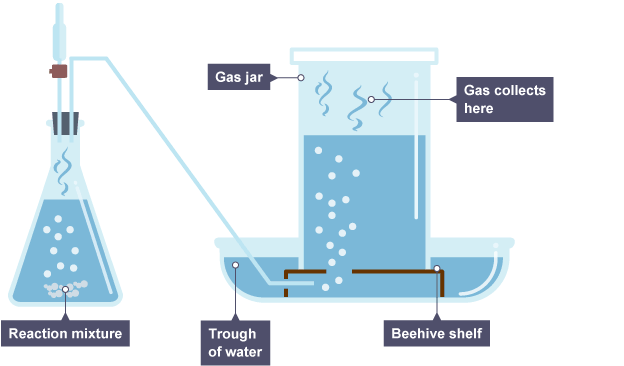
- 37How does hydrogen peroxide make water and oxygenOxygen can be made from hydrogen peroxide, which decomposes slowly to form water and oxygen
- 38What is a covalent bond?A covalent bond forms when two non-metal atoms share a pair of electrons. The electrons involved are in the outer shells of the atoms. An atom that shares one or more of its electrons will complete its outer shell.
- 39What elements produce what colour in the flame test?- Barium : Pale Green
- Calcium : Yellow-Red
- Copper : Green-Blue
- Lithium : Red
- Sodium : Orange
- Potassium : Lilac - 40What order is the reactivity series?Potassium, sodium, lithium, calcium, magnesium, aluminium, zinc, iron, copper, silver and gold
- 41What phrase can you use to remember the reactivity series?People Say Little Children Make A Zebra Ill Constantly Sniffing Giraffes
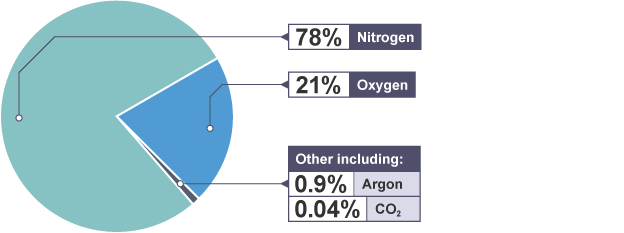
- 42What are the percentages of the gasses in our atmosphere?
- 43How to test water purity?By evaporating it on an evaporating dish or by measuring its boiling point.
- 44Electrolysis
Information
- Description
- GCSE Chemistry Flashcards on Chemistry, created by Lewis D'Arcy on 10/04/2017.
- Created by
- Lewis D'Arcy
- Views
- 1
- Rating