
Flashcards
Topic XV
Cards in this deck (98)
- 1What are the functions of the kidneys?1) Maintain plasma volume so bp (MAP)
2) Regulate [ion] and [H2O]
3) Acid-base balance
4) Eliminate waste, drugs, hormones
5) Endocrine
-renin (bp)
-erythropoietin (rbc) production - 2What is a nephron?Functional unit of kidney = renal corpuscle + tubule
- 3What are the processes in nephron leading to urine formation?Glomerular filtration, tubular reabsorption, tubular secretion
- 4What happens overall for glomerular filtration?~20% of plasma in glomerulus is filtered into Bowman's capsule = bulk flow (delta P) across filtration membrane
- 5What makes up the filtration membrane?a) fenestrated endothelium (glomerulus)
b) fused basement membranes
c) podocytes (layer of Bowman's capsule) with filtration slits between - 6What is filtrate?a) identical to plasma minus large proteins
b) H2O, glucose, aa, vitamins, ions, urea, some small proteins
c) pH ~7.45 - 7What is the net filtration pressure?10 mmHg
- 8What is the glomerular hydrostatic P (blood pressure) and is filtration favoured or opposed?55, favoured
- 9What is the blood osmotic P and is filtration favoured or opposed?30, opposed
- 10What is the capsular hydrostatic P and is filtration favoured or opposed?15, opposed
- 11What is the capsular osmotic P and is filtration favoured or opposed?0, favoured
- 12What is the glomerular filtration rate?~At this net filtration pressure, ~180 L/day filtrate (both kidneys) = 125 mL/min (entire plasma volume filtered ~65X/day)
-however <1% of filtered volume remains at end of collecting duct (reabsorption) - 13What is the purpose of the regulation of GFR?Keeps GFR from changing when bp changes - if not, MAP rises = higher GFR (and vice versa)
- 14What are the processes of regulation of GFR?Intrinsic regulation (auto regulation) and extrinsic regulation
- 15What is intrinsic regulation (auto regulation) for?For bp in range of resting to moderate exercise
- 16What happens with myogenic intrinsic regulation?Rise of MAP --> stretch --> afferent arteriole smooth muscle contracts --> prevents higher BP in glomerulus (+ vice versa)
- 17What happens with the juxtaglomerular complex (apparatus) and intrinsic regulation?NOTE: macula dense monitors [NaCl] in filtrate flowing past it --> if filtrate flow (so GFR) = higher--> reabsorption may be inadequate so [NaCl] high' if filtrate flow = low --> too much reabsorption so [NaCl] low
so bp ups (in glomerular capillaries) --> GFR ups --> ups [NaCl] at macula densa --> triggers local release of vasoconstrictor --> afferent arteriole constricts --> GFR returns to resting
-if bp lower (in glomerular capillaries) --> GFR lowers --> lowers release of vasoconstrictor --> afferent arteriole dilates --> ups GFR to resting - 18What is extrinsic regulation primarily?Primarily SNS --> arteriolar vasoconstriction
- 19What are the two places there could be arteriolar vasoconstriction? How does this impact resistance, renal blood flow and GFR?Afferent arteriole and efferent arteriole
With afferent arteriole vasoconstriction, there is less flow into glomerulus, higher resistance, over renal blood flow, lower GFR
With efferent arteriole vasoconstriction, blood backs up in glomerulus so higher resistance, lower renal blood flow, higher glomerular filtration rate - 20What two things can make NFP change?Blood OP (proteins) and capsular hydrostatic P
- 21What can extreme stress do to GFR?Lowers (e.g. heavy exercise, haemorrhage etc)
- 22What are the examples of impacts that change blood OP?e.g dehydration - higher BOP (GFR lowers)
e.g. burns, nephrotic syndrome (proteins filtered) - lowers BOP (ups GFR) - 23What is an example that can impact capsular hydrostatic P?e.g. in urinary tract obstruction (kidney stones, inflammation, prostate enlargement) - ups CHP = lowers GFR
- 24What happens with tubular reabsorption?1-1.5 L/day urine but 180 L/day filtered so 99% of filtrate reabsorbed from tubules into peritubular + vasa recta capillaries (i.e. returned to blood)
- 25What are the two types of tubular reabsorption and explain them?Active - requires NRG
-e.g. Na+ some other ions, glucose, aa
Passive - no energy required
-e.g. Cl- (in places), H2O, urea - 26What are the regions of tubular reabsorption?Proximal convoluted tubule (PCT), loop of Henle, distal convoluted tubule (DCT), late DCT + collecting duct (CD)
- 27What is reabsorbed at proximal convoluted tubule (PCT)? Is it regulated?i) glucose, aa - 100% - active transport
ii) NaCl - 66% - active transport
iii) small proteins (endocytosis --> aa --> blood)
iv) vitamins
v) obligatory (unregulated) reabsorption of H2O (osmosis as solutes reabsorbed --> water "obliged" to follow) - 28Wha tis the result of the reabsorption in the PCT?-large amount of solute removed + lower filtrate volume
-filtrate is isotonic to plasma = 300 mOsmoles/L (mOsm/L = unit of OP) - 29Where does loop of hence reabsorb from?Reabsorbs from (into vasa recta)
i) descending limb (DL) = H2O only
ii) ascending limb (AL) = NaCl only (active transport) - 30What happens with the DCT?Initial part
i) reabsorbs Na+, Cl-, Ca++
ii) impermeable to H2O - 31What happens with late DCT + CD?i) reabsorb Na+
-aldosterone rises
-atrial natriuretic peptide (ANP) lowers
ii) facultative (regulated) reabsorption of H2O
-ADH raises (ANP inhibits ADH) - 32What do nephrons normally reabsorb?99% of filtered H2O
99.5% of filtered NaCl
100% of filtered glucose
50% of filtered urea - 33What may filtrate contain?Trace aa + proteins (depends on diet) but no glucose or blood
- 34Where does tubular secretion occur?From peritubular blood into filtrate
- 35What substances are secreted during tubular secretion?a) wastes e.g. urea, uric acid, some hormones
b) K+ (ups by aldosterone)
c) H+ or NH4+ --> maintains blood plasma pH - 36What do we know about the counter current multiplier system?-Tubular reabsorption
-Permits excretion of urine that is dilute (100 mOsm/L) to concentrated (1200 mOsm/L)
-Produces and maintains a vertical osmotic gradient = ups [solute] in ISF as you move deeper into the medulla
-> produced by juxtamedullary nephrons - 37What happens within the loop of Henle?a) fluid flows in parallel tubes (DL, AL) in opposite directions
b) DL - permeable to H2O, impermeable to NaCl
c) AL - impermeable to H2O, permeable to NaCl
-NaCl pump (from filtrate --> ISF)
d) as filtrate moves down DL - H2O into ISF (osmosis)
e) highly concentrated filtrate enters AL
-NaCl pumped out against gradient (200 mOsm/L gradient
f) filtrate leaving AL (= 150 mOsm/L) is lower osmolarity than plasma due to:
-AL impermeable to H2O
-AL NaCl pump - 38What happens within early DCT?More salt removed from filtrate (reabsorbed), no H2O removed so ~100 mOsm/L when enters late DCT
- 39Where does urine production happen?When filtrate (100 mOsm/L) enters late DCT, CD
- 40What are the different ways urine can be?Concentrated and dilute
- 41What do we know about concentrated urine? What are the concentrations?-Dehydrated, low bp
-In late DCT, CD:
a) aldosterone ups Na+ reabsorb
b) ADH ups facultative H2O reabsorb (responds to need)
-Urine can be up to 1200 mOsm/L - 42What do we know about dilute urine?Excess plasma H2O, high bp
-In late DCT, CD:
a) ANP inhibits ADH, aldosterone - impermeable to H2O, NaCl - 43What is the average quantity of urine per day?1-1.5 L/day
- 44What are the different ways of regulating concentration of urine?Hormonal and CNS
- 45What are the divisions of hormonal regulation of [urine]?Renin-Angiotensin system, ADH, aldosterone, atrial natriuretic peptide
- 46What is the renin-angiotensin system overall?Renin from juxtaglomerular cells (modified smooth muscle cells of afferent and efferent arterioles)
- 47When is renin high?i) lower stretch of juxtaglomerular cells (i.e. lower bp or blood volume)
ii) higher SNS activity
iii) lower NaCl in filtrate (detected at macula densa) - 48When is renin low?i) higher stretch of juxtaglomerular cells (i.e. high bp or blood volume)
ii) higher ADH, angio II
iii) higher NaCl in filtrate
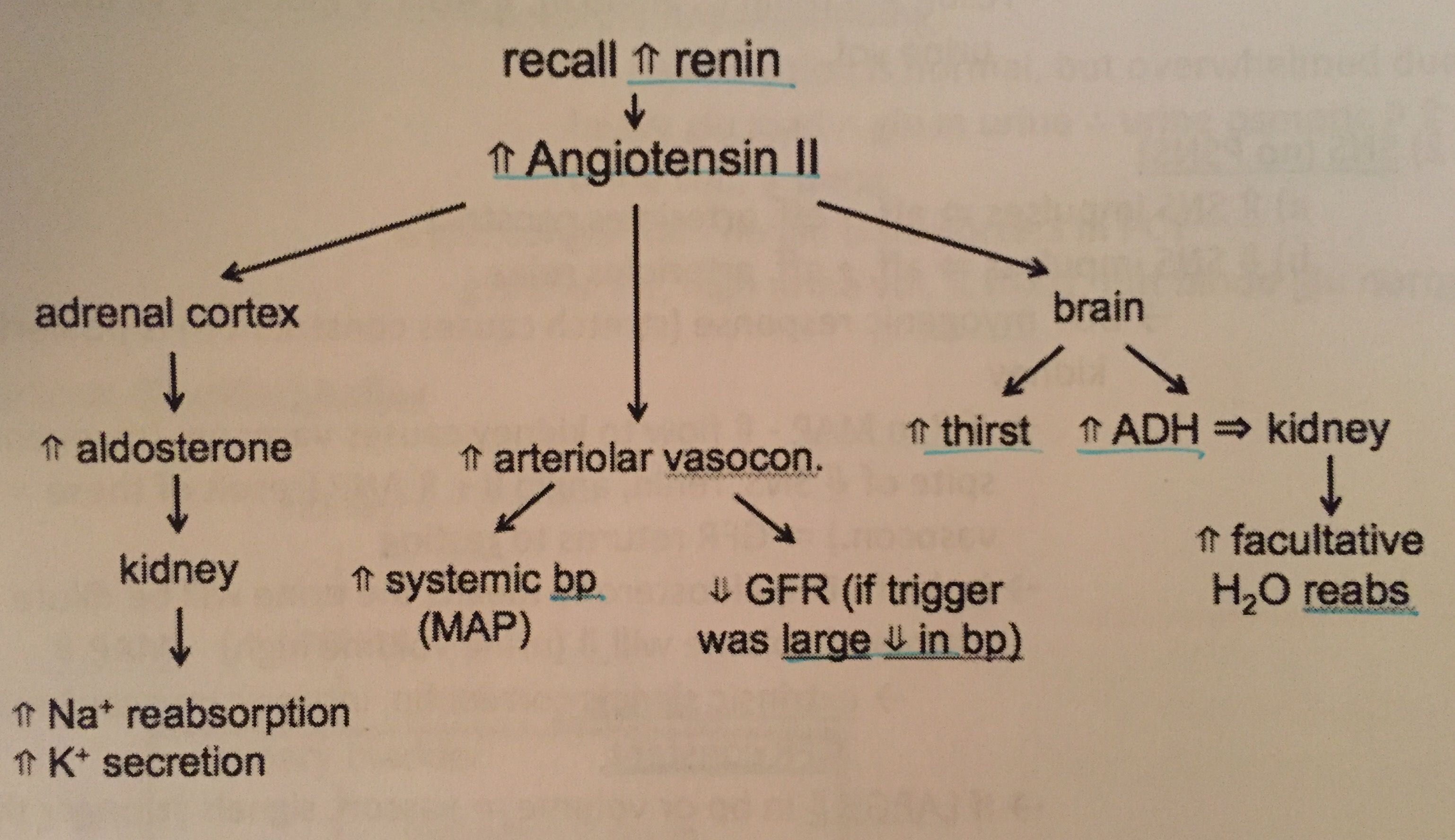
iv) lower SNS activity - 49What does renin convert?Renin converts angiotensinogen to angiotensin I, which is then activated to angiotensin II by angiotensin-converting enzyme
- 50What is the pathway of angiotensin II once it is converted?
- 51How does ADH affect the hormonal regulation of [urine]?Higher facultative reabsorbs H2O (late DCT, CD)
- 52When is ADH higher?If;
i) low blood volume or P
ii) higher plasma osmolarity (concentration)
iii) higher angio II
iv) nausea, nicotine - 53When is ADH lower?If;
i) reverse of i-iii
ii) higher ANP
iii) alcohol - 54What happens with diabetes insipidus?-No ADH or no receptors
-Large volume of dilute urine, higher thirst, normal blood + urine glucose - 55What do we know about aldosterone? When is it higher?(= steroid hormone)
-higher aldosterone when angio II, high plasma K+
-turns on genes that up the # of Na+/K+ ATPase in late DCT, CD
i) ups Na+ reabsorption in late DCT, CD so H2O follows (osmosis, if ADH present), Cl- follows (charge)
ii) ups K+ secretion - 56What does atrial natriuretic peptide (ANP) do for regulation of [urine]?-higher by higher bp
-> result = lower renin (so angio II), lower ADH, lower aldosterone, lower vasoconstriction --> higher urine volume - 57What are the types of urine constituents?Normal and abnormal
- 58What are the normal basic constituents of urine?a) H2O
b) nitrogenous wastes
c) regulated substances e.g. ions
d) pH 4.5-8.0 (average = 6.0) - 59What are the three types of nitrogenous wastes in urine?i) urea
ii) uric acid
iii) creatine - 60What is urea from and how much is reabsorbed?from aa metabolism ~50% reabsorbed
- 61What is uric acid from and how much is reabsorbed?From nucleic acid breakdown - secreted, ~10% reabsorbed
-poorly water soluble - accumulation - gout (in joints) or kidney stones - 62What is creatinine from?From breakdown of creatine in skeletal muscle
-production/excretion constant, no reabsorption
-used to estimate GFR - can indicate kidney disease before symptoms occur - 63What are the abnormal constituents of urine?Protein and glucose
- 64What is the abnormal protein in urine and what is it due to?= proteinuria (aka albuminuria) - due to higher permeability of glomerulus
-due to e.g.:
i) nephrotic syndrome - multiple causes (e.g. diabetes mellitus, heavy metals, infections)
ii) glomerulonephritis (inflammation due to infection elsewhere) - 65What is the abnormal glucose in urine and what are the two divisions?Glycosuria
i) temporary ii) pathological - 66What's an example of temporary glycosuria?E.g. IV glucose
- 67What are examples of pathological glycosuria?e.g. 1:diabetes mellitus - high blood glucose (no insulin, or receptors not responding)
-PCT reabsorption is normal, but overwhelmed due to heavy glucose load so glucose in urine so urine osmotic P is higher so high urine volume, higher thirst
e.g. 2: congenital - no glucose transporters in PCT
-glucose in urine, high urine volume, higher thirst, but blood glucose normal/low - 68What is the anatomical pathway of the micturition (bladder reflex)?Kidney --> ureters --peristalsis + gravity--> urinary bladder --contraction of smooth muscle (=detrusor) produces P gradient--> urethra
From [urinary bladder --> urethra] = micturition - 69What is the pathway for micturition reflex including the nerve pathway?
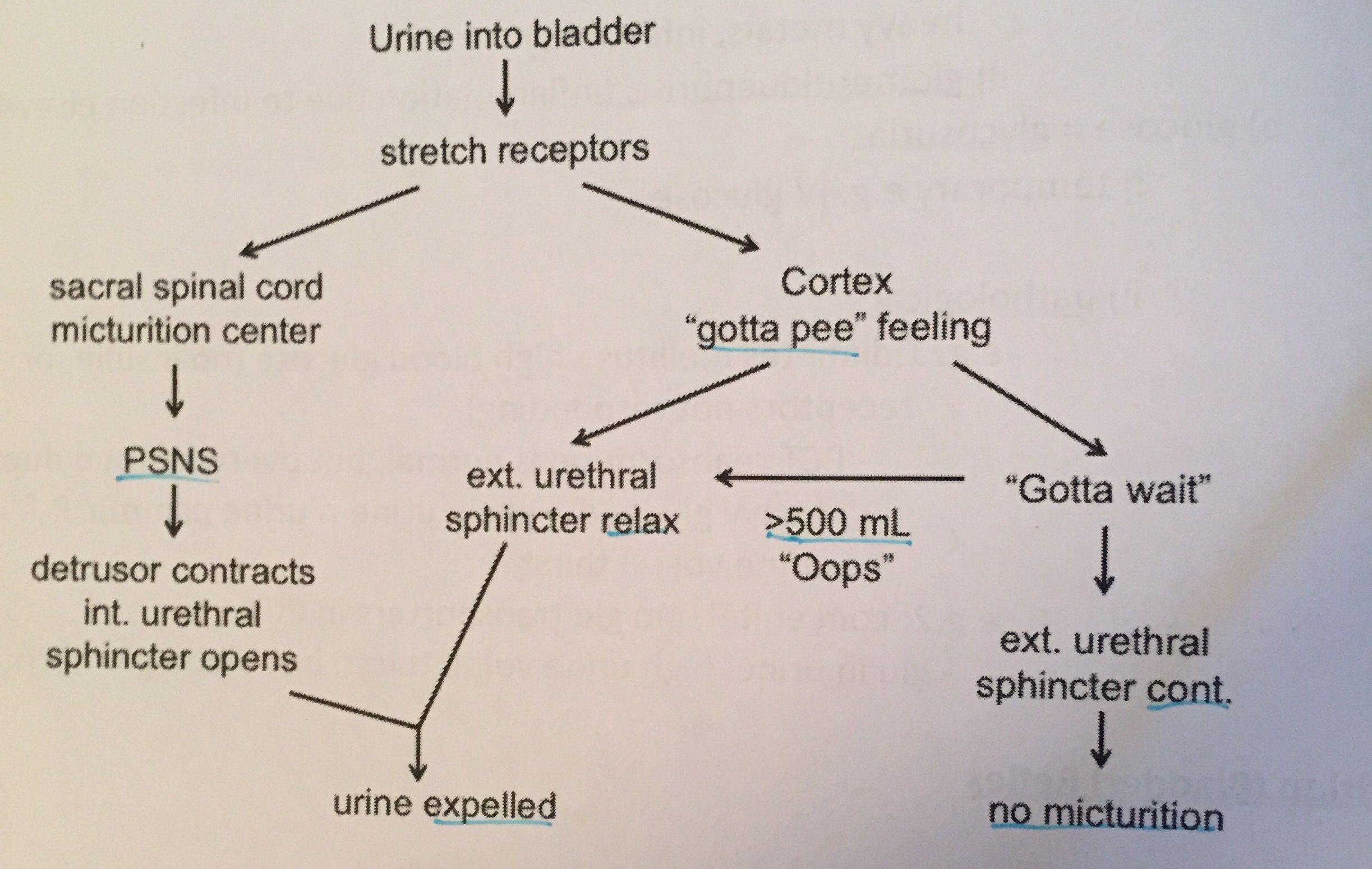
- 70What is the renal plasma clearance (PC)?Volume of plasma cleared of a substance each minute i.e. rate a substance is removed from blood by kidney
-used to estimate the time a substance remains in blood e.g. a drug - 71Formula for PC?PC of substance "A" = vol urine/min x [A] in urine / [A] in arterial plasma
- 72What is inulin? What can it be used for?CHO from daffodils; can be used to estimate GFR
-it is filtered but not reabsorbed, secreted, metabolized so amount in urine = amount filtered
e.g. if urine volume - 4 mL/min; [inulin] in urine = 62.5 g/L; [inulin] in plasma = 2 g/L
PC = 4 x 62.5 / 2 = 125 mL/min = GFR - 73What happens if PC < GFR?Substance is reabsorbed from filtrate
e.g. 1: urea PC ~ 75 m/min (~50% reabsorbed)
e.g. 2: glucose PC = 0 (100% reabsorbed) - 74What happens if PC > GFR?Substance is secreted into filtrate
e.g. penicillin, H+ - 75What is the acid-base balance?Regulation of free H+ in ECF
-H+ is normally produced by metabolism - 76What is the scale for blood pH?0 <--dead--6.8 <--acidosis--7.35--normal--7.45--alkalosis--> 8.0--dead--> 14
- 77How is H+ eliminated?1) respiratory system
2) renal system - 78What are buffer systems and what roles do acids and bases play?Pairs of chemicals
-bases take up H+ (remove from solution)
-acids give up H+ (add to solution)
-balance of 2 minimizes pH change - 79What is a major buffer in blood?Bicarbonate system
-CO2 + H2O -- H2CO3 [acid] -- H+ + HCO3- [base] - 80What are other buffers in the blood?Hb + H+ -- HbH in rbc
proteins --> cells, plasma - 81What are the divisions of the control of acid-base balance?1) respiratory system
2) renal system - 82How does the respiratory system help with acid-base balance?(acts within minutes) - eliminates CO2
H+ + HCO3- --> H2CO3 --> CO2 [removed so also removes H+] + H2O
Short term solution, if higher H+ get hyperventilation, if lower H+ get hypoventilation - 83How does the renal system help with control of acid-base balance?Longer term
a) eliminates H+ from metabolically produced acids (e.g. fatty acids, lactic acid etc
b) secretes H+ into tubule lumen
c) conserves + increases blood HCO3- - 84What happens in a tubule cell? What is this process (lengthy af)?For each H+ secreted, 1 HCO3- enters blood so to remove H+ and maintain/increase HCO3-:
i) H+ (as H+) lost in urine, 1 HCO3- gained in blood
ii) secreted H+ combines with filtered HCO3- --> CO2 + H2O in lumen
-no H+ is lost, but HCO3- is "reabsorbed" indirectly to maintain buffer
iii) secreted H+ combines with filtered Pi --> lost in urine
-result: 1 H+ (as HPi) lost, 1 HCO3- gained to blood
iv) 2 ammonia (NH3) formed from 1 glutamine (aa) in tubule cell and combine with H+ to form 2 ammonium ions (NH4+)
-result: 2H+ (as NH4+) lost and 2 HCO3- gained to blood - 85What are the two types of acid-base imbalances?Acidosis and alkalosis
- 86What happens with acidosis?Plasma pH < 7.35 (excess H+)
CNS depressed --> coma; irregular heart beat
Urine will contain: H+, HPi, NH4+, no/little HCO3- - 87What are the two types of acidosis?Respiratory and metabolic
- 88What happens during respiratory acidosis?-Arterial Pco2 rises --> H+ rises --> pH lowers
-due to hypoventilation e.g. lung disease, depression of medullary respiratory centre - 89What is the compensation for respiratory acidosis?-Lungs cannot (poor function)
-Kidneys --> higher H+ secretion + higher HCO3- into blood (buffers) - 90What happens with metabolic acidosis?-Higher H+ from any source other than CO2
- 91What are examples of metabolic acidosis?-Diarrhea --> loss of HCO3-
-Uncontrolled diabetes mellitus --> ups fat metabolism --> kept acids
-Strenuous exercise --> lactic acid
-Renal failure - 92What is the compensation for metabolic acidosis?-Lungs: up ventilation (due to higher H+ at peripheral chemoreceptors) --> lowers H+ (but central chemoreceptors will eventually lower ventilation due to lower CO2)
-Kidneys (if not damaged) --> up H+ secretion + up HCO3- into blood - 93What is alkalosis?pH > 7.45 (fewer H+)
-over-excitation of the CNS, spasms in skeletal muscles
-urine will contain: HCO3-, no HPi, no NH4+, little H+ - 94What are the types of alkalosis?Respiratory and metabolic
- 95What is respiratory alkalosis?Arteriolar Pco2 low, due to hyperventilating - e.g. anxiety attack
- 96What is the compensation for respiratory alkalosis?Lungs: cannot (unless hyperventilation is voluntary)
Kidneys: lower secretion of H+ so lower HCO3- to blood (is lost in urine) - 97What is the cause of metabolic alkalosis?Any reason but respiratory
examples:
-excess vomiting (loss of stomach acid)
-ingestion of alkaline drugs e.g. antacids - 98What is the compensation of metabolic alkalosis?Lungs: decreased H+ causes ventilation to lower so higher arterial CO2 so higher H+ (eventually high CO2 will up ventilation)
Kidneys: lower secretion of H+ so lower HCO3- to blood (is lost in urine)
Information
- Description
- Physiology Flashcards on Topic XV, created by Emma Granger on 15/04/2017.
- Created by
- Emma Granger
- Views
- 20
- Rating